The first time I heard Podman described as daemonless, I thought the container-engine argument might already be over.
No always-running daemon.
Strong rootless story.
Docker-like CLI.
Regular-user workflows that did not sound like an afterthought.
On paper, it had the shape of a very satisfying answer.
The more I sat with it, though, the more I realized that “daemonless” is one of those words that feels bigger than it is until you ask a more practical question:
what actually changes in a homelab because of that difference?
That is where the conversation gets more interesting.
Because Docker is not suddenly bad because it has a daemon. And Podman is not automatically the perfect engine because it does not. The real issue is whether the engine’s trust model, operating style, and ecosystem habits fit the way you actually run services at home.
That is the version of the comparison I care about now.
- What daemonless actually means in normal language
- Why Podman feels cleaner from a boundary perspective
- Why Docker still feels easier in many homelabs
- Where rootless workflows change the story
- What ‘daemonless’ does not magically solve
- When I think Podman is the better fit
- When I still think Docker is the calmer answer
For the technical baseline below, I use Podman's official documentation and separate documented platform behavior from my own placement and operating recommendations.
Daemonless sounds abstract until you compare the operating model
Podman documents itself very plainly: it is a daemonless container engine, and most Podman commands can be run as a regular user without requiring additional privileges.
That alone already changes the mental shape of the tool.
With Docker, the documentation explicitly calls out the attack surface of the Docker daemon itself as one of the main security areas to consider. That is not a criticism from outsiders. That is Docker explaining its own model honestly. Docker also warns in its Linux post-install documentation that the docker group grants root-level privileges.
Those two details explain why Podman sounds so attractive to homelab people who care about cleaner boundaries.
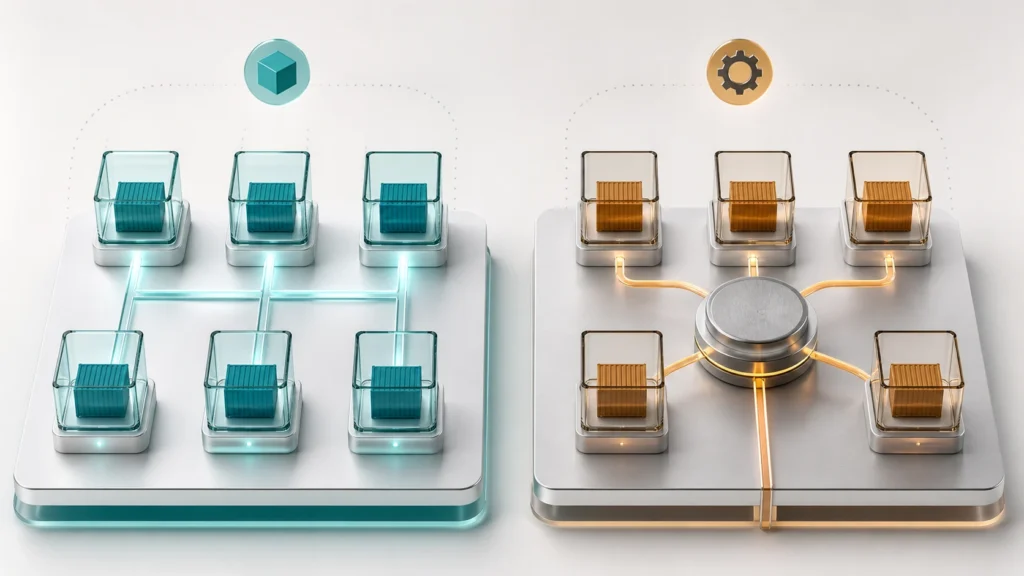
Podman does not begin with a long-running central daemon that owns the whole show in the same way. Docker does. Podman makes “run containers as a normal user” feel native. Docker can absolutely support rootless modes too, but the emotional center of the product has long revolved around its daemon model and the habits that grew around it.
That is the first real difference.
Podman feels cleaner because the trust story is easier to say out loud
This was the part that immediately made sense to me.
If I need to explain Podman to myself in one sentence, it sounds like this:
it is a container engine that tries harder not to start from a root-owned central service assumption.
That is not the whole story, but it is enough to matter.
Podman’s own manual says most commands can run as a regular user. Its documentation also leans naturally into rootless operation and into local or remote usage patterns that do not require me to emotionally accept “just join a powerful group and move on” as the first step.
For a homelab, that can be genuinely appealing.
It means:
- the security story is easier to like on first principles;
- regular-user workflows feel less like a workaround;
- the engine itself sounds less like a permanent root-adjacent control plane;
- the setup often feels closer to least-privilege instincts.
I think that matters most for people who are already becoming more suspicious of quiet privilege escalation in their lab. Once you have spent enough time thinking about unprivileged versus privileged containers, or about why Docker inside a VM can feel calmer than Docker inside an LXC, the words “daemonless” and “regular user” stop sounding like marketing fluff. They start sounding like architectural relief.
Docker still wins a lot of homelab decisions by being socially easier
This is the part I try not to ignore just because Podman has an elegant design story.
Docker still benefits from enormous documentation gravity, broader community habit, and the sheer fact that many self-hosted projects are explained in Docker-shaped language first. Even when software is technically OCI-friendly, its examples, support threads, and casual copy-paste culture are often still written for Docker and Compose.
That matters more than purists like to admit.
In a homelab, “the better design” does not always win. Very often, “the thing with the smoother path from tutorial to working service” wins.
That is why Docker still feels calmer in many environments:
- the examples are everywhere;
- troubleshooting paths are familiar;
- many projects are documented with Docker first;
- Compose has become part of how people think about app-shaped services;
- the operational habits are deeply normalized.
None of that disproves Podman.
It just means the real container-engine decision is not only about architecture. It is also about friction, ecosystem translation, and whether you want to spend energy being more correct or being more interoperable with the average guide you will read at 11 PM.
Rootless changes the emotional center of the conversation
This is where Podman earns a lot of respect from me.
Rootless containers exist in both worlds, but Podman makes them feel more central to its identity. Docker supports rootless mode too, but its own security documentation still has to spend significant effort discussing daemon exposure and daemon socket protection because that is part of its architecture story.
That difference changes how each tool feels in practice.
With Podman, rootless operation feels like a first-class native path.
With Docker, rootless often feels more like an important hardening option around a tool whose cultural defaults came from somewhere else.
That distinction is subtle, but I think it matters in a homelab.
If I am building a lab where I increasingly care about user boundaries, limited blast radius, and not handing quiet root-like power to convenience groups, Podman starts sounding more aligned with that direction.
Not because Docker cannot be hardened.
Because Podman begins from a posture I already like.
Daemonless does not automatically make Podman simpler everywhere
This is the part I do not want to oversell.
Daemonless is meaningful, but it is not magical.
Podman still has its own concepts, networking behavior, system integration choices, and compatibility edge cases. Its own documentation also includes remote workflows and a REST API model, which is a good reminder that daemonless does not mean “there is never a service component anywhere in any context.” It means the normal local operating model is different.
That is a much better claim than pretending Podman is just Docker with one problem removed.
The more honest version is:
- Podman improves the local privilege and daemon story;
- it still asks you to learn its habits;
- some Docker-native assumptions do not translate perfectly;
- the ecosystem around it is better than it used to be, but not identical.
That is why I do not think daemonless, by itself, should decide the whole homelab strategy. It is a meaningful architectural difference, but not the only one that affects your day-to-day life.
I think Podman is strongest when the lab owner already cares about boundaries
If the homelab is growing out of its “just make it run” phase, Podman becomes very attractive.
I think it is especially compelling when:
- you want regular-user workflows to feel normal;
- you dislike the idea of a central daemon with a meaningful attack surface;
- you are already moving toward least-privilege habits;
- your services are simple enough that ecosystem translation cost stays low;
- you do not mind learning a slightly different operational rhythm.
In that kind of lab, Podman can feel refreshingly direct.
It is not trying to win by theatrical novelty. It is winning by making the privilege story easier to trust.
I still think Docker is the calmer choice when the project gravity is obviously Docker-shaped
This is the sentence I come back to most often.
If the software, documentation, support culture, deployment examples, and surrounding ecosystem are all very clearly Docker-shaped, I do not think choosing Docker is a failure of principle.
I think it is often a valid operational decision.
This is especially true when:
- the service is app-shaped and Compose-driven;
- you expect to follow official installation paths closely;
- you want the shortest path from docs to working result;
- the lab’s main bottleneck is time and clarity, not privilege philosophy;
- everyone touching the environment already thinks in Docker habits.
In those cases, Docker’s daemon model may be a trade worth accepting, especially if the workload is already being placed inside a boundary you trust, such as a VM or a carefully managed guest.
That is one reason the broader runtime question in what belongs where in a homelab matters so much. The container engine is only one layer of the trust story. Sometimes Docker is perfectly acceptable because the surrounding placement decision is already doing the heavier security work.
The rule I trust now
If I care most about cleaner local trust boundaries, regular-user operation, and an engine whose posture feels closer to least privilege, Podman is deeply compelling.
If I care most about ecosystem gravity, tutorial compatibility, Compose-first habits, and the shortest path to “this service is live and understandable,” Docker is still very hard to beat.
That is why I no longer hear “daemonless” as a mic-drop argument.
I hear it as a very important clue about the engine’s philosophy.
And that is useful, because philosophy does matter in a homelab. It shapes what feels normal. It shapes what kinds of shortcuts become invisible. It shapes whether the platform quietly nudges you toward better boundaries or toward a model you later have to harden around.
But the final choice still belongs to the workload, the operator, and the amount of friction the lab can honestly absorb.
Rootless containers and unprivileged system containers solve related but different boundary problems. The comparison of unprivileged and privileged Proxmox LXC makes that distinction explicit.
This operating decision also connects to Docker Volume Management: Local Storage vs NFS Bind Mounts, where the same tradeoff appears at a different layer of the homelab.
FAQ
What does daemonless actually mean in Podman?
It means Podman does not depend on the same always-running central daemon model that Docker traditionally uses for local container management. In practice, that changes the trust and privilege story more than it changes the basic idea of running containers.
Is Podman more secure than Docker?
It can provide a cleaner starting posture, especially around regular-user and rootless workflows, but security still depends on how the host, users, workloads, and surrounding boundaries are designed. Daemonless is meaningful, but not magical.
Why do so many homelab guides still use Docker first?
Because Docker has huge ecosystem momentum. Many projects, examples, and tutorials are written in Docker language first, which makes it socially and operationally easier even when other engines are technically viable.
Does Podman work like Docker for most basic homelab tasks?
Very often, yes. Podman explicitly documents a Docker-compatible CLI style, and many users can transition easily for common tasks. The differences tend to show up more in habits, surrounding tooling, and edge cases than in basic run, build, and image operations.
Should I switch an existing Docker-based homelab to Podman?
Only if the boundary and privilege improvements matter enough to justify the migration friction. If the current lab is stable, understandable, and already wrapped in boundaries you trust, switching just for ideology may not buy as much as it first seems.