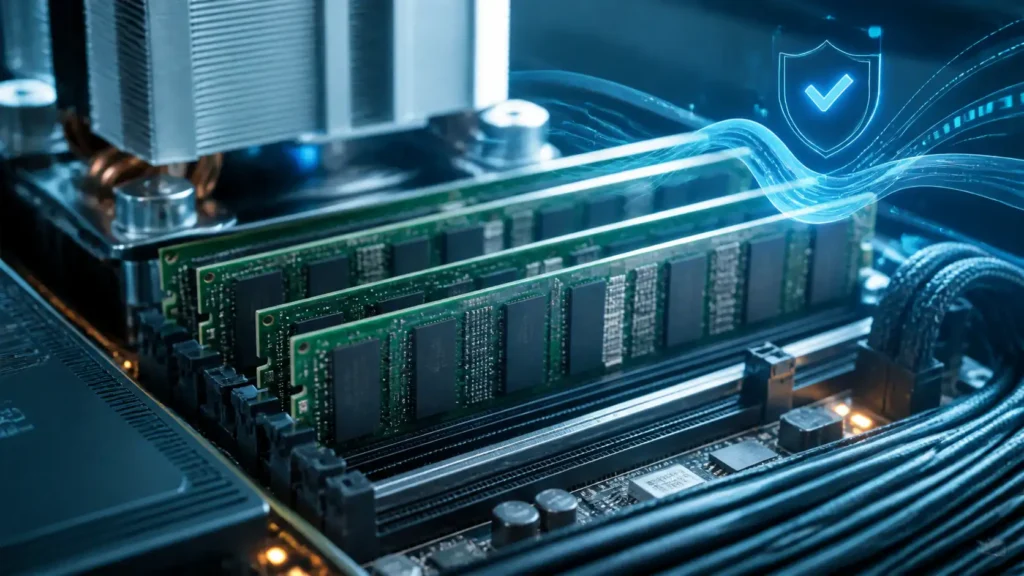
For a long time, ECC memory lived in the part of homelab discourse I trust the least.
It was either treated like a baseline sign of seriousness or dismissed like a luxury feature for people who wanted enterprise aesthetics without enterprise reasons. That binary always felt wrong to me. Hardware decisions rarely become clearer when they are turned into identity tests.
ECC is not a magic shield.
It is not a substitute for backups.
It does not automatically make every box “server grade.”
But it is also not fake.
It solves a real problem: memory errors. And the practical question is not whether that problem exists in some abstract way. The practical question is how much you care if the platform can detect and correct those errors, tell you they happened, and keep operating with a cleaner integrity story than a machine that simply assumes memory is behaving correctly.
That is the frame I find useful now.
- Why ECC is easier to evaluate once it stops being a status symbol
- What ECC memory actually gives a homelab host
- Why corrected and uncorrected errors are not the same operational story
- When ECC becomes materially useful in virtualization and storage roles
- When non-ECC is still a rational compromise
- Why platform support is more complicated than “the CPU supports ECC”
- How I would decide now on a real build
For the technical baseline below, I use the official documentation at kernel.org and separate documented platform behavior from my own placement and operating recommendations.
The first useful fact is that ECC is about memory faults, not prestige
Linux kernel documentation is unusually helpful here because it strips the marketing language away. The EDAC subsystem documentation defines corrected and uncorrected memory errors explicitly. A corrected error is one ECC could fix. An uncorrected error is one that could not be corrected, though it might not always be immediately fatal depending on where it occurred and whether recovery was possible.
That distinction matters because it turns ECC into something concrete:
- it can correct certain memory errors before they become visible as corrupted data;
- it can surface those events so the operator knows they occurred;
- it can distinguish between “the system recovered” and “the system could not trust the data.”
The Linux RAS guide goes one step further and says corrected errors can be a predictor of future uncorrectable events, and that proactive replacement of memory modules showing corrected errors can reduce the likelihood of later crashes or unrecoverable failures.
That is not abstract reliability philosophy.
That is operational visibility.
And for me, that is where ECC becomes interesting.
ECC matters more because it tells the truth, not only because it corrects
This is the part I think people skip too often.
The usual summary of ECC is “it detects and corrects single-bit errors,” which is fine as a first sentence. But the deeper value in a homelab is often that the system becomes more honest about memory health.
Without ECC, a memory fault is more likely to remain an invisible gamble until it becomes application weirdness, corruption, or instability with unclear cause.
With ECC and a platform that exposes error reporting properly, the machine can tell you:
- corrected errors are happening;
- the memory path is not pristine;
- something may need attention before the problem escalates.
That is not glamorous, but it is useful.
It changes the platform from “hopefully stable” to “capable of detecting and reporting a class of faults that would otherwise be easier to miss.”
That is a meaningful difference for any box you want to trust.
The strongest case for ECC is long-running integrity-sensitive infrastructure
This is where the answer gets practical.
I care much more about ECC when the machine is doing things like:
- running a virtualization host for weeks or months at a time;
- storing important data or backups;
- carrying several services whose state matters;
- acting as infrastructure I do not want to rebuild under ambiguity;
- holding filesystems, databases, or VM memory states I expect to remain boringly correct.
This is the kind of environment where corrected memory errors are not just trivia. They are information about a system that is expected to preserve state over time. If that host is also the kind of system I want to leave alone, observe from a distance, and trust with other layers of the lab, then ECC fits naturally into the design.
This is one reason I think ECC pairs conceptually with articles like risk versus cost in storage. In both cases, the real question is not whether the protection is universally mandatory. The real question is what kind of failure behavior you are willing to accept from a system whose job is to remain predictable.
Virtualization and storage make the ECC argument stronger
I do not mean this in a superstitious way. I mean it structurally.
A virtualization host is concentrating multiple workloads into one memory substrate. A storage-focused system is preserving data whose integrity may matter long after the original write. In both cases, the machine is valuable partly because it stays uneventful. That raises the value of memory error detection and correction.
ECC does not make bad architecture good.
It does not replace snapshots or backups.
It does not guarantee every kind of corruption disappears.
But it does mean the memory layer is no longer just hoping bit integrity holds without instrumentation.
For a Proxmox node, NAS, backup target, or mixed-service home server, that is a serious argument. Not a mandatory one in every budget, but a serious one.
It also aligns with the general lesson in memory ballooning: once memory becomes part of shared host behavior, I care more about how honestly the platform handles memory problems.
ECC matters less when the box is disposable
This is the other side of the argument, and it is just as important.
If the machine is:
- a throwaway test box;
- a short-lived development node;
- a tiny side system that is easy to rebuild;
- a light desktop-class host with no important stored state;
- a budget-first experiment where platform cost matters more than integrity refinement,
then non-ECC can be entirely rational.
I do not think every homelab needs ECC to justify its own existence. That would be lazy advice. A lot of home systems are not carrying enough responsibility for ECC to become the highest-leverage upgrade.
If the bigger risks in the build are actually:
- no backups;
- poor storage layout;
- unstable power;
- cheap SSDs doing important work;
- unclear restore procedures;
- too much complexity on one host,
then insisting on ECC first may be solving the cleaner problem before the messier ones.
This is why I do not like moralized ECC advice. It can distract from larger design flaws.
Platform support is the part people oversimplify
This is where the article needs to stay precise.
Intel’s support documentation says ECC memory support requires both processor and chipset support. AMD’s current Ryzen PRO product pages phrase it similarly from another angle: ECC support is present, but it requires motherboard support.
That is the practical rule.
“CPU supports ECC” is not the full sentence.
You need the platform path to support it end to end:
- processor support;
- motherboard or chipset support;
- compatible memory type;
- firmware that exposes it correctly;
- operating system and tooling that can actually report errors if you expect observability.
This is where a lot of casual ECC discussions become sloppy. People reduce the topic to CPU family branding or to scattered forum anecdotes about “unofficial ECC working.” I do not think that is a strong enough standard for a build decision.
If ECC matters to the role, I want explicit platform support, not hopeful compatibility.
The observability side matters almost as much as the correction side
A quiet but important point in the Linux EDAC and RAS documentation is that error reporting itself is part of the value. Corrected errors can be logged. Uncorrected errors can be categorized. Preventive maintenance becomes possible because the system exposes evidence instead of simply failing later under a less clear story.
That means the practical benefit of ECC is not just “some bit flips get corrected.”
It is also:
- I may learn that memory is degrading before the box becomes unstable;
- I can distinguish memory health from application instability more clearly;
- the platform can help me decide when hardware needs replacement.
That is extremely relevant in long-lived homelab hosts, especially those that gradually become more important than originally intended.
The same pattern appears in other infrastructure decisions too. A good system is not only one that survives problems. It is one that reports them early enough to act.
ECC is not a substitute for the boring disciplines
This has to be said clearly because ECC can sound more magical than it is.
ECC does not replace:
- backups;
- restore testing;
- good PSU sizing;
- stable storage;
- sane thermal behavior;
- proper monitoring;
- careful host design.
And it definitely does not rescue a build whose bigger issue is that the whole system is under-planned.
This is why I would never present ECC as a universal first priority. In some builds, spending money on a better backup target, a more reliable motherboard, a right-sized UPS, or simply a second host may improve the real failure story more than ECC alone.
What ECC does is narrow one particular class of risk in a meaningful way.
That is valuable.
It is just not the whole game.
How I would decide now
This is the framework I trust most.
I would push harder for ECC when:
- the host is a Proxmox or storage-heavy server;
- the machine is expected to run for long periods with important state;
- I care about memory error reporting, not just theoretical uptime;
- the platform role is serious enough that quiet corruption risk is worth reducing;
- the ECC platform cost premium is reasonable.
I would be comfortable with non-ECC when:
- the box is disposable or easy to rebuild;
- the workload is light and not integrity-sensitive;
- the real constraints are budget and platform simplicity;
- stronger wins exist elsewhere in the design;
- the platform role does not justify forcing workstation/server-class parts.
I would avoid the weakest middle ground when:
- ECC allegedly works only through uncertain board support;
- the role actually depends on reliability but the platform support story is vague;
- I am using forum lore instead of explicit specifications.
That last point matters. If the system’s role is important enough to argue for ECC, then it is important enough to implement ECC on purpose.
The real question is whether the host is allowed to be uncertain about memory
This is where I landed.
I do not think ECC is mandatory for every homelab.
I do think its absence is easier to justify in systems that are easy to lose.
Once a machine becomes:
- a real hypervisor,
- a real NAS,
- a real backup node,
- a real always-on service host,
I find it harder to dismiss ECC as irrelevant. At that point, the machine is no longer just a sandbox. It is part of the trust fabric of the lab. And memory is too central a subsystem to reduce the conversation to “probably fine.”
That is why ECC matters most when the box is not allowed to be casually wrong.
Conclusion
ECC RAM in homelabs matters when the machine has a real integrity job: virtualization, storage, backups, long uptimes, or infrastructure you want to trust and observe clearly. It matters much less in disposable or low-stakes boxes where rebuildability is the real safety mechanism.
What changed the topic for me was stopping the false choice between “ECC is mandatory” and “ECC is pointless.” It is neither. It is a targeted reliability feature whose value rises with the seriousness of the host and the clarity you expect from its memory subsystem.
That is why I no longer ask whether ECC is elite hardware culture.
I ask whether this particular machine is allowed to be uncertain about RAM.
FAQ
Does ECC RAM make a homelab server immune to data corruption?
No. ECC addresses certain memory errors. It does not replace backups, storage integrity, or broader operational discipline.
When is ECC most worth paying for in a homelab?
Usually when the host is running virtualization, storage, backups, or long-lived services whose state matters and whose platform is expected to provide better fault visibility.
Is non-ECC RAM automatically a bad choice for a homelab?
No. It can be a perfectly rational tradeoff for disposable, budget-first, or low-stakes systems that are easy to rebuild and are not carrying important persistent state.
Is CPU support alone enough to guarantee ECC works?
No. Intel explicitly says ECC support requires processor and chipset support, and AMD product pages note that ECC support requires motherboard support. The whole platform path matters.
Why does ECC reporting matter if the system already corrects errors?
Because visibility changes maintenance decisions. Linux EDAC and RAS documentation makes clear that corrected errors can be a useful warning sign before uncorrectable faults appear later.