Before I understood game engines, I understood game worlds.
Each box on a store shelf felt like its own sealed universe. One game was one team, one style, one miracle. I noticed art direction, frame rate, weapons, music, and mood. What I did not notice right away was the reusable machinery underneath.
That changed slowly in the late 1990s and early 2000s, and Unreal was one of the names that made the change visible.
At some point, the engine stopped feeling like a hidden implementation detail and started feeling like part of the promise. "Powered by Unreal Technology" did not read like a footnote. It read like an assurance that somebody had already solved a difficult class of problems for you. The phrase suggested that a studio was not beginning from raw chaos. It was stepping onto a prepared road.
That is why Unreal Engine 1 and 2 still matter to me now. They did more than power games I remember. They helped teach the industry, and eventually ordinary players too, that the technology beneath a game could become a recognizable product in its own right.
- Why early 3D games once felt like isolated technical miracles
- How Unreal started making engine technology visible as a brand
- Why Unreal Engine 2 made the licensing promise feel more serious
- How tools and cross-platform ambition mattered as much as graphics
- Why licensing changed the shape of development before it became accessible
- What the early Unreal era still explains about engines today
Before engines felt public, 3D games felt like private acts of wizardry
It is easy now to forget how opaque game development once looked from the outside.
Today, engines are part of the conversation even when someone has never shipped a game. People know what it means to choose Unity, Unreal, Godot, or a proprietary stack. They understand that tools, pipelines, and licensing models shape what kinds of games get made.
That was not always the default perspective.
In the first big wave of consumer 3D, many games still felt like individual technical events. One studio had somehow produced something smooth, atmospheric, or advanced, and unless you followed development culture closely, the explanation seemed to stop there. The result felt singular.
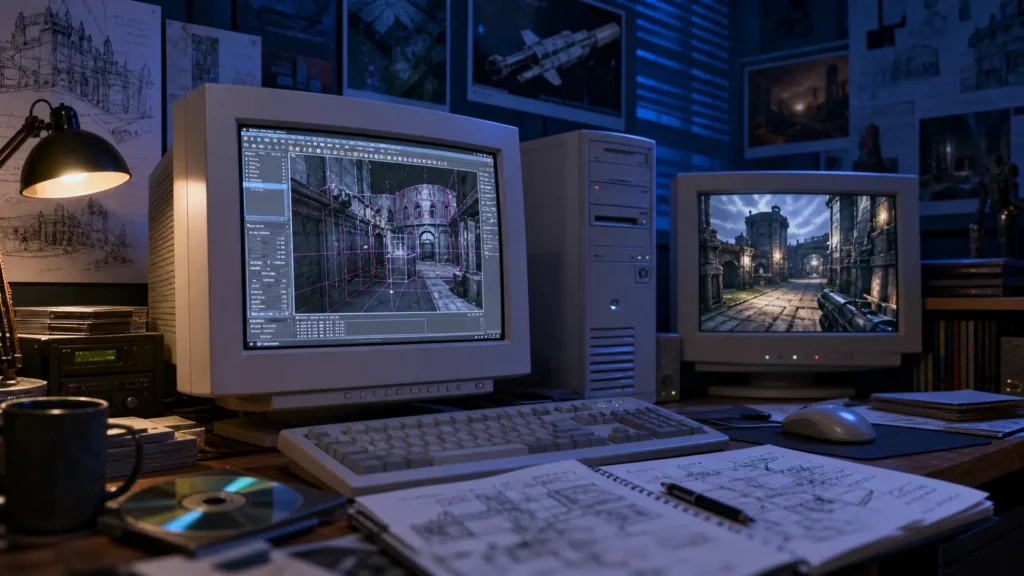
That is part of what made Unreal memorable. Even before the licensing story fully clicked in my head, Unreal looked like more than a one-off success. It looked like a stack. Its worlds had a certain spatial confidence. Its lighting had presence. Its levels suggested that artists and designers were working inside tools that wanted scale, drama, and modifiability rather than barely tolerating them.
The point was not that Unreal looked identical everywhere. The point was that it made me suspect there was an underlying system robust enough to travel.
Unreal started turning the invisible layer into part of the pitch
Epic's official Unreal Technology Roadmap still treats the brand as something larger than a single release, and even now Epic continues to preserve the language around "Unreal" and "Powered by Unreal Technology" as identifiable marks. That matters because branding follows confidence. You do not foreground the underlying technology unless you believe the technology itself now carries meaning.
That was the psychological shift.
Unreal Engine 1 belonged to the moment when the engine stopped being only an internal workshop and started feeling like exportable infrastructure. A studio could license not just rendering code, but a development posture: editor workflows, scripting expectations, content pipelines, and a proven way of building a 3D game that did not begin from first principles every time.
I find that transition more interesting than any individual feature checklist. Features age. Resolutions age. Effects age. A development model can redraw an industry.
When a game engine becomes licensable in a visible way, the center of gravity changes. Some studios can spend less time inventing foundations and more time deciding what kind of world, combat loop, atmosphere, or fiction they want to build on top. That does not make development easy. It just moves the difficulty to a higher and more creative floor.
What Unreal represented in the UE1 and UE2 era was a serious commercial platform, not a casual download for everyone. The important shift came first in mindset: the engine itself had become a product with strategic value.
Unreal Engine 2 made the promise feel bigger, broader, and harder to ignore
If Unreal Engine 1 helped make the idea legible, Unreal Engine 2 made it feel industrial.
Epic's official Unreal Technology Roadmap describes UE2 as supporting DirectX 8 and powering games across PC, Mac, Linux, Xbox, and PlayStation 2. That single summary captures why the engine mattered so much at the time. UE2 was not only about prettier scenes. It represented a more serious claim about reach.
That reach changed how the engine felt in the imagination.
A licensable engine stops being merely a renderer when it can plausibly support multiple platforms, multiple genres, and multiple teams with different ambitions. The same roadmap page also frames UE2.5 as the latest UE2 version and notes that it was proven in Unreal Tournament 2004, which says something important in Epic’s own understated way: iteration and maturity had become part of the product story too.
That is why UE2 sits so clearly in memory for me. Unreal was presenting itself as a way to build bigger worlds without assembling the entire ladder by hand.
What I remember from that era is not only visual polish. It is a feeling of possibility under organization.
The tools mattered at least as much as the screenshots
This is the part players do not always see, but they can still feel it indirectly.
Epic’s legacy UDN pages do not only present Unreal as a graphics technology. They talk about a "powerful and flexible game engine and its toolset" and about learning the skills needed to create games on previous-generation platforms. That wording is revealing. The sale was never just pixels. It was workflow.
That distinction matters because graphics alone do not scale a studio.
The future belonged to engines that could help teams build, iterate, script, assemble, and revise without rebuilding the world every time a design changed. An engine becomes strategically valuable when it makes production more repeatable.
This is one reason early Unreal still feels historically important to me. It participated in the long shift from game technology as private craft to game technology as shared production environment.
You can see the long echo of that in how Epic later described Unreal Engine 4 when it became free. In Tim Sweeney's 2015 announcement, the emphasis was not simply on visuals. It was on complete technology, source code, platform reach, and control. That message only lands because an earlier generation had already trained developers to think of Unreal as a licensable foundation rather than a mysterious in-house miracle.
Licensing changed the shape of ambition before it changed the price of entry
This is where I think the early Unreal story becomes especially important.
People sometimes flatten engine history into a story of access: first engines were expensive, then they became cheaper, then they became free or royalty-based. That is true, but incomplete.
The deeper story is that licensing changed what kinds of teams could imagine themselves attempting.
Even before modern distribution models made engines dramatically more accessible, a licensed engine could already compress uncertainty. It could tell a studio: you do not have to solve every low-level problem alone before you can begin making decisions that players will actually notice.
That is a profound shift in creative psychology.
Epic's current Unreal licensing page still treats licensing as a central design decision around business model and scale. The terms are very different from the UE1 and UE2 world, but the underlying idea remains familiar: engine access shapes who gets to move quickly and which problems are already solved before production begins.
What changed over time was not only affordability. It was the widening of the circle. But Unreal Engine 1 and 2 belong to the earlier chapter, when the circle was still comparatively narrow and the signal was therefore more dramatic. If you licensed something like Unreal in that era, you were not downloading a hobbyist toy. You were buying entry into a serious technical lineage.
That seriousness became part of the brand.
What early Unreal still explains about engines now
What lingers for me is not nostalgia for one editor layout or one specific rendering style.
It is the memory of a threshold being crossed.
Once the industry learns to see an engine as a platform, everything downstream changes. Middleware becomes normal. Teams compare pipelines, not only screenshots. Developers evaluate tools as strategic commitments.
Unreal did not invent the entire idea of reusable game technology by itself, of course. But Unreal Engine 1 and 2 helped give that idea cultural mass. They gave it a recognizable name, a recognizable aura, and eventually a recognizable licensing identity.
That is why the phrase "licensed the 3D future" still feels right to me.
Not because Epic literally owned the future. Not because every important 3D game flowed through Unreal. But because Unreal helped make one version of the future legible: a world where the foundation beneath a game could be built once, sold outward, iterated across generations, and treated as a serious product line rather than a hidden pile of code no one outside the studio was meant to think about.
That world is so normal now that it barely looks like a revolution. Back then, it did.
For more context on the hardware culture around this transition, compare the AGP-versus-PCI graphics era with the original 3dfx Scan-Line Interleave story.
Conclusion
Unreal Engine 1 and 2 matter to me because they mark the moment when game technology started stepping into the light as a product with its own identity. What looked at first like a powerful internal solution became something larger: a licensable promise that other teams could use to reach toward the same 3D horizon without beginning from raw engineering solitude.
The real legacy is not only in the games those engines powered. It is in the way they taught developers, publishers, and eventually players to think differently about what an engine was: not just hidden machinery, but a platform, a workflow, a business model, and a vision of how the future of 3D development could be shared.
FAQ
Was Unreal Engine 1 already important as a licensed engine, or did that mostly happen with Unreal Engine 2?
UE1 matters because it helped make the idea visible: the engine beneath a game could itself become a recognizable and exportable product. UE2 then made that promise feel much larger by reinforcing platform reach, tool maturity, and the sense that Unreal was becoming serious industry infrastructure.
What made Unreal Engine 2 feel different from Unreal Engine 1?
In Epic’s own legacy roadmap, UE2 is framed as supporting DirectX 8 and multiple desktop and console targets, which made it feel broader and more industrial. The conversation shifts from a striking engine to a more mature cross-platform technology stack.
Why does licensing matter so much in game-engine history?
Because licensing changes where teams spend effort. If a studio does not have to build every foundational system itself, it can spend more energy on design, worldbuilding, tools, iteration, and production quality. Licensing does not remove difficulty, but it moves the problem upward into more visible creative territory.
Did Unreal Engine become accessible to everyone during the UE1 and UE2 era?
No. In that period, Unreal represented a serious commercial technology, not a universally accessible public toolkit. The much broader accessibility story came later, especially when Epic made Unreal Engine 4 available under a far more open model.
Why is the phrase "Powered by Unreal Technology" historically significant?
Because it signals that the underlying engine had become part of the value proposition, not an invisible implementation detail. Once the technology itself can function as a brand, it means the engine has cultural and commercial weight beyond any single game.