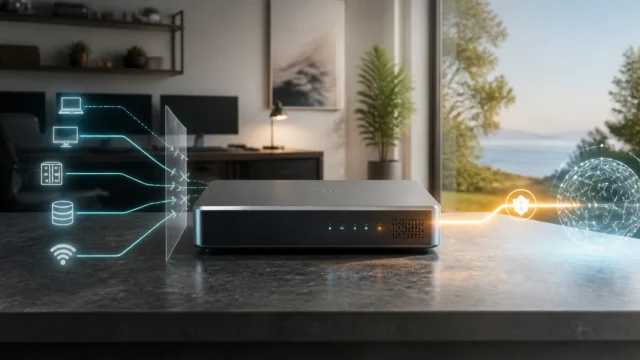
For a long time, I did not really want a firewall. I wanted a calmer network.
That distinction matters more than it sounds.
If you start from the wrong question, OPNsense can look like overkill very quickly. It is easy to see a full firewall and routing platform, notice the features, notice the menus, notice the documentation tree, and assume the whole point is to make a home network more serious than it needs to be. I think that is exactly why some people bounce off it at first. They think the choice is between a normal home router and an enthusiast project.
What finally changed for me was realizing that the real choice was different: do I want the network to remain a stack of defaults I keep working around, or do I want one clear place where routing, policy, segmentation, NAT, and remote access actually make sense together?
That was the question OPNsense answered.
- Why a normal consumer router eventually stopped feeling enough
- What OPNsense is actually trying to be
- Why the control-plane feeling mattered more to me than raw features
- Where OPNsense starts making home segmentation and routing feel cleaner
- Why NAT, firewall rules, and aliases feel better when they live together
- What tradeoffs come with choosing OPNsense at home
- Why I still think it was the right direction
The protocol and configuration baseline below is checked against OPNsense's official product documentation; the topology and risk recommendations are my practical interpretation.
I did not outgrow consumer routing because I wanted more dashboards
This is important to me, because it changes the tone of the whole decision.
I do not think most people arrive at OPNsense because they woke up wanting a more complicated appliance. They usually arrive there because a network that once felt simple has started developing real boundaries:
- trusted devices versus IoT devices;
- guest access versus personal devices;
- lab services versus everyday household traffic;
- remote access versus “just being on Wi-Fi at home”;
- one subnet versus several intentional ones.
At that point, the weakness of a typical consumer router is not merely that it lacks one checkbox. It is that it often stops being the right place to express the network’s intent cleanly.
That was the shift for me. I did not want more noise. I wanted fewer workarounds.
OPNsense made more sense when I stopped calling it "just a firewall"
The OPNsense project itself describes the platform as a user-friendly firewall and routing platform. That wording matters. It is not only a firewall box in the dramatic sense of “block the bad things.” It is meant to be a real network control point.
The official feature and introduction pages describe capabilities that tell the story clearly:
- stateful firewalling;
- routing;
- NAT;
- traffic shaping;
- intrusion detection and prevention;
- VPN support;
- proxying and related services;
- one-time-password support and other security-oriented features.
That sounds like a long feature list, but what mattered to me was not the list itself. It was the architectural meaning of the list.
All of those things are really different ways of answering one question:
"Where should the network decide what traffic is allowed to do?"
OPNsense gave me an answer that felt much more coherent than a consumer router trying to be a little bit of everything while mostly hiding the logic.
The real appeal was not power. It was one honest place for responsibility
This is probably the sentence that best explains why I chose it.
OPNsense felt like one honest place where the network’s important decisions could live.
Not scattered across:
- half-finished router menus;
- access point settings;
- switch-side guesses;
- random static port forwards I would later forget existed;
- unclear DHCP behavior;
- a consumer UI that encouraged convenience until the day the network needed structure.
The moment I started thinking about the home network as something I actually wanted to design, not just tolerate, that centralization became much more valuable than any single feature.
This is why I think OPNsense pairs naturally with the kinds of networking lessons in early VLAN design and where routing should live. Once your network has multiple segments, the firewall/router stops being a generic box at the edge and starts becoming the place where those segments either remain intentional or slowly collapse back into convenience.
Firewall rules and NAT finally felt related instead of accidental
One of the things I appreciate most about OPNsense is that it helps the network stop feeling like a pile of exceptions.
The official firewall and NAT documentation makes the platform’s scope very clear. OPNsense is not only filtering packets; it also handles outbound NAT, destination NAT, port forwarding, and the logic that ties those translations to policy. Its documentation even states directly that NAT rules are processed before filter rules, which is the kind of detail that sounds dry until you realize how many home-network misunderstandings begin right there.
That matters because home routing often becomes messy in exactly these places:
- a port forward exists but nobody remembers why;
- remote access half-works because NAT and firewall logic were never thought about together;
- outbound behavior looks simple until multiple subnets and special cases appear;
- the edge device was doing important things implicitly, not transparently.
I liked OPNsense because it made those responsibilities feel like they belonged in the same room.
Aliases and structured policy felt more grown-up than raw rule count
This is a quieter point, but an important one.
OPNsense’s documentation on aliases describes them as named lists of networks, hosts, or ports that can be reused across firewall rules and other sections. On paper, that is a small convenience feature. In practice, it changes the feeling of administration a lot.
It means the network can start being described in reusable language instead of scattered IP-by-IP edits.
That is a big shift.
A firewall becomes easier to trust when the rules start sounding like policy instead of trivia:
- trusted-admin-hosts;
- iot-networks;
- public-services;
- vpn-clients;
- blocked-destinations.
The exact names vary, of course, but the principle is what matters. OPNsense gave me the feeling that the network could be named and reasoned about properly, not just toggled until working.
Hardware expectations also felt more honest than I expected
One thing I appreciate in the official documentation is that OPNsense does not pretend the hardware question is mysterious.
Its hardware sizing page gives straightforward guidance: reasonable requirements, recommended specifications, and the idea that capability depends on which features you intend to run. The docs note that a basic install can run on modest hardware, while a fuller setup with more standard features benefits from stronger CPU, more RAM, and solid storage. The virtual installation guidance is similarly practical, including minimum RAM guidance and recommendations like disabling hardware offloading in certain virtualized setups.
That honesty mattered to me because it kept the project grounded.
OPNsense did not feel like a magical black box that demanded enterprise hardware to justify itself. It felt like software I could place intentionally on hardware that matched the role. That fits very naturally with the mindset behind choosing router hardware. I was not buying identity. I was choosing where the network’s brain should live.
The tradeoff is real: more clarity also means more responsibility
I do not want to romanticize this choice.
OPNsense is not better for everyone merely because it is more explicit. The same thing that makes it powerful is also what raises the bar. A more capable control plane means:
- more settings you can misunderstand;
- more design responsibility on your shoulders;
- more need for basic networking literacy;
- more consequences if you create policy you do not fully understand.
That is not a flaw in OPNsense. It is just the price of moving from appliance convenience toward deliberate infrastructure.
I think that tradeoff is fair. But I also think it should be stated kindly. The right question is not “Can OPNsense do more?” It obviously can. The right question is whether you want the network to become something you understand structurally rather than something you mostly inherit from defaults.
If the answer is no, that is fine.
If the answer is yes, OPNsense starts becoming very attractive.
Remote access, updates, and segmentation all started fitting the same story
This is where the decision stopped feeling theoretical to me.
The more I thought about:
- VLAN boundaries;
- Dynamic DNS;
- remote-access entry points;
- NAT behavior;
- firewall rules;
- update discipline;
the more I wanted those concerns to live in one place that was meant to be the edge. OPNsense’s documentation tree itself reflects that worldview: installation, updates, firewall, NAT, aliases, virtual deployment, routing behavior. It feels like a platform built around being the place where network edges are made explicit.
That was the deeper reason I chose it.
Not because I needed every advanced feature immediately.
But because it gave the network a home for complexity before the complexity became accidental.
The sentence that settled it for me
I chose OPNsense because I wanted the network to become intentional.
That is really the whole answer.
Not intentional in the sense of being dramatic or enterprise-like.
Intentional in the sense that routing, policy, NAT, segmentation, and remote access should stop feeling like five separate stories.
OPNsense felt like the first platform that made those stories belong together.
The same boundary becomes clearer alongside untagged and tagged port behavior, because those choices affect where traffic, policy, and trust meet.
As the policy grows, firewall aliases keep groups of hosts, networks, and ports readable instead of duplicating raw values across many rules.
FAQ
Why would someone choose OPNsense over a consumer router?
Usually not because they want more complexity for its own sake, but because they want clearer control over routing, firewall policy, NAT, segmentation, and remote access.
Is OPNsense only for advanced users?
No, but it rewards people who want to understand their network more deliberately. It is more explicit than a typical consumer router, which is both its strength and its responsibility.
Does OPNsense work on modest hardware?
Yes, the official documentation provides straightforward sizing guidance, and a basic setup can run on fairly modest hardware. Heavier feature use benefits from stronger CPU, more RAM, and solid storage.
Is OPNsense just a firewall?
Not really. OPNsense positions itself as a firewall and routing platform, and its value in home networks often comes from being the central place where routing, NAT, policy, and segmentation all live together.
What is the biggest reason to choose OPNsense?
For me, it is clarity. It gives the network one honest control point instead of leaving important behavior scattered across defaults and workarounds.