There was a time when burning a disc felt like making something official.
Not sending a file.
Not dragging a folder into cloud storage.
Not sharing a link.
Making a disc.
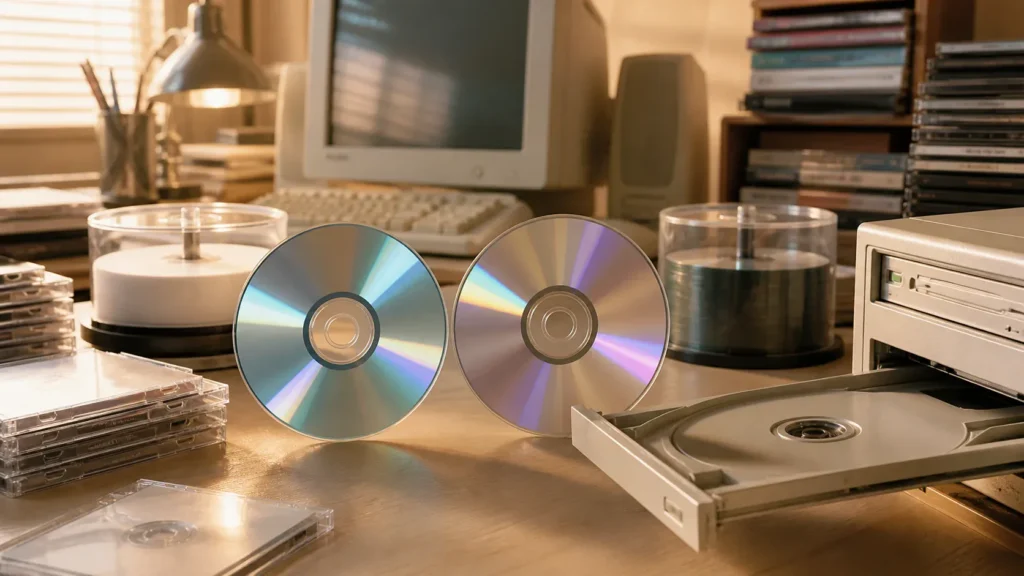
That act had weight to it. You chose the blank media, waited for the drive tray to slide out, placed the disc carefully, watched the progress bar with the kind of concentration usually reserved for fragile operations, and then held the final result in your hand as if the data had become more real simply because it now lived on a reflective circle with a marker-written label.
CD-R was the format that made this ritual feel normal for ordinary people. DVD-R was the format that made it feel bigger.
That is the simplest way I can describe the shift.
CD-R taught home users that digital things could be authored, copied, carried, and given away in a physical form that still felt personal. DVD-R kept the same basic ritual but changed its scale. Suddenly the homemade disc no longer felt suited only to songs, documents, drivers, and modest backups. It felt suited to video, larger archives, broader collections, and projects that seemed almost finished enough to deserve packaging.
In that sense, the move from CD-R to DVD-R was not just a storage upgrade. It was a change in ambition.
- Why CD-R felt like a breakthrough in everyday ownership
- How the ritual of burning discs became part of home computing culture
- Why DVD-R made the same ritual feel more serious and more cinematic
- What changed when capacity stopped being a small constant worry
- Why optical media still feels emotionally different from modern storage
- What the CD-R to DVD-R shift says about the era itself
The historical details below are checked against the Computer History Museum archive; the interpretation and first-person perspective remain the author’s own.
CD-R made digital life feel portable in a new way
Part of CD-R’s magic came from timing.
By the mid-1990s, the personal computer was already full of digital things people cared about: songs, saved files, downloaded utilities, game patches, shareware, photos, school projects, copied installers, and strange little collections that only made sense to the person who assembled them. What was still missing, at least for many ordinary users, was a satisfying way to package those things at home.
The Computer History Museum notes that Philips and Sony had already published the Orange Book for recordable compact discs in 1990, and by 1995 consumer CD-R drives had dropped below the psychologically important US$1000 mark. That detail matters because it marks the moment recordable optical media stopped feeling purely professional and started feeling reachable.
Once CD-R crossed into normal-user territory, it changed the atmosphere of the PC.
Files were no longer trapped inside one machine in the same emotional way. A blank disc could become:
- a music compilation;
- a driver archive;
- a game backup;
- a folder of photographs;
- a stack of documents you did not want to lose;
- or simply proof that your digital life could take physical shape when you wanted it to.
That shift felt liberating.
The storage limit, of course, was still visible. A typical recordable CD lived in the world of roughly 650 to 700 MB, which meant choice still mattered. You had to think about what deserved to come along. That selectivity made CD-R feel curated by default. A burned CD often carried taste, intention, and constraint all at once.
Burning a CD was half utility, half ceremony
This is why CD-R remains such a vivid memory for people who grew up around it.
The process was never entirely invisible. You did not simply declare that data should exist somewhere else and move on. Burning a disc created a period of suspense. The drive spun up. Software warned you not to interrupt the process. Buffer underruns were feared like tiny domestic disasters. The machine suddenly seemed engaged in a task that was both delicate and irreversible.
That irreversibility was part of the thrill.
A CD-R was not endlessly editable. Once written, it felt committed. That gave every successful burn a quiet sense of completion. The disc was no longer just a folder. It had crossed into objecthood.
I think that is one reason optical media stayed emotionally powerful for so long. It borrowed some of the intimacy of older storage while feeling far more futuristic than a floppy disk ever could. In the floppy-disk era, storage felt precious because it was visibly small. CD-R made storage feel polished. It turned the act of saving into something smoother, shinier, and more presentable.
And then, naturally, that new polish began to feel small too.
DVD-R changed the size of the story users could tell themselves
If CD-R was the age of the compilation, DVD-R was the age of the project.
That is not a technical definition. It is a cultural one. But I think it captures the difference better than a simple capacity chart ever could.
Pioneer places a clear milestone in its own history: in October 1997, it introduced the world’s first DVD-R drive. Its press materials from the same period describe the introduction of the DVR-S101 and DVR-A101 as early market-first products compliant with the emerging DVD-R specification. Years later, recordable DVD media would become an ordinary sight in home computing and consumer electronics. But in spirit, those late-1990s and early-2000s steps marked the beginning of a new promise.
That promise was scale.
Standard DVD-R media settled into the familiar 4.7 GB identity that brands such as Verbatim still describe in straightforward product language today. Even if most people did not care about the exact mathematics behind capacity labels, they understood the emotional conclusion immediately: this was much bigger than a CD.
And "much bigger" changes behavior.
A CD-R asks, "What fits?"
A DVD-R starts asking, "What whole thing can I finish?"
That is a profound difference.
Suddenly homemade video collections felt natural.
Large software sets felt more practical.
Backups felt less fragmented.
Photo archives no longer seemed so cramped.
Discs started to feel less like packets and more like containers.
CD-R made me think in selections.
DVD-R made the era think in editions.
DVD-R made home computing feel more cinematic
This is the part I find most interesting.
DVD-R did not simply give users more room. It changed the emotional genre of what they were doing.
The CD belonged to music, software, and smaller digital bundles. Even when used for data, it retained some of the cultural aura of the audio CD: track lists, albums, mix collections, neatly bounded sets of content. DVD-R arrived carrying the prestige of the DVD era itself, which meant menus, movies, boxed sets, home video, chapters, and the subtle sense that digital media could now look "produced" instead of merely stored.
The blank disc inherited some of that prestige.
A burned DVD could feel like a deliverable.
It could feel like an archive.
It could feel like a finished package you handed to someone with less embarrassment than a random folder copied onto older media.
This was especially powerful in home video culture. Once ordinary households could author their own video discs, the line between consumer and small-scale publisher blurred in a very particular way. The computer was no longer only helping you keep files. It was helping you assemble memory into a form that resembled commercial media.
That mattered aesthetically. It also mattered psychologically.
Technology changes us not only by making things possible, but by making certain forms of completion feel believable.
Capacity was the obvious revolution, but legitimacy was the deeper one
Of course the numbers matter.
They always matter.
The jump from the world of hundreds of megabytes to the world of several gigabytes is not a subtle one. It changes what users attempt, how often they split data across discs, how much compression they tolerate, and how confidently they treat optical media as a serious backup or delivery format.
But the numbers alone do not explain the emotional memory of DVD-R.
The deeper shift was legitimacy.
A CD-R often felt personal.
A DVD-R often felt publishable.
Not professionally publishable in the industrial sense, of course. But close enough for ordinary home users to feel a new kind of pride in the result. A stack of burned DVDs on a shelf could look strangely official. The label, the case, the sense of a finished unit of media: all of it pushed digital storage toward presentation.
That is why DVD-R felt like more than "a bigger CD."
It changed what a blank disc was for.
The storage jump mattered, but the larger emotional change was that DVD-R made home-authored media feel more complete, more substantial, and more presentable.
The strange weakness of optical progress was always time
For all their elegance, burned optical discs never fully escaped fragility.
This is one place where the historical romance needs a little honesty. The Library of Congress, in its longevity research, notes that a greater percentage of CD products were predicted to achieve long life expectancy relative to DVD products, partly because of differences in bit-mark size, dye stability, and the maturity of the technology at the time of study.
That is a useful reminder.
The optical revolution felt clean and permanent while we were living inside it. The discs looked stable. They looked finished. They looked archival even when they were not necessarily archival in practice. A neatly labeled spindle or case collection could create the illusion that the data problem had been solved once and for all.
Often it had only been postponed.
Still, I do not think that fragility diminishes the cultural importance of the format. If anything, it makes the era more poignant. CD-R and DVD-R belonged to a period when home users believed, with understandable sincerity, that preservation could happen in objects. Not abstracted away into servers and subscriptions, but burned into circles you could store in drawers, folders, binders, and towers near the desk.
That kind of belief gave storage a domestic presence.
Optical media made digital life visible on a shelf
This may be the part I miss most when I think about the era.
Modern storage is wonderfully efficient and often much safer when managed well, but it is also far less theatrical. A cloud backup does not gleam under a lamp. A synchronized folder does not sit in a case beside your desk. A shared album does not carry the same small dignity as a labeled disc someone took time to author.
Optical media made digital life visible.
Collections could be stacked.
Backups could be counted.
Projects could be handed over.
Memories could be arranged in rows.
That visibility changed how ownership felt. It gave the digital world some of the furniture of the physical one.
In that sense, CD-R and DVD-R participated in the same broader emotional story as older creative tools that felt private and local or even hardware transitions like AGP’s promotion of graphics to a first-class concern. The era was full of moments when the PC stopped feeling like a sealed appliance and instead felt like a workshop for producing, storing, and arranging your own version of digital life.
Optical media was one of the clearest expressions of that workshop feeling.
CD-R and DVD-R now look like two chapters of the same confidence
From a distance, it is tempting to summarize the story too neatly.
CD-R came first.
DVD-R came later.
Capacity increased.
Then newer formats arrived and the old ones faded.
That outline is true, but it leaves out the human texture.
CD-R represented the moment ordinary users learned that they could burn their own digital collections into a portable, polished form. DVD-R represented the moment those same users started expecting that the disc could hold something larger, more complete, and more worthy of a case on the shelf.
The revolution was optical, yes.
But it was also emotional.
It taught a generation that authorship could happen at home.
It taught us that backup could feel ceremonial.
It taught us that a blank disc was not just empty media, but a promise about what kind of package our digital lives could become.
Final thoughts
CD-R and DVD-R were not merely storage formats competing on capacity.
They were two stages in the maturation of home digital publishing.
CD-R made it normal to burn something personal.
DVD-R made it normal to burn something substantial.
That is why the change still feels memorable. It was not only about more space. It was about a new scale of confidence. The same tray opening, the same spinning drive, the same patient progress bar suddenly led to a result that felt larger, more finished, and more cinematic than before.
For a while, that was enough to make the future feel writable.