There was a time when 1.44 MB did not feel small to me at all. It felt official. It felt self-contained. It felt like a square plastic promise that something meaningful could travel from one computer to another in the pocket of a shirt or in the corner of a school bag. A floppy disk was not just storage. It was a small object with ceremony around it. You held it carefully, slid it in with a particular sound, and waited for the drive to decide whether today it was going to cooperate gracefully or complain like a tiny mechanical bureaucrat.
When I think about childhood and computers, floppy disks are never far away. They were part of games, part of homework, part of curiosity, part of disappointment, and part of the strange dignity of early personal computing. They made digital things feel physical in a way that later storage rarely did. You did not just have a file. You had the disk that contained the file. You did not just install a game. You fed the machine disk after disk until the game finally became yours.
- Why a floppy disk felt bigger than 1.44 MB in childhood
- How games turned disk swapping into a ritual
- Why physical storage made digital things feel more precious
- How the limit itself shaped patience and imagination
- Why floppy disks remain emotionally larger than they ever were technically
The historical details below are checked against IBM's historical archive; the interpretation and first-person perspective remain the author’s own.
A floppy disk felt like an event before it even did anything
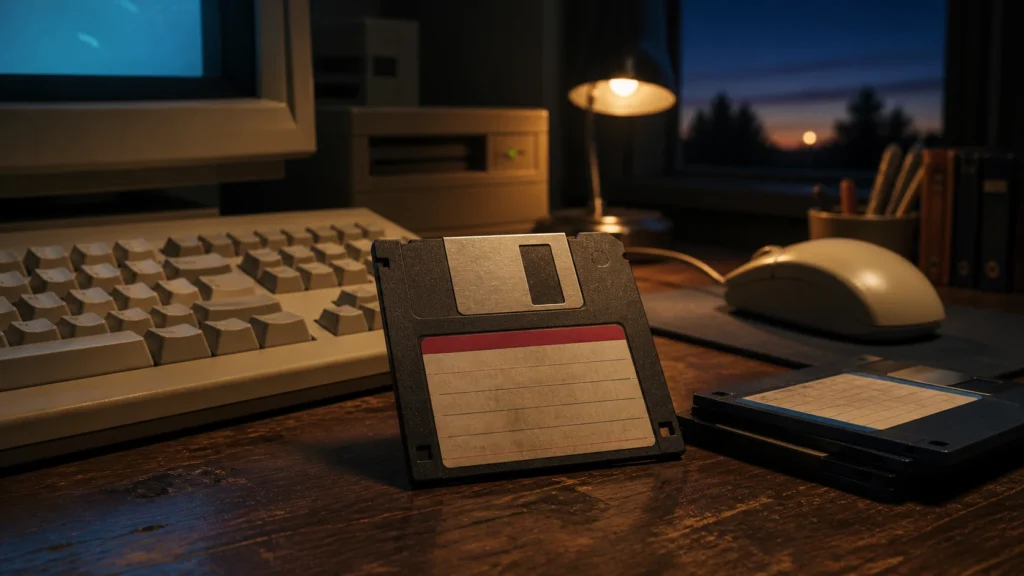
The object itself mattered. A floppy disk was compact in the way serious things are compact. It had a label space that invited handwriting, a metal shutter that moved with just enough resistance to feel important, and a shape so distinct that it became part of the mental furniture of the era. Even before I understood storage capacity, I understood that these little squares carried possibility.
That possibility was wonderfully vague. A floppy might contain a game, a save file, a drawing, a school assignment, a utility passed from one person to another, or something that would fail to open because the disk had become corrupted in one of the mysterious ways old media loved to become corrupted. The uncertainty was part of the drama. You did not click an icon in a list of infinite cloud-synced folders. You inserted a specific object and asked it to reveal its contents.
That physical step made the computer feel less abstract. The digital world did not float invisibly around us yet. It lived inside containers you could lose, lend, mislabel, stack, protect, or treasure.
Games on floppy disks taught me that software could arrive in chapters
This is probably the strongest memory of all: games that did not come as a single instant download or even as one neat installation package, but as a sequence of disks that had to be negotiated one by one.
Insert Disk 1.
Wait.
Insert Disk 2.
Wait again.
Then Disk 3.
Sometimes more.
It turned installation into a process with rhythm. A game did not simply appear. It assembled itself gradually, and you participated in the assembly like a small apprentice helping the machine complete a ritual. That made software feel larger than it was. If a game needed multiple disks, then surely it must be vast, important, full of hidden rooms and serious intentions.
The truth, of course, is that the size often reflected limitation as much as grandeur. But as a child, disk swapping felt epic. It gave software a physical scale. The more disks involved, the more the game seemed to deserve your patience.
There was also tension in it. If one disk failed, the whole process could stumble into frustration. If a disk was missing, scratched, mislabeled, or simply in the wrong box, your afternoon could be held hostage by absence. That dependence on sequence made the experience more fragile, but it also made it memorable. You remember the things you had to help happen.
1.44 MB taught me that space was real
One of the invisible gifts of old storage media was that it made digital limits tangible. Modern storage is often so abundant that many people never emotionally feel the size of a file. Childhood computing was different. The space on a floppy disk was not theoretical. It was something you encountered directly.
Maybe a file fit. Maybe it did not.
Maybe you had to delete something.
Maybe you had to use another disk.
Maybe a save game mattered because it occupied a little square of actual portable space that you did not want to waste.
That limit created a small but useful discipline. It made the computer feel finite in a way that sharpened attention. You could not casually treat storage as a bottomless floor. Every file had more weight because the space around it had less generosity.
This is one of the reasons old storage still lingers so strongly in memory. The limit turned ordinary decisions into visible tradeoffs. That visibility made even mundane computing feel a little more material.
The disk itself became part of the value of the game
Games were not only software in that era. They were objects, and floppy disks were part of the objecthood.
A disk with a game on it felt different from a disk with homework on it, even if they were physically identical. One promised obligation. The other promised escape. One lived in the school part of your mind. The other lived in the private imaginative part.
There was satisfaction in arranging them, labeling them, stacking them, protecting them, and recognizing them by sight. A disk collection did not look impressive in the way later shelves of CD cases did, but it felt intimate. It was closer to a pocket archive than to a library. Each disk had to justify itself.
That intimacy is hard to explain to anyone who grew up with storage so large that no single medium needed to feel selective. A floppy disk felt selective by default. If something lived on it, that fact itself gave the thing a kind of significance.
Disk swapping was annoying, but it also made the machine feel alive
I do not want to romanticize the inconvenience too blindly. Swapping floppy disks could absolutely be annoying. It interrupted flow, slowed everything down, and introduced the possibility of error into moments that would now be considered trivially simple. No serious modern user wants to return to a world where the next step in installing or launching something might depend on whether the right disk is nearby and readable.
But inconvenience is not the whole memory.
The ritual gave computing texture. A drive would click, whir, hesitate, and continue. You listened to the machine think through matter. The computer was not just displaying results. It was actively negotiating with a physical medium, and you could hear that negotiation happening.
That tactile drama is part of what made older PCs feel so alive. The same energy exists in the memory of drawing on a beige-era PC in MS Paint or in the broader feeling described in why older Windows machines felt more personal. The machine was not invisible. It had habits, sounds, resistance, and ritual.
Floppy disks did not make computing easier. They made it more tangible. That tangibility is one reason the memory of them stays so vivid.
A fresh floppy disk felt full of future
There was also a special pleasure in blank disks. A fresh floppy disk did not just represent empty storage. It represented potential. It could become anything worth saving.
That might sound overly sentimental, but childhood attaches easily to containers. A blank notebook, an unused cassette, a new folder, an unopened sketchbook, a clean sheet of paper: these things all carry a low electrical charge of possibility. Floppy disks belonged to that family of objects.
You could imagine the game save that would live there, the file you would carry to another computer, the secret little archive of things important enough to keep in portable form. The emptiness of the disk was not absence. It was invitation.
That is one reason 1.44 MB feels much larger in memory than it does in modern math. The capacity itself was tiny. The projected future inside it felt enormous.
Childhood was small enough that 1.44 MB could still feel generous
Adults often describe old technology by what it lacked. That is understandable. But childhood does not always experience limits as deprivation. It often experiences them as the size of the world.
If your drawings were small, your school documents were simple, your game saves were precious, and your expectations had not yet been inflated by abundance, then 1.44 MB could genuinely feel meaningful. It was enough to hold something that mattered to you. That was the whole emotional equation.
This is part of why the memory is so durable. Floppy disks belonged to a scale of life in which small containers still matched small worlds. You did not need infinite storage because your relationship with the computer had not yet become one of endless accumulation. A few files, a few saves, a few disks, a few afternoons. That was enough to make the machine feel rich.
The technology lasted longer in memory because it trained care
Floppy disks were fragile enough to encourage respect. You learned not to bend them, not to leave them in the wrong place, not to trust every disk equally, and not to assume that stored things would always remain perfectly obedient. There was a mild anxiety in that, but also a kind of care that later storage often hid from view.
When media is vulnerable, ownership feels more active. You are not only consuming digital life. You are maintaining it.
That maintenance shaped behavior. It made copying feel important, labeling feel necessary, and saving feel deliberate. It also made failure memorable. A bad disk was not just an error message. It was a tiny betrayal by an object you had trusted.
In hindsight, that fragility was inefficient. In memory, it is part of why the whole era still feels tactile.
Nostalgia should not pretend floppy disks were better than what came next
They were not better in the practical sense. They were slow, limited, delicate, and eventually absurdly undersized for the software world they helped build. Once newer media arrived, the technical argument was not complicated. Better storage was better storage.
But that does not erase what floppy disks were good at culturally.
They made digital things feel ownable. They turned software into something passed hand to hand. They gave childhood computing a portable physical heartbeat. They taught patience, selection, and material awareness in ways that were annoying in practice but unusually sticky in memory.
Floppy disks are memorable because they gave early computing shape and ritual, not because anyone should seriously want modern life to run on 1.44 MB again.
That broader period is easier to understand alongside CD-R vs. DVD-R: The Optical Storage Revolution, which captures another part of the same transition in personal computing.
Conclusion
1.44 MB shaped my childhood not because it was generous by any objective standard, but because it was enough for the size of the digital world I inhabited then. A floppy disk could carry a save, a school file, a small program, a piece of a game, or simply the feeling that something digital had become physically yours. The limit made files feel heavier, the rituals feel slower, and the machine feel more alive.
That is why floppy disks still seem bigger in memory than they ever were in reality. They were tiny squares of plastic that taught a whole generation that digital life could be held, labeled, exchanged, protected, and treasured. And when you are young, that is more than enough space for wonder.
FAQ
Why were floppy disks so memorable for people who grew up with them?
Because they made digital things feel physical. Files, saves, and games did not live in abstract endless storage. They lived on small objects you could hold, label, carry, and lose.
Why did installing games from floppy disks feel so important?
Because it turned software into a process rather than an instant result. Swapping multiple disks made the game feel larger, rarer, and more event-like than a single quick installation.
Was 1.44 MB actually enough for much?
By modern standards, no. But for childhood computing at the time, it could still feel meaningful because the files, saves, and expectations were smaller too.
Why do blank floppy disks feel nostalgic too?
Because a fresh disk represented possibility. It was an empty container waiting to become useful, personal, and worth carrying between computers.
Is this just nostalgia for inconvenience?
Not exactly. The inconvenience was real, but the emotional memory survives because the inconvenience also made computing more tactile, material, and memorable.