Before the internet became ambient, it used to arrive like an event.
Not a background service.
Not a quiet assumption.
Not a permanent atmosphere of connectivity humming invisibly around the house.
An event.
You decided to go online. The computer tried. The phone line got involved. The modem began its tiny metallic performance, and for a few seconds the room filled with one of the strangest pieces of consumer technology sound ever normalized: screeches, hisses, pulses, rising tones, abrupt negotiation, and then, if everything went well, entry.
That sound is why dial-up modems remain larger in memory than their specifications.
They made connectivity audible.
- Why dial-up felt more ceremonial than modern internet access
- How the modem made the phone line part of computing life
- Why the connection sound became emotionally unforgettable
- How standards like V.90 and V.92 shaped the end of the era
- What dial-up taught people about patience and presence online
- Why the memory still resonates now
The historical details below are checked against the Computer History Museum archive; the interpretation and first-person perspective remain the author’s own.
The modem made the internet feel negotiated rather than given
One of the reasons dial-up lives so vividly in memory is that access had friction you could hear.
The Computer History Museum’s networking timeline gives the long historical backdrop: modems were developed in 1949 to transmit radar signals over phone lines, adapted to computers in 1953 for the SAGE system, and commercialized by Bell in 1958. By the late 1970s, CHM’s internet history page says the appearance of very small computers and their potential for communication via modem helped spark a boom in niche industries around software and modems.
That history matters because it reminds us that by the time home internet arrived, the modem was already an old idea entering a new emotional role.
At home, the modem did not feel like a military or institutional technology. It felt like a translator perched uneasily between the personal computer and the ordinary household telephone line. It took digital intention and converted it into sound. That is such an improbable sentence when you stop to think about it.
The internet, in many homes, began by pretending to be noise.
Going online had a beginning, a middle, and a cost
This is what broadband quietly erased.
Dial-up had a start button in the emotional sense. It interrupted the room. It often occupied the family phone line. It could fail halfway through the ritual. It could connect faster one day and slower the next. It made presence online feel bounded by circumstance, hardware, line quality, and time.
That boundedness mattered.
When access is always available, the internet becomes environment. When access requires initiation, it feels more like travel. You leave one state and enter another. That transition gives the act of going online a narrative shape modern connectivity rarely has.
The Computer History Museum’s blog post on dial-up community captures some of this human context beautifully through BBS culture: first you had to buy a modem, then you discovered new virtual communities that quickly became indispensable. I love that phrasing because it preserves both the hardware burden and the emotional reward. Access was not abstract. It had prerequisites.
You bought the door before you could use it.
The sound was not decorative; it was the sound of two systems agreeing
This is why the so-called nostalgic symphony still works as memory.
The noises were not random in the artistic sense. They were negotiation. The modem handshake was the audible proof that machines were trying to establish a common language over a medium never designed for the internet fantasies that users were now forcing through it.
That is why the sound carried tension.
You listened for success.
You listened for failure.
You listened for the little moment when chaos resolved into possibility.
It is hard to imagine a more theatrical interface for connectivity. Most modern systems hide protocol behind clean icons and silent progress. Dial-up did the opposite. It let you hear protocol struggling into cooperation.
That may be one reason the memory remains so emotional. The machine was no longer pretending to be effortless. It was letting you witness the effort.
The modem made the phone line feel haunted by a second life
I think this is one of the most overlooked cultural effects of the era.
An ordinary telephone line already belonged to conversation, routine, family logistics, and everyday domestic life. Once the modem entered the picture, that same line gained a secret second identity. It was now also a route into bulletin boards, email, early websites, downloads, IRC, forums, multiplayer fragments, and the vast uneven frontier of the web.
That duality made the household feel technologically stretched in an exciting way.
The same wire that carried a human voice could also carry a hidden world of data, if the machine and modem sang the right opening notes. That made the home internet feel less like a utility and more like a clever repurposing of the ordinary.
The phone jack became a portal only after enough noise.
Standards mattered because they turned private noise into public compatibility
Dial-up nostalgia can drift into pure mood if we are not careful, but one reason the era scaled was standardization.
ITU’s own standardization timeline says V.90 appeared in 1998 for the new generation of 56 kbit/s dial-up modems, and V.92 followed after work beginning in 1999, with approval in 2000. The ITU recommendation family also preserves the broader formal history around modem command sets and data-over-telephone-network protocols.
That may sound dry, but it is actually the infrastructure of memory.
Without standards, the sound of connection would have been less universal. The whole emotional geography of dial-up depended on enough compatibility that ordinary users could buy modems, sign up for service, and expect the ritual to work often enough to build habits around it.
The romance of dial-up is partly the romance of standardization doing its job invisibly until it briefly becomes audible.
Dial-up taught users patience because the network taught delay
There is no noble reason to pretend waiting was fun in every moment. It often was not.
Pages loaded slowly.
Images arrived in sections.
A disconnected session could waste effort.
The line could be busy.
The speed could disappoint.
And yet all of that produced a different psychological relationship to being online.
You were usually more aware that you were online.
More aware that access had been achieved.
More aware that time on the network had shape and value.
Scarcity is not always pleasant, but it often sharpens attention. Dial-up gave the web edges. It made connection something you entered consciously, not something that followed you automatically into every quiet second of the day.
That edgefulness shaped early web memory in ways it is difficult to recreate now.
The modem sat at the intersection of home life and technical ambition
This is why it feels so emblematic of the 1990s.
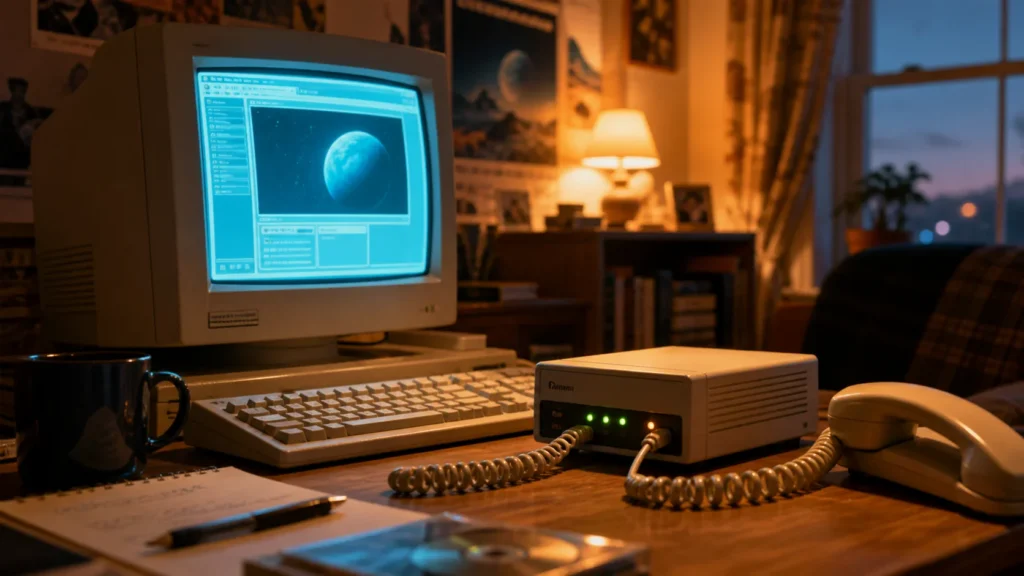
The modem was not glamorous hardware. It was a box with lights, a card hidden in the machine, or a line item in the system configuration. But it connected domestic space to global possibility with a level of ceremony few later technologies retained.
That places it in the same broad family as the chunky connector era, where ports and cables made computing feel physically connected to the world, or the PalmPilot era, where synchronization taught users that digital life could move between contexts and devices. The modem did something similar for the network itself. It made "elsewhere" reachable from a bedroom or living room, but only through a process you could feel happening.
That feeling matters historically.
The web felt stranger because the entry ritual was stranger
I think this may be the deepest reason dial-up nostalgia remains so persistent.
The early web was already unusual enough. But the method of arrival made it feel even more improbable. You did not glide into the network on a seamless slab of background infrastructure. You coaxed your way in through a phone line using a machine that literally transformed data into sound and back again.
No wonder the internet felt magical.
The route to it already sounded like science fiction trying to happen in your bedroom.
And once you have experienced that, later seamlessness can feel efficient but emotionally thinner. Better, yes. Kinder, absolutely. But less mythic.
What dial-up modems still symbolize to me
Looking back now, I think dial-up modems symbolize the moment when home internet still had ritual.
Connection had to begin.
The machine had to try.
The line had to cooperate.
The household had to adapt.
The user had to wait.
All of that created a sense that online life was something entered, not merely inhabited by default.
That distinction is powerful.
It gave the web a threshold.
Final thoughts
Dial-up modems remain unforgettable because they made internet access audible, physical, and time-bound.
They turned the phone line into a data path.
They turned standards into household ritual.
They turned waiting into anticipation.
And they gave the early web a sound so strange that it still functions as shorthand for an entire era of digital possibility.
That is why the memory lasts.
The modem did not just connect you to the internet.
For a few seconds, it let you hear the internet trying to arrive.