There are moments in computing history when technology improves, and then there are moments when technology seems to reveal an entirely new category of expectation.
The 3dfx Voodoo era belonged to the second category.
Before that moment, games could already be exciting. PCs were already fun. People were already spending serious money trying to push visuals further. But when dedicated 3D acceleration truly arrived in the consumer imagination, the experience did not feel like a normal upgrade. It felt like the machine had been shown a trick it was somehow always supposed to know.
That is why the Voodoo years remain so vivid to me.
They were not only about more speed.
They were about a new kind of shock.
The same game.
The same desk.
The same person in the chair.
And suddenly the screen looked like it belonged to the future.
- Why pre-acceleration PC graphics already felt ambitious but unfinished
- What made 3dfx seem magical instead of merely technical
- How Glide and dedicated acceleration changed the feeling of games
- Why the Voodoo era felt like a cultural event and not just a hardware release
- How that first visual shock shaped what gamers expected afterward
- Why the memory of 3dfx still glows so brightly now
The historical details below are checked against the Computer History Museum archive; the interpretation and first-person perspective remain the author’s own.
We were already impressed by games before Voodoo; that is why the leap felt so violent
This part matters, because nostalgia can make it seem as if everything before 3dfx looked primitive in a boring way.
It did not.
PC games before the Voodoo breakthrough could already feel atmospheric, clever, fast, and absorbing. Artists and developers were doing remarkable work within the limits they had. Software rendering, clever texture work, and the whole improvisational energy of 1990s PC gaming had already taught people to be impressed.
That is exactly why dedicated 3D acceleration landed so hard.
If the baseline had been emotionally empty, the jump would have felt academic. Instead, gamers were looking at worlds they already cared about and seeing them become smoother, cleaner, more dimensional, more fluid, and more coherent in motion. The improvement felt personal because it happened to things people already loved.
It was not just “look what this card can do.”
It was:
“Look what this game was apparently waiting to become.”
3dfx did not only sell hardware; it sold a revelation
The Computer History Museum’s 3dfx history describes the company’s role in bringing advanced 3D graphics to the consumer PC at a moment when that shift could change the whole market. Their oral-history material paints the same broader picture: 3dfx arrived when graphics technology, game development, and consumer excitement were all reaching for each other at once.
That convergence is what made the company seem larger than a normal hardware vendor.
3dfx did not merely offer more frames.
It appeared to offer a better version of the entire near future.
There was something intoxicating about that. A Voodoo board was not just a component in the case. It was a promise that PC games could feel less like smart software illusions and more like full visual spaces. The card turned 3D from a concept people admired into an effect they could experience physically at home.
That is why I think the era lives so vividly in memory. People were not only buying performance. They were buying entry into a before-and-after moment.
The first shock was visual, not theoretical
I do not think most people fell in love with 3dfx because they began by studying bus architecture or framebuffer logic.
They fell in love because of what the screen did.
Lighting looked different.
Movement looked different.
Texture filtering looked different.
The world seemed less stitched together from compromises and more willing to hold itself together while moving.
That is what made the moment so emotional.
A lot of hardware progress is easiest to appreciate in charts, measurements, and comparative language. The Voodoo era was one of those rarer times when the selling point could arrive as a facial expression instead. You looked at a game, or watched someone else look at it, and there was a visible moment of recognition:
this is not the same thing anymore.
I think that kind of reaction is one reason retro hardware memories stay so strong. The upgrade was not abstract. It passed through the eyes first.
Glide made the whole experience feel like it belonged to a secret better path
One of the strange romance points of the era was that 3dfx did not feel like ordinary generic graphics progress. It had its own language around it.
The 3dfxzone glossary still captures a bit of that old identity by describing Glide as a dedicated 3D API associated with the company’s hardware. That alone is enough to summon the old mood. You were not just running a game with a faster card. You were entering a slightly more privileged rendering path, one that seemed tailored to a more advanced vision of what the game could be.
That exclusivity mattered emotionally, even when it also created fragmentation.
There was a thrill in knowing that some experiences were not merely “better on my machine” but were being unlocked through a whole parallel graphics culture. It made acceleration feel less like general progress and more like membership.
That feeling connects naturally to the later drama remembered in the original SLI era. By then, 3dfx hardware had already become something people treated with identity and mythology, not just shopping logic.
The hardware looked important because it was important
This is another underrated part of the Voodoo memory.
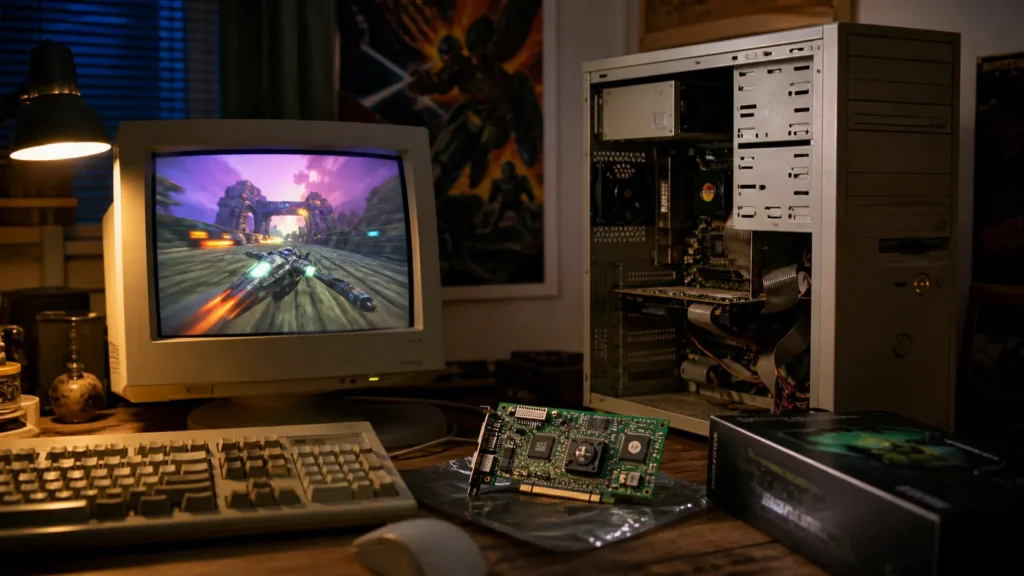
In the late 1990s, internal PC hardware could still look like destiny. Cards had mass. Slots had hierarchy. Cases were being opened by people who genuinely expected the inside of the machine to explain something about its future.
The Voodoo boards fit perfectly into that atmosphere.
They were not invisible upgrades. They were installed, discussed, admired, compared, and eventually mythologized. You could point to the hardware and say: that is where the new feeling came from.
I think that tangibility mattered. The transformation on screen had a visible cause inside the box. The future had a circuit board.
That is one reason the whole period still feels spiritually related to the AGP-versus-PCI moment. Graphics had started acquiring social prestige inside the architecture of the PC itself. The machine was reorganizing around visual ambition, and everyone could see it happening.
The Voodoo era taught gamers to expect more than “playable”
This may be the most lasting consequence of all.
Once players had seen what dedicated acceleration could do, “good enough” graphics started feeling less final. The floor of expectation rose. Smoothness, filtering, visual depth, and overall 3D quality stopped being exotic luxuries in the imagination. They became the direction games were clearly supposed to keep moving.
That is what makes the era historically important to me. It was not merely a pleasant chapter in graphics-card nostalgia. It changed the emotional standard.
After that first shock, people knew the PC could look like that.
And once you know the machine can do that, it becomes harder to feel satisfied with less.
This is how eras become irreversible. A temporary amazement becomes a permanent expectation.
Part of the magic was that it still felt slightly unbelievable
Modern hardware can do far more astonishing things than a Voodoo card ever could. That is obviously true. But the emotional ratio was different back then.
The jump felt larger because the before-state was still close enough to remember intimately. The screen had not been slowly improved across ten invisible generations of optimization and abstraction. It had been pushed into a noticeably different register while you were still paying close attention.
That created a kind of disbelief that later graphics progress rarely reproduces.
You could still feel the old world next to the new one.
The comparison was alive.
The contrast was sharp.
That is why the memory glows so much. It was not only that 3D acceleration was impressive. It was that it arrived while people were still emotionally calibrated to be stunned by it.
3dfx felt brave in the way some old hardware companies only could
The Computer History Museum’s material on 3dfx carries some of this energy implicitly. The company belongs to a period when hardware makers could shape identity, not just benchmark tables. A board was a bet on where the whole medium was going.
3dfx made that bet loudly.
There was style in it.
There was swagger in it.
There was also risk.
That combination matters to the memory. The brand did not become iconic only because the products were technically meaningful. It became iconic because it seemed to embody the feeling that PC gaming was about to become something more spectacular than it had been a year earlier.
That is an unusually powerful thing for a hardware company to symbolize.
The improvement was visible enough, sudden enough, and emotionally legible enough that a card inside the case could seem to change not just performance, but the whole future of games.
Why the memory still feels warm now
I think people still love the 3dfx period because it preserved something rare: the sense that technology could still surprise ordinary users in ways that felt immediate and almost innocent.
The surprise did not need a lecture.
It did not need a benchmark chart first.
It did not need a ten-minute technical explainer before the wonder arrived.
The wonder was the explainer.
That is the kind of computing memory that stays alive longest. Not only because the hardware mattered, but because the feeling it produced was simple enough to remember decades later.
You saw it.
You recognized it.
And you knew, almost at once, that games were not going back.
That broader period is easier to understand alongside Unreal Engine 1 & 2: How Epic Games Licensed the 3D Future, which captures another part of the same transition in personal computing.
Conclusion
The 3dfx Voodoo era blew our minds because it turned 3D acceleration into a visible, emotional event. Dedicated graphics hardware did not just make games faster. It made them look transformed, and it did so at a moment when players were still close enough to the older visual world to feel the leap in their bones. That is why the period remains so beloved. It was one of the first times the PC did not merely improve. It seemed to wake up visually.
FAQ
Why was 3dfx so important to PC gaming?
Because it helped bring dedicated consumer 3D acceleration into mainstream PC gaming in a way that visibly changed how games looked and felt, not just how they benchmarked.
What made the Voodoo era feel different from normal hardware upgrades?
The leap was unusually visible. Players could often see immediately that familiar games looked smoother, richer, and more convincingly 3D with acceleration enabled.
What was Glide?
Glide was 3dfx’s own 3D API, closely associated with its hardware. For many players, it contributed to the feeling that Voodoo cards were unlocking a special, better rendering path.
Was 3dfx only about performance?
No. Performance mattered, but the real cultural impact came from the combination of speed, image quality, identity, and the sense that graphics had entered a new era.
Why do people still remember the Voodoo era so fondly?
Because it was one of those rare hardware moments where the future felt visibly present. The improvement was easy to feel, easy to admire, and tied to a specific kind of wonder that later generations of graphics progress no longer delivered in quite the same way.