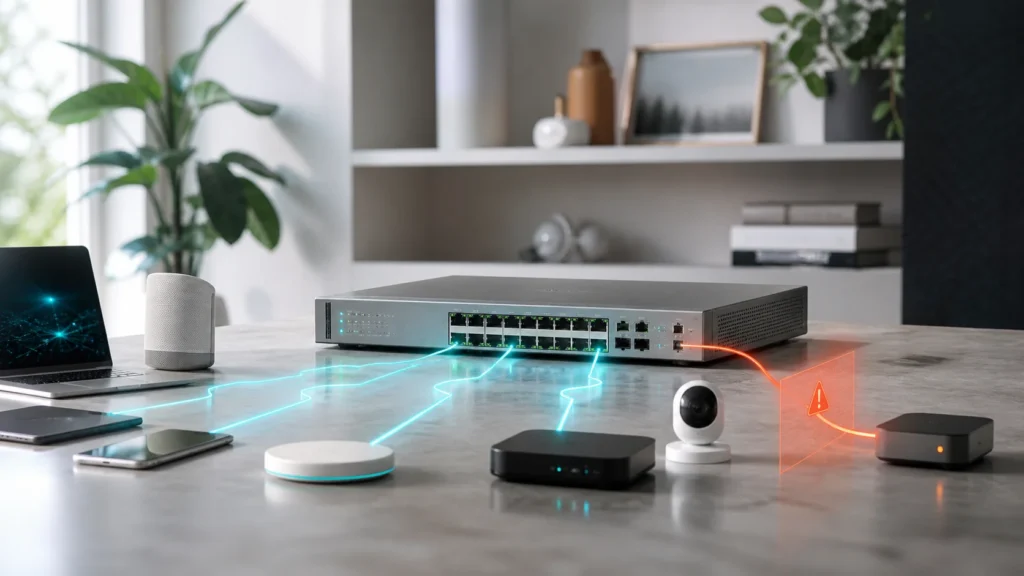
For a long time, I assumed the inside of a home network was automatically the “safe part.”
The real danger, I thought, lived at the internet edge.
The WAN needed a firewall.
Remote access needed care.
Public exposure needed skepticism.
All of that is still true.
But it leaves out one quieter truth:
the local network can be tricked too.
That was the shift that made ARP spoofing and rogue DHCP servers feel less like enterprise trivia and more like normal networking literacy. Once you understand how much local traffic depends on trusting the right answers about IP addresses, MAC addresses, gateways, and leases, it becomes much easier to see why one lying device can make a whole LAN feel cursed.
- Why ARP spoofing and rogue DHCP attacks matter at home
- What each attack is actually doing
- How DHCP snooping and Dynamic ARP Inspection help
- Why home networks with flat trust are easier to poison than people expect
- What to do if your gear does not support these protections
- How I think about local trust now
The protocol and configuration baseline below is checked against the published Internet standard; the topology and risk recommendations are my practical interpretation.
The problem is not only “malware on the internet” but also “lies on the LAN”
That sentence would have sounded dramatic to me a few years ago.
Now it sounds precise.
RFC 826 defines ARP as the way a host maps protocol addresses to local hardware addresses on an Ethernet-like network. In practice, that means devices use ARP to learn which MAC address should receive traffic for a given IPv4 destination on the local segment. RFC 2131 does something similarly foundational for DHCP by describing how hosts receive IP configuration from a DHCP server.
Those two mechanisms are ordinary.
That is exactly why they are dangerous when abused.
If a device can lie convincingly about:
- who owns an IP address;
- who the default gateway is;
- who should hand out leases;
- or which MAC address belongs to which local path,
then the rest of the network may behave badly before anyone notices the attacker at all.
ARP spoofing is basically a lie about where traffic should go
The Aruba dynamic ARP protection guide explains this very clearly.
It says ARP caches are vulnerable because most devices update their IP-to-MAC entries whenever they receive an ARP packet, even if they did not ask for the information. It then describes how an attacker can broadcast or unicast a forged ARP reply, poisoning other devices so traffic meant for a legitimate host gets sent to the attacker’s MAC address instead.
That is the core of ARP spoofing.
Cisco Meraki’s Dynamic ARP Inspection guide describes it in almost the same practical shape: an attacker sends crafted ARP packets that poison ARP caches and redirect traffic intended for one host toward another machine, creating a classic man-in-the-middle condition.
This is why ARP spoofing feels so unfair the first time you think about it.
The attacker is not smashing the network from the outside.
They are answering a local question dishonestly.
And because ARP is so ordinary, devices often listen.
A rogue DHCP server lies earlier in the process
If ARP spoofing lies about where traffic should go after a device is already on the network, rogue DHCP lies during onboarding.
RFC 2131 frames DHCP as the system that gives hosts their address and other configuration information. Aruba’s DHCP security guidance then adds the security reality: DHCP snooping protects against common DHCP attacks, including address spoofing from a rogue DHCP server and exhaustion of available addresses caused by mass bogus requests.
That matters because a rogue DHCP server can hand out:
- the wrong default gateway;
- the wrong DNS server;
- the wrong subnet details;
- or overlapping and chaotic address assignments.
At home, that can look like:
- devices intermittently losing internet access;
- clients landing on strange IP ranges;
- DNS suddenly resolving through somewhere unexpected;
- or traffic being quietly steered through a device that should never have been in charge.
It is one of those attacks that can feel like a flaky network long before it feels like an attack.
DHCP snooping is one of the cleanest protections a managed switch can offer
This is where the whole topic becomes much calmer.
Aruba’s documentation says DHCP snooping designates trusted DHCP servers and trusted ports, and protects the network by controlling where DHCP requests and responses are accepted. Meraki’s Dynamic ARP Inspection guide reinforces the same idea indirectly by relying on a DHCP snooping table as the source of truth for later validation.
That means a capable switch can learn a very important sentence:
“Only this port or this server is allowed to behave like DHCP authority.”
Once that sentence exists, the switch can stop forwarding DHCP offers and replies from untrusted places.
That is why DHCP snooping feels so powerful to me.
It does not merely react after the damage.
It narrows who is even allowed to answer the question.
Dynamic ARP Inspection builds on that same trust model
This is the beautiful part.
Meraki says Dynamic ARP Inspection intercepts ARP packets, compares their IP-to-MAC claims to the DHCP snooping table, and drops any ARP packet that does not match the learned bindings. Aruba says the same thing in slightly more expansive terms: dynamic ARP protection verifies IP-to-MAC bindings on untrusted ports using the lease database maintained by DHCP snooping, plus user-configured static bindings where needed.
That relationship matters.
DHCP snooping says:
- these are the trusted DHCP sources;
- these are the bindings we learned from legitimate lease behavior.
Dynamic ARP Inspection then says:
- if an ARP packet contradicts that reality on an untrusted port,
- do not believe it,
- and do not forward the lie.
That pairing is the cleanest answer I know for local IPv4 trust on a managed switch.
The catch is that these protections assume you know which ports deserve trust
This is where the home version of the problem becomes very real.
Meraki’s DAI guide says trusted ports are excluded from validation checks and that only end-host ports should normally remain untrusted, while ports facing infrastructure devices such as switches or access points are often marked trusted to avoid connectivity issues.
That sounds simple until you realize it is really a design question.
Which port is the real uplink?
Where does the legitimate DHCP server live?
Is that downstream access point just carrying clients, or could it also hide a problematic path?
These protections work best when the topology is understandable.
That is one reason they pair so naturally with the broader lesson from thinking clearly about VLANs and trust boundaries. Layer-2 security features do not replace architecture. They reward good architecture.
Static-IP devices are where the story gets slightly less convenient
This is an important nuance that vendor documentation does not hide.
Meraki says DAI relies on the DHCP snooping table and should be used only on DHCP-enabled subnets. It also notes that static-IP devices can be blocked by DAI because there is no corresponding snooped lease entry unless you explicitly allow or define it. Aruba says something similar by recommending static bindings in non-DHCP environments or for statically addressed devices.
That nuance matters a lot at home, because the most infrastructure-like devices often use:
- static IPs;
- DHCP reservations;
- or manually controlled addressing habits.
So the cleanest mental model is not “turn on DAI everywhere blindly.”
It is:
- use DHCP snooping where DHCP really is the authoritative model;
- add static bindings or exceptions where truly needed;
- and understand that strong validation depends on having a real source of truth.
Flat home networks are especially easy to trust too much
This is the part I care about most editorially.
In many homes, everything shares:
- one switch or one big switch fabric;
- one trusted SSID;
- one casual LAN;
- one emotional assumption that “inside equals safe.”
That is exactly the kind of environment where a rogue DHCP server or ARP spoofing host gets more room than it deserves.
The more I learned about this, the less I liked flat trust for mixed environments. If guests, random IoT gear, lab devices, and personal machines all live on one easy layer-2 island, the network may be convenient, but it is also trusting a lot of ordinary local behavior without much skepticism.
That is one reason I increasingly value:
- separate guest networks;
- lower-trust IoT segments;
- wireless isolation where appropriate;
- and not letting every physically present device share the same social contract.
This topic fits naturally beside clear VLAN boundary planning and home IoT VLAN isolation because the real issue underneath all of them is the same:
who gets to be believed locally?
If your gear does not support snooping or inspection, the fallback is smaller trust and clearer authority
Not every home switch can do DHCP snooping or ARP inspection.
That is fine.
The answer is not despair.
The answer is to make the local network less casual.
If I did not have those features, I would still try to make the network harder to poison by:
- keeping one clearly authoritative DHCP server;
- disabling extra consumer-router DHCP services when repurposing old gear;
- reducing flat LAN exposure for guest and IoT devices;
- avoiding unnecessary wired access to sensitive segments;
- keeping Wi-Fi on strong security settings so random nearby clients do not join casually;
- treating unexplained gateway or DNS changes as suspicious, not merely annoying.
This is not as strong as snooping and inspection.
But it is much better than assuming layer 2 deserves blind trust just because the traffic is “inside.”
If you cannot enforce DHCP snooping or ARP inspection in hardware, the next best protection is to reduce who can share the same layer-2 space and to keep one very clear source of addressing authority.
The best home strategy is usually boring: one DHCP authority, untrusted host ports, and fewer shared neighborhoods
I like this topic best when it becomes boring.
One real DHCP server.
Managed switch protections if available.
Infrastructure uplinks understood clearly.
End-host ports treated with more skepticism.
Legacy or low-trust devices kept out of important local neighborhoods.
That is not flashy.
It is just sane.
And sane networks age better than clever ones.
How I think about ARP spoofing and rogue DHCP now
I no longer see them as advanced-switching trivia.
I see them as reminders that local trust is still trust.
The inside of the network is not automatically honest.
It is merely closer.
Once that clicked, the whole topic became easier:
- if the switch can enforce who may answer DHCP, let it;
- if it can validate ARP against real lease bindings, let it;
- if it cannot, narrow the layer-2 neighborhood and reduce who gets easy proximity to important devices.
That mindset made my networks feel less magical and more deliberate.
Conclusion
ARP spoofing and rogue DHCP attacks matter on home networks because they exploit ordinary local trust rather than dramatic internet exposure. A lying device can redirect traffic, poison gateway resolution, or hand out broken network settings long before most people realize they are dealing with more than a flaky LAN. The strongest clean defense on capable switches is the combination of DHCP snooping and Dynamic ARP Inspection or equivalent ARP protection, backed by trusted-port design and careful handling of static-IP devices.
What changed for me was realizing that home networks are not exempt from layer-2 skepticism. If anything, they often need more of it because convenience encourages one big trusted neighborhood. Once I stopped assuming local automatically meant safe, the design choices became much clearer.