Before gameplay capture became easy, it felt slightly impossible.
Not impossible in a strict technical sense. People were already doing it. But impossible in the emotional sense that matters to ordinary users: the sense that this probably required specialist gear, some broadcast-grade workaround, a level of patience you did not have, or a kind of competence that belonged to someone older, richer, or deeper inside computer culture than you were.
Then along came Fraps.
It did not arrive like a media empire. It arrived like a utility. Small. Direct. Slightly plain. The sort of software that looked like it belonged beside benchmarking tools and hardware checklists rather than beside a new kind of entertainment culture.
That is part of what made it so powerful.
- Why Fraps made gameplay recording feel possible
- How the tiny FPS counter became part of gaming culture
- Why early capture still felt like hard work
- How Fraps helped shape machinima and early YouTube habits
- Why the software felt bigger than its interface
- What its legacy says about creator culture before creator tools
The historical details below are checked against the official FRAPS site; the interpretation and first-person perspective remain the author’s own.
The miracle was not that Fraps was glamorous, but that it was understandable
The official Fraps home page still describes the software in the most straightforward possible terms: benchmarking, screen capture, and real-time video capture for DirectX and OpenGL games. That plainness matters.
The program did not need a grand mythology to be influential. It only needed to answer a question a lot of players suddenly had:
"Can I record this?"
And more importantly:
"Can I record this without turning my room into a television studio?"
Fraps answered yes in a way people could grasp.
Install it.
Run the game.
See the frame-rate overlay.
Press the hotkey.
Now the thing on your screen is becoming a file.
That sequence may sound ordinary now, but it did not feel ordinary then. It felt like the moment gameplay stopped being purely live and started becoming portable.
The yellow FPS counter became one of the quiet visual signatures of an era
You did not always need to see the full interface to know Fraps was there.
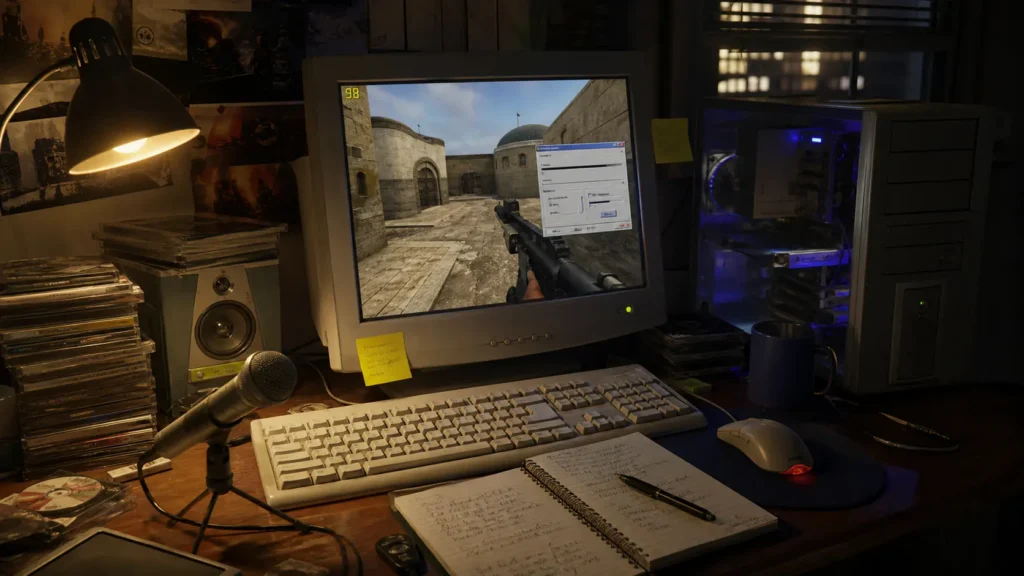
Often all it took was the little frame-rate counter in the corner.
That overlay mattered more culturally than a normal software detail should have. It became part of the look of early recorded PC footage, a tiny yellow witness to the fact that the video you were watching had not come from a TV capture card pointed at a console or some distant professional setup. It came from a player’s actual machine in the middle of play.
The overlay made the computer feel present inside the recording. It gave the video a kind of local honesty. You could almost feel the desktop, the hardware, the fan noise, the storage stress, and the fragile hope that the game would keep running well enough while also being captured.
That is why Fraps belongs emotionally beside other small software markers from older PC culture. Like the oddly proud function keys in Total Commander or the private weirdness of old screensavers, it became more than a feature. It became part of how a whole generation recognized a certain kind of computer experience.
Fraps made recording feel available, but never effortless
This is important, because nostalgia can flatten the difficulty.
Fraps was powerful, but it was not magical in the modern sense of being invisible. The official FAQ is unusually honest about performance impact. Drawing the overlay only adds a small overhead, but recording movies can have a noticeable effect because of all the extra work involved in saving screen data to disk.
Anyone who lived through that era remembers what that meant in practice.
Huge files.
Hard drives filling alarmingly fast.
Frame rates dipping at the worst possible moment.
Experiments with capture settings.
Post-recording compression rituals.
A constant negotiation between what looked good and what your machine could survive.
And yet that difficulty is part of why Fraps mattered so much. It did not remove all the friction. It lowered the barrier just enough that ordinary people would try.
That is how cultural doors really open most of the time. Not when everything becomes easy, but when it becomes barely possible for enough curious people.
It arrived exactly when gaming wanted to become shareable
This is where Fraps gets historically interesting.
The official Fraps site itself uses a phrase that says everything about the moment: "Come join the Machinima revolution!" That line captures the culture around it perfectly. Fraps did not just appear during a time when people wanted benchmarks and screenshots. It appeared during a time when players increasingly wanted to turn gameplay into media.
Not just proof.
Not just bragging rights.
Media.
Montages.
Funny moments.
Tutorials.
Clips for forums.
Machinima experiments.
PvP highlights.
Commentary attempts before people even knew what the modern commentary format would become.
Fraps sat right at that threshold between playing games and publishing game experience.
That is why I think the title claim, that it helped create the first gaming YouTubers, is emotionally true even if history is always messier than one tool. YouTube did not come from Fraps alone, obviously. But Fraps helped make PC gameplay recordable in a way that regular users could actually act on, and that mattered enormously once video sharing stopped being a niche hobby.
The software taught a whole generation that gameplay could become an artifact
Before that shift, a lot of gaming still felt ephemeral.
You played.
Maybe a friend was there.
Maybe someone on a LAN saw it.
Then the moment vanished.
Fraps changed the psychology of that.
Once recording became imaginable, every great, stupid, lucky, or embarrassing moment inside a game started carrying a second possibility: maybe this is not only happening now. Maybe this can become a clip.
That altered the feeling of play itself.
And if that sounds like a big claim for such a tiny program, I think it is only because we have forgotten how radical ordinary capture once felt. Today, clipping and streaming are built into platforms, GPUs, and operating systems. Back then, making gameplay into an artifact still felt like an action you had to intend.
Fraps gave that intention a usable shape.
It also bridged two different kinds of users
This is another reason it became so culturally sticky.
Fraps appealed to both:
- the hardware-conscious user who wanted benchmarking and frame-rate numbers;
- the creatively restless user who wanted to capture games as moving images.
That overlap mattered.
The official product positioning reflects it clearly. Benchmarking, screenshots, and video capture were all part of the same package. So the tool lived in a space between performance culture and media culture. It belonged equally to the person testing a new GPU and the person trying to turn a multiplayer round into something watchable later.
That mixed identity feels very early-2000s PC to me.
The same machine was often a game machine, editing machine, internet machine, tinkering machine, and experimental studio all at once. Fraps fit that ecology beautifully. It did not require a user to declare whether they were a reviewer, a gamer, a forum kid, or a future creator. It simply offered a new layer of possibility to all of them.
Even the limitations helped define the era
The official buy page is revealing here too. The full version removed time limits and watermarks and allowed full-size recording, while the broader site made clear that registration was the path to recording seriously and without restriction.
That split between "possible" and "unlocked" feels extremely true to the period.
First you tried the thing.
Then you hit the limit.
Then you learned there was a paid version.
Then you decided whether this hobby mattered enough.
That structure shaped culture in its own way. It made gameplay capture feel like a commitment rather than a toggle. If you were willing to deal with massive files, frame drops, editing effort, and maybe even paying for the unrestricted tool, then you were already half-becoming the kind of person who wanted to make something out of play.
This is one of the reasons early gaming videos often feel so earnest in hindsight. They were not created in an environment where content flowed effortlessly by default. Someone had to want it.
Fraps belongs to the same world as LAN parties, forum culture, and improvised digital ambition
That is why it feels so nostalgic now.
It belongs to a period I also touched on in the culture LAN parties built, where gaming still had strong local energy even as it was becoming more networked and more public. Fraps was one of the tools that helped bridge those worlds. A great local moment no longer had to stay local.
That mattered.
Suddenly the spectacular bug, the impossible frag, the dramatic race finish, the physics glitch, the skill shot, or the ridiculous social moment inside a game could travel outward. Not perfectly. Not without work. But it could travel.
And once that became normal, a whole new layer of gaming identity began to form around recording, editing, uploading, and sharing.
Before creator culture became polished, Fraps made it feel scrappy and human
This may be what I miss most about that era.
The early gameplay-video world felt improvised. People were inventing formats while using them. Tutorials were rougher. Compression artifacts were heavier. Audio setups were inconsistent. The software was not doing much hand-holding. The result was often awkward, but also strangely intimate.
Fraps belongs to that intimacy.
It was not a complete creator ecosystem. It was a utility that gave people raw material. What they did next was often messy, personal, and experimental. That is exactly why so much of early online gaming media still feels charming. You can sense the gap between ambition and available tools, and that gap gave everything a little character.
That was enough. Once ordinary PC gamers could reasonably try capturing gameplay at home, a whole culture of clips, montages, machinima, and early YouTube experimentation had room to grow.
Nostalgia should not pretend it stayed on top forever
Of course it did not.
The official site still exists and still lists Fraps 3.5.99 as the latest release, dated February 26, 2013. That date tells its own story. The center of gaming capture eventually moved elsewhere. Streaming platforms matured. Hardware encoders improved. New tools made recording easier, lighter, and more integrated.
That is the normal lifecycle of software.
But decline does not erase influence.
What matters historically is that Fraps arrived at the moment when enough people were ready to record their games and needed a tool that felt achievable. It served that need so well that its tiny FPS counter became part of the visual memory of early gaming video itself.
Fraps also inherited the hands-on PC culture described in the MS-DOS batch-file era: users learned by experimenting, measuring, and building their own small workflows around imperfect tools.
Conclusion
Fraps mattered because it made gameplay capture feel possible before modern creator software made it feel ordinary. It was small, plain, and honest about its tradeoffs, but it lowered the barrier far enough for regular PC gamers to start experimenting with recorded play, machinima, and the first wave of gaming YouTube culture.
That is a bigger cultural role than its little interface would ever suggest.
The yellow counter in the corner was not just a benchmark.
It was a signal that play could become media.
And for a generation of gamers, that changed everything.