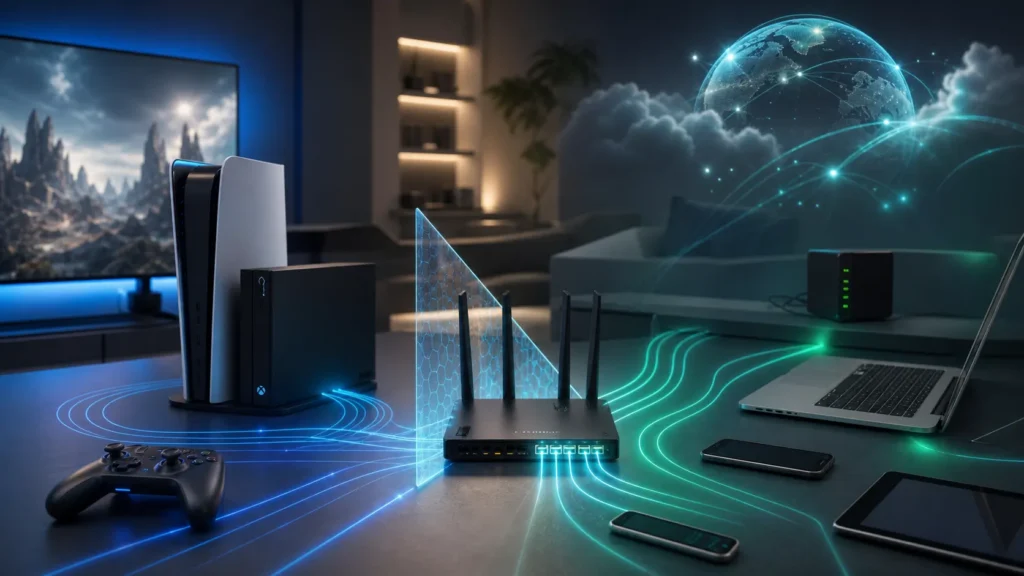
Game consoles live in an awkward trust category at home.
They are not as obviously low-trust as a random smart bulb.
But they are also not devices I manage like laptops, workstations, or homelab servers.
They sit somewhere in the middle:
- internet-heavy;
- multiplayer-sensitive;
- convenience-driven;
- long-lived;
- often dependent on easy NAT behavior to avoid frustrating online problems.
That combination is exactly why I do not love putting them on the main trusted network.
Not because they are dramatic villains.
And not because every console is one step away from attacking the rest of the house.
But because they often want a more permissive relationship with the internet than I want to grant to the rest of my trusted devices, especially once UPnP enters the conversation.
- Why NAT type matters enough to change network design for consoles
- Why UPnP is convenient and still worth containing
- How an isolated gaming subnet can balance convenience and trust
- What I would allow from a console segment and what I would avoid
- How to notice when the gaming setup is too open or too restrictive
NAT type is not just a technical footnote for consoles
One reason consoles complicate home segmentation is that they care about NAT in a way many ordinary devices do not.
Xbox’s own support documentation is very explicit: NAT type affects whether multiplayer gaming and party chat work reliably. Their guidance distinguishes between Open, Moderate, and Strict NAT behavior, and the practical meaning is obvious even if the implementation details vary by game and platform. The more restrictive the NAT result, the more likely a player is to run into limitations with connectivity or hosting.
Nintendo’s support material lands in a similar place with its own terminology. Their NAT compatibility guidance treats more open NAT states as more broadly compatible and less restrictive types as more problematic for peer connectivity.
That matters because it changes the design goal.
If I put a console on a carefully restricted isolated subnet but the result is persistent bad NAT behavior, then the design may be theoretically tidy and practically annoying. Gaming equipment is one of the few device categories where convenience has a very direct effect on whether the whole setup feels successful.
So the question is not:
- “Can I isolate consoles?”
Of course I can.
The better question is:
- “Can I isolate them without making online play miserable?”
That is the real challenge.
UPnP is the convenience lever that makes people flatten the whole network
This is usually where the compromise begins.
pfSense’s own UPnP/NAT-PMP documentation describes these protocols very plainly: they allow local software and devices to autonomously create dynamic NAT rules so incoming connections from remote hosts can be redirected inward.
That is why gaming people like it.
It is friction-reducing.
It helps devices ask for the mappings they need without forcing the admin to hand-build a pile of manual port forwards for every console and game behavior.
But that is also why I do not like letting it exist casually across my most trusted network.
UPnP is not “evil,” but it is a tool that intentionally gives internal devices the ability to request inbound openings. That is a different trust model than a quiet laptop network where nothing should be asking for dynamic inbound exposure in the background just because an app felt like it.
So once I accept that consoles benefit from easier NAT behavior, my next instinct is not “fine, everything stays on one flat LAN.”
My next instinct is:
- “Then the devices that need this convenience should probably live together in a narrower trust zone.”
An isolated console subnet is not anti-gaming, it is a cleaner compromise
This is the part that finally clicked for me.
If a device category wants a looser edge relationship with the outside world, then I would rather create a segment tailored to that reality than drag the rest of the trusted LAN toward the same posture.
That is why a dedicated console or gaming subnet makes so much sense.
It lets me say:
- these devices need solid outbound internet access;
- these devices may need friendlier NAT handling than my admin devices do;
- these devices do not need broad visibility into laptops, file shares, dashboards, or management surfaces.
That is a much healthier statement than pretending every device in the house deserves the same network trust just because online play is easier on a flat network.
This fits naturally with the broader segmentation logic behind VLANs and pfSense at home. Once you accept that different device groups deserve different treatment, consoles stop feeling like exceptions and start feeling like exactly the sort of group that benefits from their own policy boundary.
The policy should be gaming-friendly, not trust-blind
This is where pfSense’s firewall guidance helps.
Netgate’s rule methodology reminds us that rules are applied per interface in the inbound direction on that interface, and their firewall best practices push a default-deny philosophy: permit only what is actually required and let the rest stay closed.
That mindset is perfect for a gaming subnet.
On a console segment, I usually want to allow:
- internet access;
- DNS;
- NTP;
- the normal outbound behavior required for platform services;
- optional tightly scoped UPnP/NAT-PMP if I decide that convenience is worth it there.
What I do not want is broad unrestricted access from the consoles into:
- personal computers;
- work laptops;
- management interfaces;
- hypervisors;
- private service dashboards;
- file shares that have nothing to do with gaming.
That is where the segment earns its value.
The point is not simply to make a new subnet.
The point is to say:
- “These devices may get a more tolerant edge posture, but they do not get peer-level trust with everything else in the house.”
UPnP, if enabled, should be enabled where it hurts least
This is my real bias on the subject.
If a household decides UPnP is necessary for the best console experience, I would much rather see it enabled on a narrowly scoped gaming segment than on the primary trusted LAN where all kinds of unrelated devices also live.
That is the more honest compromise.
It acknowledges two truths at once:
- gaming platforms and peer connectivity still benefit from easier mapping behavior;
- not every internal device should inherit the same privilege just because the consoles want it.
This also pairs nicely with the same instinct behind keeping guest devices off your private shares and even keeping smart TVs off the main trusted network. The house does not need one emotional category called “stuff with screens.” Different devices earn different trust.
What I would watch for if the design feels wrong
If online gaming starts failing, voice chat breaks, or NAT type looks too restrictive, I would not immediately abandon segmentation.
I would ask:
- does the console segment have clean outbound access;
- is there double NAT somewhere upstream;
- is UPnP/NAT-PMP disabled where the console expects friendlier mapping behavior;
- did I accidentally block something that the gaming platform actually needs;
- did I make the subnet isolated in a smart way, or just isolated in an angry way.
That last question matters.
There is a difference between secure and spiteful.
A good gaming subnet should feel deliberately limited, not randomly broken.
If the result is constant frustration, the answer may be to tune the policy, not to throw the consoles back onto the fully trusted LAN and forget the lesson.
Verification note: Commands, terminology, and support details in this guide were cross-checked against Xbox’s official NAT troubleshooting guidance.
For broader context, continue with What I Wish I Knew Before My First VLAN and Home Assistant on an IoT VLAN: Safe Network Rules Without Breaking Discovery.
Conclusion
I think segmenting game consoles is one of the cleaner compromises a home network can make. Official Xbox and Nintendo support material shows clearly that NAT type affects real multiplayer compatibility, while pfSense documentation makes it equally clear that UPnP/NAT-PMP exists to create dynamic inbound mappings and that firewall policy should still follow a default-deny model. Put together, those two ideas lead to a design that makes sense: give consoles a gaming-friendly network segment, allow the behavior they genuinely need, and avoid granting them the same lateral trust as personal and administrative systems.
That approach is not anti-gaming. It is pro-classification. Consoles are devices that benefit from convenience at the edge, but that does not mean the rest of the house should inherit the same trust assumptions. A dedicated gaming subnet is often the place where those two truths stop fighting each other.
FAQ
Will putting consoles on an isolated subnet always make NAT type worse?
Not necessarily. A badly designed gaming subnet can make NAT behavior worse, but a well-designed one can still provide good outbound access and, if you choose to allow it, contained UPnP/NAT-PMP where the consoles live. The issue is not segmentation by itself. The issue is whether the segment still gives the consoles the edge behavior they need.
Is UPnP safe enough if it is only enabled on a console subnet?
It is safer than enabling it casually across a broad trusted LAN because the devices allowed to request dynamic mappings are now in a narrower trust zone. That does not make it magically risk-free, but it does make the convenience much easier to contain and reason about.