Some upgrades are impressive on paper.
Some are impressive in benchmarks.
And some are impressive because the machine itself seems to breathe differently afterward.
That is how I remember RAM upgrades in the 1990s.
Moving from 8MB to 16MB did not sound dramatic in the abstract, especially to anyone looking at modern hardware through modern numbers. But in the lived reality of that era, it could feel like a machine had crossed from irritability into cooperation. The computer stopped acting like every new window was a negotiation. You could hear less struggle, feel less hesitation, and trust the next click a little more.
That is why the memory jump still feels magical in retrospect. It did not turn a modest home PC into a workstation fantasy. It simply landed at exactly the point where daily computing had started to outgrow old assumptions about what “enough” memory meant.
- Why late-90s PCs often felt memory-starved before they felt truly slow
- How Windows and everyday software were pushing home machines harder
- Why doubling RAM changed the feel of the whole system
- What made the upgrade emotionally bigger than the number suggested
- Why 16MB became a kind of practical threshold in the 90s imagination
- What this small upgrade still says about personal computing now
What I remember first is not performance charts, but a cramped feeling
That is the real memory.
Older 1990s PCs did not always feel catastrophically broken. They often felt cramped. A system could boot, launch programs, and technically do what you asked, but the experience carried a background tension. Open one more thing and the machine lost some composure. Switch between applications and the rhythm changed. The hard drive became more talkative. Redraws became less graceful. You learned, even without understanding the architecture, that the computer did not like abundance.
That is why RAM was such a visceral upgrade.
CPU changes could feel abstract unless you were doing something obviously heavy. More storage was useful but less immediate. More memory changed the emotional texture of ordinary use. It touched the exact layer where the machine decided whether multitasking felt natural or resentful.
And by the late 1990s, ordinary use was getting heavier in a very specific way.
Graphical computing had become normal, but normal was no longer light
This is the context that makes the 8MB to 16MB jump make sense.
Raymond Chen noted on Microsoft’s Old New Thing that Windows 95 had a minimum memory requirement of 4MB and a recommended level of 8MB. That is useful because it reminds us how narrow the margins really were. A great many home computers were living close to the floor rather than comfortably above it.
But “can run” and “feels relaxed” are not the same thing.
By the time Windows 95 and then Windows 98 became part of everyday home life, people were no longer asking the PC to do just one clean task at a time. The machine was becoming a place for more overlapping behavior:
- a graphical desktop always present in the background;
- multiple utility icons living in the tray;
- a browser left open because reconnecting took time;
- office software that wanted more breathing room;
- media apps, image tools, chat clients, and games all competing for attention.
This is the same world that made software feel more personal and layered, the kind of environment I still think about when remembering why older Windows PCs felt so personal. The desktop was no longer just a launcher. It was becoming a lived-in space. And lived-in spaces need headroom.
16MB mattered because software was quietly admitting that 8MB was getting tight
This is where the historical record becomes especially revealing.
In a 1998 Microsoft announcement about Windows 98 and memory upgrades with Kingston, the company said Windows 98 runs well on a system using 16 MB of memory, while 32 MB or even 64 MB would further improve the experience for peripherals, multimedia, and high-end games. That statement is telling not only for what it recommends, but for what it normalizes. Sixteen megabytes is no longer extravagant. It is the practical center of gravity.
A year later, Microsoft’s Office 2000 release materials said that users of Windows 95 or Windows 98 would require 16 MB of RAM for the operating system, plus additional memory per application running simultaneously. Microsoft Project 98 similarly listed 12 MB of RAM for Windows 95. These are not exotic workstation products. They are exactly the kinds of mainstream software expectations that quietly redefine what a home PC feels like.
That is why doubling memory from 8MB to 16MB could feel so disproportionate. You were not moving from luxury to excess. You were moving from scarcity to a more livable baseline just as the software ecosystem itself was stepping over an invisible threshold.
Upgrading from 8MB to 16MB felt huge because it happened at the exact moment when consumer Windows, office apps, web browsing, and media playback were all becoming normal enough to overlap on the same machine.
The real difference was that the computer stopped negotiating every decision
That is still the best way I know to describe it.
With too little RAM, a 90s PC often behaved as if every extra action had to be bargained for. Open a browser, then a paint program, then a document, then maybe some music, and the machine began revealing its internal anxiety. It shuffled. It waited. It thought too long between intentions. The storage light flickered as if the computer were borrowing patience from the hard disk.
With 16MB, many systems stopped feeling luxurious and started feeling plausible.
Not fast in the modern sense. Not effortless in every workload. But plausible. You could keep a little more open. Switching context felt less punishing. The machine felt less likely to sulk when you asked it to hold several thoughts at once.
That mattered enormously in the culture of the time because PCs were becoming places where small forms of digital life started to accumulate. Maybe you were sketching in something simple like Paint, the kind of modest creative software that could still feel huge at the time, as I wrote in my piece on why MS Paint felt like a digital canvas. Maybe you were juggling saved files, floppy transfers, and half-finished ideas, the same kind of small-scale material world behind those old 1.44 MB memories. RAM did not create that world, but it made the world less fragile.
The upgrade felt magical because the numbers were small enough to understand
This is another part people forget.
Modern hardware often becomes emotionally numb through scale. Gigabytes and terabytes are huge, but they are also abstract to many people. In the 1990s, memory still felt countable in a more intimate way. Eight megabytes was not just a specification. It was a limit you could feel and, eventually, outgrow.
So when the number doubled, the emotional story doubled with it.
The upgrade had a satisfying logic:
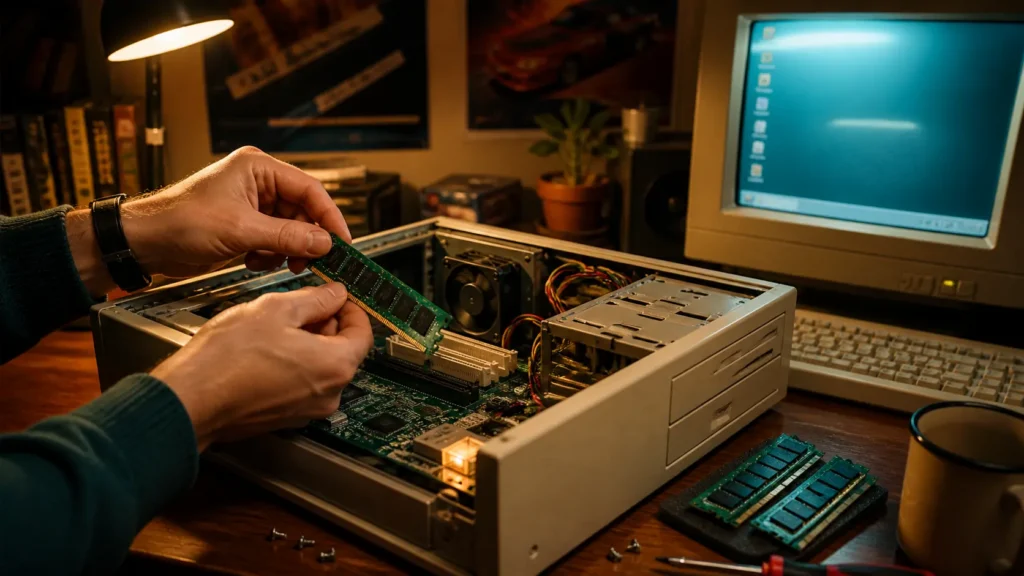
- you opened the case;
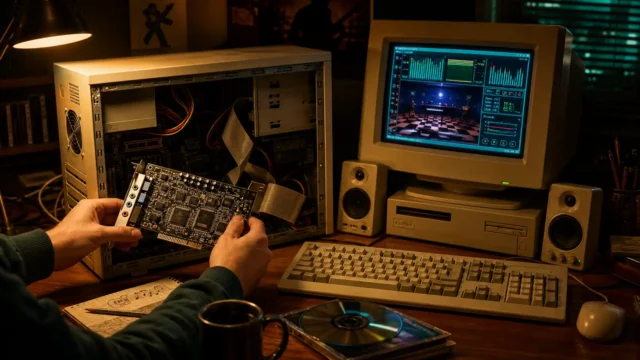
- you touched something small and physical;
- you installed a few little modules;
- and the machine behaved differently the next time it started.
That sequence had real dramatic power.
The result was not theoretical. It arrived at boot. It arrived in how quickly windows repainted. It arrived in whether the machine felt annoyed by a second or third program. It arrived in how much less often you could sense the computer leaning on the hard drive to cover its discomfort.
That is one reason memory upgrades became part of home-computing folklore. They offered a rare kind of everyday transformation. Not glamorous enough to sound like legend, but direct enough to become one anyway.
16MB became a threshold number in the way people talked about being comfortable
I do not mean that every 16MB machine suddenly became perfect.
I mean that 16MB began to sound like a sensible answer to the question, “What does this machine need to stop feeling undersized?”
That matters culturally. Once a number becomes a comfort threshold rather than a bare minimum, it changes buying advice, upgrade decisions, magazine recommendations, and the way ordinary users describe whether a PC feels “good enough.” Microsoft’s own late-90s messaging reflects this shift clearly. Sixteen megabytes was where the conversation started sounding less apologetic and more practical.
And practical is exactly the right word.
The upgrade was magical in feeling, but practical in meaning. It did not promise futuristic excess. It promised fewer interruptions. Fewer pauses. Fewer moments where the computer reminded you that it was juggling too much too close to the edge.
That is why the memory jump feels so vivid in retrospect. It was one of the cleanest examples of a technical change translating directly into emotional relief.
What this still says about personal computing
The old 8MB to 16MB jump reminds me that performance is not always about speed in the spectacular sense. Sometimes it is about dignity. A machine feels better when it stops exposing its discomfort during ordinary use.
That lesson survives every generation change.
The best upgrades are often the ones that remove negotiation from the background. They do not always make a computer exciting. They make it less hesitant. Less brittle. Less likely to turn normal behavior into friction.
In the 1990s, RAM upgrades did that with unusual clarity because home computing was crossing from simpler single-purpose tasks into a more layered, graphical, multitasking life. The upgrade from 8MB to 16MB landed right on that fault line.
That is why it felt like magic.
Not because the number was huge.
Not because the hardware was glamorous.
But because the machine finally had enough room to stop feeling nervous all the time.
Verification note: Historical and technical details in this retrospective were cross-checked against the archived Microsoft Windows 95 Resource Kit.
For broader context, continue with How 1.44 MB Shaped My Childhood and The Turbo Button Myth: What That PC Case Button Actually Did.
Conclusion
Moving from 8MB to 16MB of RAM in the 1990s felt magical because it changed the everyday texture of using a PC. It arrived at exactly the point where consumer Windows, office software, browsers, media apps, and casual multitasking were all asking for more than a bare-minimum machine could comfortably hold. The result was not abstract betterment. It was relief.
What I remember most is not a benchmark or a spec sheet. It is the feeling that the computer had become more patient. More willing. More breathable. That is what made the upgrade so memorable then, and it is still what makes it so easy to understand now.