There was a time when moving in a video game mostly meant choosing a direction.
Up.
Down.
Left.
Right.
Even when the worlds around those directions were imaginative, the body language of movement itself was still fairly strict. You pressed a button or a pad and the character obeyed in clean, digital certainties. The game did not usually ask whether you wanted to walk timidly, push forward just a little, arc into a turn with confidence, or ease into momentum like a person testing a floor before trusting it.
Then the Nintendo 64 controller arrived with that strange central stick.
And movement stopped feeling so absolute.
That is why I think the Nintendo 64 analog stick mattered so much. It did not simply introduce a new hardware part. It taught a generation of players that 3D movement could be expressive. It taught the thumb to speak in gradients. And once that lesson landed, it became hard to return to the old idea that motion in games should be mostly about selecting one of a few directions and committing instantly.
- Why the analog stick felt unusual before it felt natural
- How 3D spaces demanded a new kind of movement language
- Why the Nintendo 64 made speed and angle feel meaningful
- How analog movement changed the emotional rhythm of play
- Why this controller still feels historically important now
- What the N64 stick actually taught our hands
The historical details below are checked against Nintendo's official history; the interpretation and first-person perspective remain the author’s own.
The stick looked like a promise before we fully understood it
Nintendo’s own hardware history page still describes the Nintendo 64 controller as breaking new ground by introducing the first analogue control stick and giving players full 360-degree control. That is a concise official summary, but it hides how strange the idea could feel when seen for the first time.
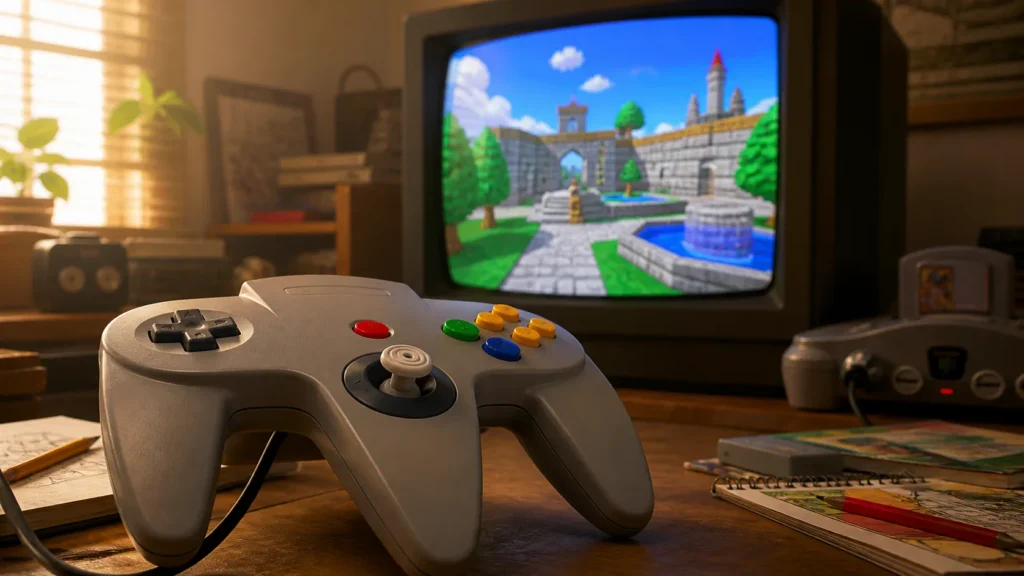
The controller itself already looked unusual. The three-pronged shape seemed to admit that the future had not yet settled on one clean standard for how hands should relate to a 3D machine. And right in the middle sat the control stick, not as a tiny optional extra off to the side, but as something central enough to reorganize your grip and your expectations.
That centrality mattered.
The message was not subtle: this was not merely another controller with one more feature. This was a controller built around a different assumption about how movement should work.
And that assumption turned out to be enormous.
3D space needed more than digital direction
This is easy to forget now because analog sticks feel normal. But 3D movement was not normal in the same way before it became legible through the hand.
A 3D game world introduces problems the directional pad solves only bluntly. Angles matter more. Camera relationships matter more. Speed matters more. Distance judgment matters more. The player is no longer simply crossing a flat plane of discrete lanes. The player is learning how to move within depth, around curves, near edges, toward moving objects, and through spaces that feel less like boards and more like places.
That requires nuance.
The analog stick gave that nuance physical form.
Push a little and the character could move with restraint.
Push farther and the body on screen committed more fully.
Tilt diagonally and motion could feel rounded rather than chopped into corners.
Ease off the pressure and the whole interaction began to suggest that movement was not merely on or off.
This was one of the great hidden design lessons of the Nintendo 64 era. It was not only teaching us to control Mario or Link differently. It was teaching us that 3D worlds deserved a more human vocabulary of motion.
The revelation was not just freedom; it was gradation
People often summarize the analog stick as "more freedom," and that is true, but I think it misses the deeper point.
The revelation was gradation.
Digital input tells the game whether you are choosing a direction. Analog input also begins telling it how much you mean it.
That is a profound change.
It gives movement mood. It gives the player the ability to hesitate, to commit, to feather direction, to circle, to test distance, to accelerate emotionally rather than just mechanically. In older directional systems, movement could still be satisfying, but it often felt declarative. Analog motion felt negotiable.
That negotiability is what made early 3D play suddenly feel less alien.
The world might still be new and the camera might still occasionally feel argumentative, but the body had gained a better chance to translate intention into something fluid. The controller was starting to meet the world halfway.
Nintendo quietly taught players how to think with their thumbs
This is where the importance of the N64 controller becomes even clearer to me.
It did not merely offer a capability and assume everyone would use it elegantly from day one. It participated in teaching an entirely new bodily habit.
Iwata Asks interviews about later Nintendo projects still reflect how meaningful analog movement had become. In the Ocarina of Time 3D staff discussion, the developers talk naturally about pushing the stick forward slowly versus more fully, and about how analog input carries subtle interpretive choices. That kind of conversation only makes sense after the medium has already internalized a whole language of gradation.
The Nintendo 64 period was where many players first learned that language.
We learned:
- that a gentle push could matter;
- that turning could be a curve instead of a corner;
- that speed and angle belonged together;
- that character motion could feel more like steering than like command entry;
- and that a 3D world became easier to trust when the thumb had a more proportional relationship to it.
That is not a small lesson. It is one of the foundational literacies of modern play.
The analog stick made space feel more inhabitable
This may be my favorite part of the whole story.
The stick did not only change control. It changed atmosphere.
When movement becomes analog, the world stops feeling like an arrangement of positions and starts feeling more like terrain. The character is not teleporting from decision to decision anymore. The character is moving through a space with varying force, slight corrections, soft approaches, sudden runs, and tiny half-committed adjustments near danger.
That makes presence easier.
A castle courtyard, an open field, a narrow ledge, a circular platform, a room with objects placed at different depths: all of these begin to feel more convincing when motion through them is no longer a chain of binary declarations. The world becomes less symbolic and more tactile.
I think this is why the memory of early 3D platforming is so bound up with feeling, not just architecture. People remember what it was like to circle, nudge, aim, and overcorrect. Those sensations were part of learning what 3D even meant in a home game.
It also made mistakes more personal
This might sound like a criticism, but I mean it as praise.
Analog control can make failure feel more specifically yours.
If a character runs too far, clips an angle badly, turns too late, or edges off a platform after a slightly overeager push, the mistake often feels less like the system betrayed you and more like your own hand was still learning the conversation. That does not make the games perfect, and the N64 stick itself had its own durability issues over time, but it does make the learning process unusually intimate.
The controller was not just accepting instruction.
It was training judgment.
That is one reason the memory of early analog play remains so vivid. It asked more from the player physically, but it also gave more back. Even awkwardness felt educational. Every cautious step and every overcommitted sprint was teaching the body a new ratio between intention and movement.
The N64 analog stick belongs to the same great transition as other late-90s breakthroughs
Looking back now, the controller feels part of a larger moment when games and hardware were both learning how to become three-dimensional in public.
The late 1990s were full of hardware and design shifts that did not merely improve numbers; they changed what players expected the medium to feel like. In PC culture, you can see this in the status jump described in the AGP era or in the theatrical excess of early multi-GPU systems. On the console side, the analog stick played a similar role at the level of input. It was one of those moments where a piece of hardware quietly redefined the future and made the old assumption feel smaller than it had the week before.
That is why it still seems so historically important to me.
It did not just refine an old habit.
It helped create a new one.
It taught us that movement could have personality
This may be the clearest way I can put it.
Before analog movement, character control often felt like intention translated into action.
After analog movement, it increasingly felt like intention translated into style.
You did not only move.
You edged.
You swung wide.
You lined up.
You jogged.
You dashed.
You tiptoed toward a turn.
That difference gave players a new emotional relationship to movement. Games could now ask not just where you wanted to go, but how you wanted to arrive. Once that possibility entered mainstream play, it became foundational. Later controllers refined it, improved comfort, added more sticks, and normalized the layout. But the early revelation remains attached to the Nintendo 64 because that was where many players first felt motion become expressive under the thumb.
That broader period is easier to understand alongside Atari 2600: The Machine That Built the Home Console Industry, which captures another part of the same transition in personal computing.
Final thoughts
The Nintendo 64 analog stick mattered because it did more than solve a hardware problem.
It taught players a new bodily idea.
It taught us that 3D movement could be proportional rather than binary.
It taught us that speed and angle could live together.
It taught us that worlds feel more believable when the body on screen can move with hesitation, confidence, softness, and force.
Most importantly, it taught our hands that moving through a game world was no longer just about picking a direction.
It was about learning how to inhabit space.