The Atari 2600 did something more important than sell a successful machine.
It taught people what a game console was allowed to become.
Before that lesson settled in, home video games could still feel like novelties, gadgets, or self-contained curiosities. A machine might arrive with a limited identity, a short life in the room, or the sense that it had delivered its trick already. The Atari 2600 changed that emotional contract. It suggested that a console could stay in the living room not as a one-off toy, but as an evolving platform whose future arrived in cartridges.
That idea is so normal now that it is hard to feel how radical it once was.
But I think the home console industry, as most of us instinctively imagine it, begins there.
- Why the Atari 2600 mattered even beyond being first
- How cartridges changed the meaning of a console
- Why the machine turned gaming into a living-room habit
- How the 2600 made software feel like an expanding future
- Why its cultural importance outlasts its technical limits
- What the Atari 2600 still symbolizes now
The historical details below are checked against Atari's official history; the interpretation and first-person perspective remain the author’s own.
It was not only a console; it was a model of continuity
One of the most useful facts about the Atari 2600 is also one of the most clarifying.
The Computer History Museum notes that the 2600, originally called the Atari Video Computer System, was not the first home game console to use a microprocessor and removable game cartridges. What it did do was help establish that approach as the standard.
That difference matters enormously.
History is full of products that arrive early.
Far fewer products make an early idea feel permanent.
The Atari 2600 did.
Its importance lies not in a shallow claim of total originality, but in the much more powerful fact that it made the cartridge-based, software-driven home console model emotionally and commercially legible to a mass audience. It turned a technical format into a habit. Once that happened, the industry had a shape it could keep repeating.
The cartridge changed the psychology of ownership
This is where the machine really begins to feel modern.
A fixed-function device is a promise with a ceiling. It may entertain brilliantly, but it tells you roughly what it is on the day you bring it home. A cartridge console offers a different emotional proposition. It says the machine in front of you is not finished yet.
That is a powerful thought to place in a living room.
Atari’s own official history page frames the VCS as the console that brought video games out of the arcade and into the home. The phrase is simple, but it carries an enormous cultural shift inside it. The console did not just relocate games physically. It relocated expectation. Once households accepted that a single machine could keep becoming new through separate game purchases, the console stopped feeling temporary.
It became infrastructure.
That is what the cartridge really sold.
Not only software, but continuity.
One machine could remain familiar while the experiences changed. New games did not require a new hardware identity every time. The platform survived, and the future arrived in pieces.
The living room became a site of return, not only of surprise
This may be the part I find most historically meaningful.
The Atari 2600 helped make gaming repetitive in the healthiest commercial sense. It created the idea that play at home could be revisited, expanded, collected, and normalized rather than treated like a rare or one-season novelty.
The Computer History Museum’s broader story on Atari describes how the company introduced the VCS in 1977 and then sold millions of cartridges over fifteen years. Atari’s own history page goes further in tone, describing nearly 30 million units sold worldwide and emphasizing how the machine sold out its initial run and became a holiday hit.
Those numbers matter, but the habit matters more.
A home console industry does not really exist until people start behaving as though the machine will stay.
They leave space for it.
They talk about future games for it.
They build memories around it.
They expect the next cartridge to matter.
That expectation is one of the great invisible foundations of the medium.
The Atari 2600 made software feel collectible before that was normal
One of the quiet revolutions of the machine was that it transformed games into a serial relationship.
You did not merely own "the game system."
You began owning particular games for the system.
That may sound trivial now, but it changed consumer imagination. The console became a stable anchor, and software became the expanding personal layer on top of it. A game collection could grow. Preferences could emerge. Some cartridges became household favorites. Others became curiosities, experiments, disappointments, or treasured rituals.
The machine taught people to think in libraries rather than only in devices.
That way of thinking leads directly to so much of what came later: the magazine demo disc culture described in the cover-CD era, the broader expectation that new experiences should arrive for familiar hardware, and eventually the entire platform logic of modern consoles and storefronts.
The Atari 2600 did not invent every one of those later forms.
But it helped normalize the consumer instinct behind them.
Technical limitation did not stop cultural expansion
This is one reason the 2600 remains so fascinating.
By modern standards, the hardware was primitive. The Computer History Museum describes its video system as so limited that it earned a reputation as one of the most complex machines to program. Developers had to be clever because the machine demanded it.
And yet limitation did not prevent greatness. In the Museum’s own language, programmers still produced genre-defining games such as Adventure and Pitfall! for the VCS. That contrast is part of the console’s legend: a modest box with enough cultural force to outgrow its own specifications through design ingenuity and persistence.
I think this matters because it reminds us what "industry-building" really means.
It does not only mean inventing better hardware.
It means creating a structure within which software creativity can accumulate publicly.
The 2600 created that structure.
It made the arcade dream feel domestic
The home console industry did not grow only from technology. It grew from aspiration.
Arcades carried glamour. They felt public, exciting, social, and slightly larger than everyday domestic life. Bringing even part of that feeling into the home was not a small achievement. It changed how entertainment space inside a house could feel.
Atari’s own history page explicitly frames the VCS as the machine that brought games out of the arcade and into the home. I keep returning to that phrase because it captures something deeper than distribution. It suggests translation.
The console translated an outside excitement into a repeatable indoor ritual.
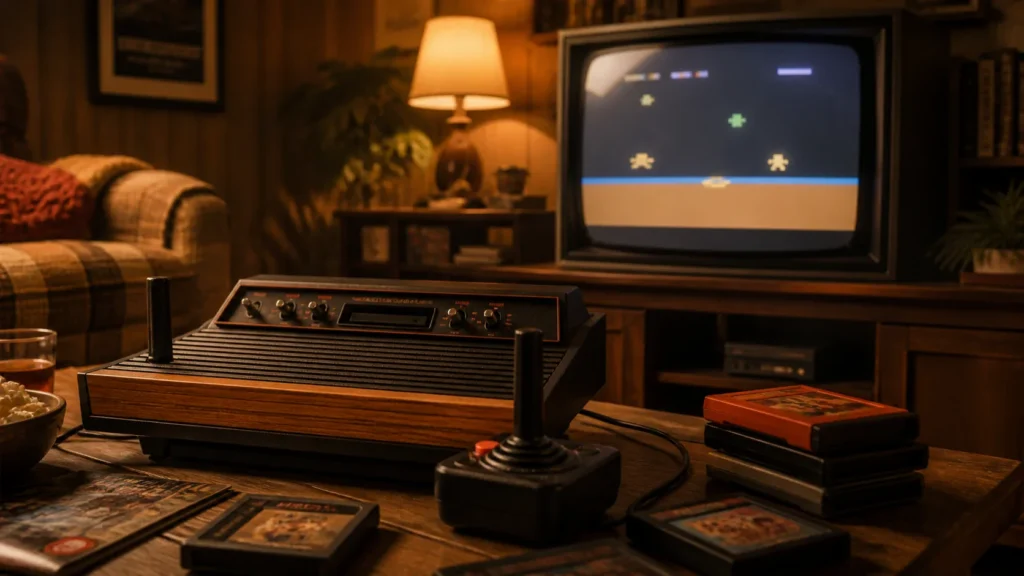
A television was no longer only for broadcast.
A cartridge slot was no longer only an engineering detail.
A joystick on the coffee table was no longer a novelty after a few weekends.
The room itself learned a new use.
That is why I think the Atari 2600 belongs in the same category of historical change as later transitions that taught us new habits of space and media, whether that means learning to move in 3D with an analog stick or learning how display technology shapes memory in the CRT era. Some machines do more than perform. They retrain domestic expectation.
The machine also gave the industry a reusable business logic
This is the more commercial side of the story, but it matters because culture and business architecture often arrive together.
The 2600 helped prove that a console could function as a durable base and that software sold separately could sustain interest over time. That model created a rhythm the industry still understands instinctively:
- launch hardware;
- build an installed base;
- sell software into that base;
- let the platform identity deepen through new titles;
- and keep the machine culturally alive through its library.
Today that logic feels obvious because it worked so thoroughly. In the late 1970s and early 1980s, it still needed to become believable at scale.
The Atari 2600 helped make it believable.
That is why I do not think of it merely as a successful console. I think of it as a machine that taught both players and publishers how a home console economy could breathe.
Why the Atari 2600 still feels foundational
Looking back now, the console feels less like a piece of hardware and more like a template that became reality.
It showed that a machine could persist through software.
It showed that households would welcome an expanding game library.
It showed that home play could be habitual rather than occasional.
It showed that a console could become part of the furniture of culture, not just the furniture of a room.
That is a remarkable legacy for something so bounded by its era’s engineering.
The 2600 was not perfect.
It was not alone.
It was not the final form of anything.
But it was one of those decisive products that made the next steps easier for everyone who followed.
Final thoughts
The Atari 2600 built the home console industry because it made a lasting platform model feel real to ordinary people.
It taught households that one console could keep becoming new.
It taught publishers that software libraries could sustain a machine.
It taught the living room that gaming was not a passing stunt.
Most importantly, it gave video games a domestic future that arrived one cartridge at a time.
That is why the Atari 2600 still matters to me.
Not only as a beloved old console, but as the machine that convinced the home that a console could stay.