Before I knew what digital art was, I knew the blank white rectangle inside MS Paint. It opened without ceremony: a small toolbox, a row of colors, and an empty space that seemed to be waiting specifically for me. There was no account to create, no tutorial to complete, and no suggestion that I needed talent before I began. I could choose a color, press the mouse button, and something existed that had not existed a second earlier.
As a child in the 1990s, I did not think of Paint as limited software. I thought of it as the place where the computer stopped telling me what to do. Games had rules. School programs had answers. Even Windows had folders, buttons, and warnings that implied there was a correct next step. Paint gave me a white field and stayed quiet. For a while, that made it feel like the largest place on the entire PC.
- Why Paint never asked me to prove I was creative
- How a tiny toolbox became an open-ended toy box
- Why its limits gave childhood drawings a distinct visual language
- How mistakes, saving, and local files created a sense of ownership
- What creativity felt like before every creation expected an audience
- Why the lesson of Paint still matters to me now
It never asked whether I was an artist
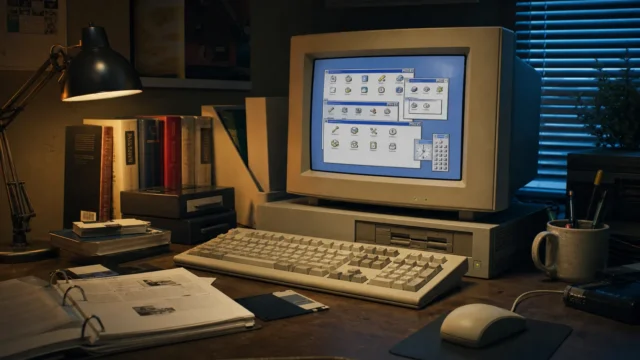
The most important thing about Paint was that it was already there. On a Windows 95 or Windows 98 computer, it lived among the Accessories rather than behind a price, a manual, or a serious creative identity. Opening it did not feel like entering professional software. It felt like discovering an unused room in the house.
That distinction mattered to me. I did not have to decide that I wanted to learn illustration. I did not need to understand layers, color theory, file formats, or the difference between a raster image and a vector. Paint let the action come before the identity. I drew first. Whether the result counted as art was a question for a much later version of me.
The interface encouraged that freedom because almost everything announced its purpose visually. A pencil looked like a pencil. A paint bucket promised color. A magnifying glass made things larger. Rectangles and ellipses waited to become houses, windows, planets, buttons, or anything else a child could assign to them. The software did not disappear, but it rarely stood between intention and result.
That accessibility felt intentional. The tools were arranged around actions rather than professional vocabulary, and most of them could be understood by trying them once. Decades later, that still feels like the clearest explanation for why Paint became a first creative program for so many people.
The canvas felt larger than the screen
My memory of Paint is not one masterpiece. It is the feeling of beginning again. The white canvas would appear, clean and slightly intimidating for perhaps half a second, and then the first line removed all pressure. Once the canvas was no longer perfect, it belonged to me.
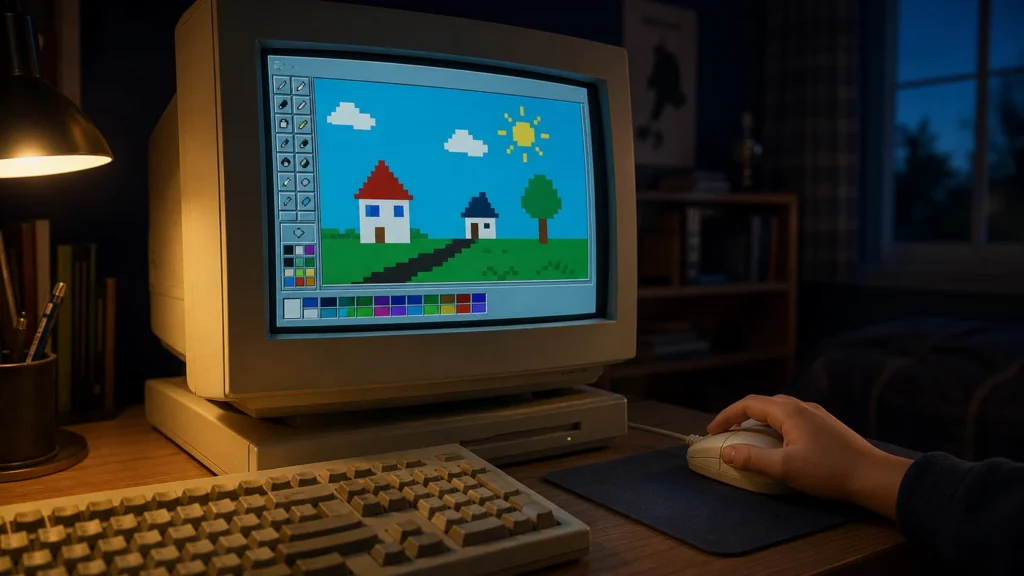
A horizon line could divide it into sky and ground. A rectangle with a triangle on top became a house. A circle in the corner became the sun. The spray can made weather, smoke, stars, or chaos depending on how long I held the mouse button. None of this required realism. The picture only needed enough internal logic for me to recognize the world I was building.
The physical experience mattered too. Drawing with a mouse was awkward, but the awkwardness was part of the charm. A line did not follow the hand the way a pencil did. It wobbled, hesitated, or jumped when the mouse reached the edge of its pad. I learned to lift, reposition, and continue. The computer translated a clumsy movement on the desk into a mark made of light, and that translation never stopped feeling a little magical.
The CRT gave the image its own kind of presence. Colors glowed more intensely than they did on paper, and the empty white area seemed almost luminous in a dim room. The computer was no longer only showing me someone else's world. It was holding one I had just made.
Every tool became a toy before it became a technique
I did not learn Paint in a sensible order. I clicked everything. The toolbox was a collection of possibilities, and each tool invited a different kind of experiment.
The line tool made order. The freehand pencil broke it. The rectangle created a building, and the fill bucket decided whether that building would remain a building or become a solid block of the wrong color. The curve tool felt mysterious because it demanded another click after the line already seemed finished. Text could label a picture, but it could also become part of the image when I chose an enormous font or a color that made no practical sense.
Copy and paste produced one of the earliest forms of abundance I understood on a computer. One carefully drawn window could become six. A small tree could become a forest. A shape could be flipped, stretched, moved, or repeated until the picture looked less like a drawing and more like a system I had invented.
This was learning, although it never felt educational. I was discovering selection boundaries, coordinates, repetition, foreground and background colors, destructive edits, and the strange behavior of pixels. Paint taught through consequences. Click, observe, undo if possible, then try again.
Its limits gave every image a recognizable accent
Paint did not imitate paper very well, and it did not need to. The Windows 95-era version belonged openly to the screen. Hard edges, flat colors, visible pixels, simple shapes, and mouse-drawn lines were not defects hiding behind realism. They were the language of the program.
The history helps explain that visual character. Paint arrived with the first Windows generation in 1985, evolved through the Paintbrush era, and was updated again for Windows 95. The technical limits of that period helped create a distinctive computer-made aesthetic. Paint images looked like Paint images because the tool did not conceal the grid underneath them.
As a child, I did not think in those terms. I only knew that zooming in revealed a secret construction material. A diagonal line was not truly smooth. It was a staircase of colored squares. A circle was a careful arrangement of compromises. If one pixel looked wrong, I could replace it directly. The image became both picture and object: something I could see from a distance and repair one square at a time.
Its visible pixels and blunt tools made digital images easier to understand. The limitation was also a lesson: pictures on a screen were constructed, editable things.
That directness is part of why old Paint drawings still feel honest. They rarely pretend to be photographs or traditional paintings. They carry the motion of the mouse, the limited palette, and the patience of the person placing the pixels. The tool leaves its accent in the work.
Mistakes were not interruptions; they were the process
The fill bucket was capable of instant disaster. A tiny gap in an outline could release color into the entire background. A careless selection could remove the part of the image I meant to keep. Resizing something could transform a clean shape into a stretched mosaic. Paint made mistakes fast and visible.
Undo existed, but it did not feel infinite or protective. I learned to pause before a risky click and to save versions when a picture began to matter. Sometimes the wrong color or accidental line became a new feature because repairing it seemed harder than explaining it to myself. A failed cloud could become smoke. A misplaced shape could become a door. The image adapted to the error.
That was a gentle way to learn creative resilience. The software did not judge the picture, and there was no audience waiting to point out the mistake. I could close the file, start over, or keep the strange version. Failure had almost no cost, which made experimentation feel natural.
Modern creative tools are far more forgiving, but that abundance can make every action feel provisional. Paint's small margin for reversal gave choices a little weight. Not enough to create fear, but enough to make the final image feel earned.
Saving a picture made the imagination feel real
The moment of saving changed the drawing. Until then it was light on a screen, vulnerable to a closed window or a wrong answer in a dialog box. Giving it a filename turned it into a thing the computer could remember.
The names were not elegant. They were often literal, hurried, or numbered after earlier attempts. The format was usually less important than the fact that the image now lived somewhere in the folder structure. I could reopen it tomorrow, set it as a desktop background, copy it to another directory, or show it to someone sitting beside the computer.
This was one of my earliest experiences of digital ownership. The file did not belong to a feed or an account. It did not need to synchronize before it became real. It existed on the machine because I had made it and chosen where to put it.
That local relationship is part of the larger reason older Windows PCs remain so emotionally vivid. In remembering why Windows XP felt more personal, the same theme appears: files and applications made the computer feel like a place with an interior you could arrange. Paint fit perfectly inside that world. It produced small artifacts that made the machine more recognizably mine.
It was creativity before creativity needed an audience
Most of my Paint experience was private. A picture did not begin with the question of where it would be posted. There were no likes waiting, no algorithmic crop to consider, and no public identity to maintain. The immediate audience was usually me, the person next to the computer, or perhaps the desktop wallpaper.
That privacy created a different kind of attention. I could spend too long adjusting an unimportant detail because the process itself was the reward. I could make something ugly without turning ugliness into irony. I could abandon a picture without feeling that unfinished effort had been wasted.
The PC of that era contained many small private worlds. Winamp skins, desktop themes, local game saves, carefully arranged folders, and drawings in Paint all contributed to the feeling that software could reflect the person using it. That is part of why Winamp felt like the future: it invited personality rather than smoothing it away. Paint did something even more basic. It handed me an empty surface and trusted me to decide what belonged there.
Today, sharing creative work can build community and teach skills that a child at a disconnected PC could not easily access. I would not trade all of that away. But I do miss the innocence of making a picture with no imagined crowd standing behind the screen.
Nostalgia should not turn Paint into something it was not
Paint was not secretly a perfect art application. The mouse was imprecise, text handling could be awkward, file support was limited by era and version, and destructive editing punished ambition. More capable graphics programs existed, and anyone doing serious image work had good reasons to leave Paint behind.
The computer itself was not always peaceful either. Files disappeared into badly understood folders. A crash could erase progress. Printers turned bright screen colors into disappointing paper. Storage was smaller, displays were lower-resolution, and learning often meant guessing because help was not always nearby.
What I miss is not every limitation of old hardware or software. I miss the clarity of a tool whose purpose was obvious and whose empty canvas did not arrive with expectations.
Nostalgia becomes useful when it identifies a quality rather than declaring an era superior. Paint's quality was permission. Its lack of sophistication lowered the emotional stakes. It did not look like a professional studio, so I never worried that my work failed to look professional.
Microsoft saw the scale of that relationship much later. In 2017, when reports suggested Paint might disappear, the company responded to an outpouring of affection and nostalgia. Another Microsoft post described the original Paint as having more than 100 million monthly users. Not all of them were artists. That was exactly the point.
What Paint taught me without ever becoming a lesson
Paint taught me that a computer could be used to make, not only to consume or calculate. It taught me that interfaces could be explored safely, that mistakes could become ideas, and that digital objects had structure underneath their appearance. It also taught me the pleasure of a local file: something small, imperfect, and mine.
None of those lessons arrived as a curriculum. They emerged because the barrier between curiosity and action was one click wide. The software opened quickly, the tools were visible, and the canvas did not care whether I understood what I was doing.
That may be the reason Paint still feels more important in memory than its feature list can explain. It was not the best digital canvas in any objective sense. It was my ultimate canvas because it appeared at the exact moment when possibility mattered more than power.
Conclusion
When I remember MS Paint as a 90s kid, I remember the freedom of a blank space that belonged to nobody else. I remember colors chosen because they were bright, houses built from rectangles, lines that wobbled under the mouse, and mistakes that quietly changed the plan. The program was small enough to understand and open enough to disappear into.
Paint did not make me feel like I was using professional creative software. It offered something more valuable at that age: the feeling that creation was already available to me. No permission, no audience, no expertise. Just a white rectangle, a row of colors, and the possibility that the next click might become a world.
FAQ
Why was MS Paint so appealing to children in the 1990s?
It was included with Windows, opened quickly, and used visual tools that could be understood through experimentation. A child could create something immediately without first learning professional concepts or reading a manual.
Was the Windows 95 version the first Microsoft Paint?
No. A paint program shipped with the first version of Windows in 1985, and the application evolved through versions known as Paint and Paintbrush before the updated Windows 95 release.
Did MS Paint actually teach useful computer skills?
Yes, even when it felt like play. Selection, copy and paste, file saving, undo, pixel editing, color choice, and basic spatial reasoning all introduced concepts that transferred to other software.
Why do old MS Paint images have such a recognizable style?
The simple tools, hard edges, limited interfaces, mouse input, and visible pixel grid shaped what people could make. Those constraints gave Paint images an unmistakably computer-native visual character.
Is modern Paint better than the version from the 1990s?
It is much more capable and convenient, but capability is not the whole memory. The older version mattered because it arrived when many children were discovering that a home computer could also be a personal creative space.