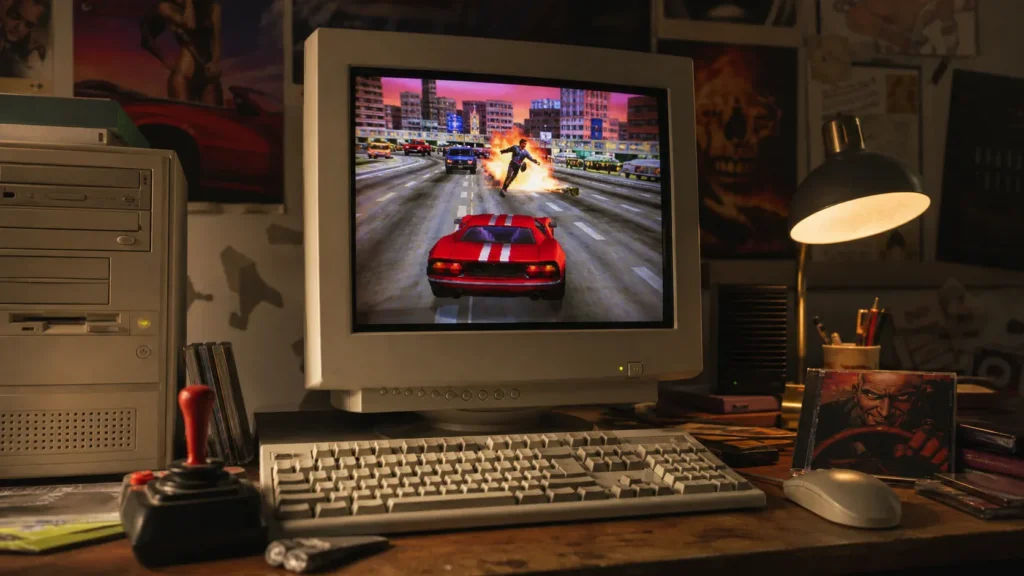
Some games become famous because they are loved.
Some become famous because they are excellent.
And some become famous because they seem to arrive already surrounded by argument.
Carmageddon belonged to the third category before it had even finished proving whether it belonged to the second.
That is what makes it so memorable to me now. The game did not merely release into a market. It detonated into a cultural mood that was already suspicious of games, already ready to panic, and already looking for examples that could be treated as evidence that interactive entertainment had finally gone too far.
Carmageddon was all too willing to be that example.
And yet the strangest part of its history is that the controversy became larger than simple outrage. The game did not just shock people. It exposed how games in the late 1990s were still being argued over as cultural territory.
- Why Carmageddon arrived at exactly the right moment to become a scandal
- What made the game’s tone feel more anarchic than merely nasty
- How censorship and regional edits became part of its mythology
- Why controversy made the game larger than its design alone
- What the moral panic around Carmageddon says about the 1990s
- Why its legacy still feels bigger than shock value now
The historical details below are checked against Stainless Games' official history; the interpretation and first-person perspective remain the author’s own.
The 1990s were still a time when games could become public scandals very easily
This context matters as much as the game itself.
In the late 1990s, video games still felt culturally unstable in a very visible way. They were big enough to attract mainstream anxiety, but not yet normalized enough to be granted the same shrugging tolerance that later generations of controversial games would often receive. A game could still become a morality headline in a way that felt immediate and socially theatrical.
Carmageddon was almost designed to walk straight into that atmosphere.
Stainless Games’ own current history page says the original Carmageddon was released in 1997 and then “promptly banned.” The official Steam page for Carmageddon Max Pack still describes the series in language that captures its whole deliberate provocation: pedestrians and cows as points, opponents as automotive killers, and the game as an antidote to racing games.
That is not subtle positioning.
It was never trying to be.
Carmageddon felt less like a racing game than an act of bad behavior
That is one reason it stood out so sharply.
Most racing games invite competition.
Some invite aggression.
Carmageddon invited mischief, destruction, and a kind of gleeful refusal to treat racing etiquette as meaningful at all.
The official Stainless description still captures that anarchic identity perfectly: drive wherever you like, waste your opponents, kill every pedestrian, or complete the laps if you absolutely insist on being boring. Even in its own pitch, the game seemed to understand that the race itself was not the center of the experience.
That design choice mattered more than people sometimes admit.
The game was not only violent in the abstract. It was structurally disrespectful. It took a familiar genre and rewired the value system inside it. Winning no longer had to mean racing well. It could mean causing the most chaos, weaponizing the environment, and treating the whole premise of proper competition as something to laugh at.
That is part of why the reaction became so intense. Carmageddon did not merely contain offensive material. It built a whole playful logic around refusing the moral frame other racing games had quietly inherited.
The tone mattered because the game was grotesque, but also cartoonishly unserious
This is an important nuance.
Carmageddon was controversial, but it was not controversial in the same way a grim or solemn game might be. Its energy was exaggerated, surreal, and ugly in a deliberately unserious way. The world did not feel like a realistic simulation of cruelty. It felt like a nasty comic book had been welded onto a demolition derby and then given a PC case to live inside.
That does not erase why people objected to it.
But it does help explain why the game has such a peculiar afterlife.
What players remember is not only the scandal. They remember the outrageousness. The game seemed to understand that excess itself was part of the performance. It was taunting the boundary between tastelessness and parody, and that made it harder to process through simple moral categories.
This is one reason it still feels very 1997 to me. It comes from a period when games could be both more juvenile and more culturally explosive at the same time.
Censorship did not weaken the legend; it helped build it
This may be the most important part of the whole story.
The BBFC’s current record confirms a 1997 release entry for Carmageddon, while Australia’s classification database shows the game receiving an MA 15+ rating on June 25, 1997 with consumer advice for high-level animated violence. Those two official records already tell you something crucial: different territories were not reacting to the game in the same way.
That difference became part of Carmageddon’s mythology.
In some regions, censorship took the form of edits. In others, the game’s reputation hardened through outright resistance or bans. Time Extension’s detailed historical feature on the game’s dispute with the BBFC describes the protracted legal and classification struggle around the UK release. Whether players encountered the original, a modified version, or simply the story of the controversy first, the effect was the same:
the game became more than software.
It became an argument.
That is often what censorship does to provocative art or entertainment. It can reduce access in one sense while increasing symbolic power in another.
People begin wanting to see not only the work itself, but the version of the work that somebody else tried to contain.
It became one of those games people talked about even if they had never played it
This is how controversy changes scale.
A normal game lives inside its players.
A scandalous game starts living in rumor too.
People hear about it from magazines, schoolyard retellings, forums, television segments, shop counters, and conversations that make the game sound either monstrous or irresistibly rebellious depending on who is speaking.
Carmageddon became that kind of object.
Its identity stretched beyond the direct experience of playing it. It became shorthand for an anxiety: the idea that games were becoming too violent, too irreverent, too ungovernable. At the same time, it became shorthand for a different fantasy: that games could still shock the adults, outrun the gatekeepers, and refuse to apologize for being impolite.
That dual meaning gave it unusual longevity.
The game was controversial, but the panic around it was also about control
I think this is what makes the subject more interesting now than it was at the time.
Looking back, Carmageddon was obviously provocative. But the fury around it was not only about content. It was also about the fear that games were becoming harder to supervise with old instincts. They were interactive, increasingly sophisticated, increasingly available, and not always willing to behave like politely containable entertainment.
Carmageddon made that anxiety visible.
It asked, almost mockingly:
what happens when a game not only includes offensive possibilities, but builds its identity around laughing at the limits of genre respectability itself?
That question landed harder in the 1990s because the medium still felt culturally unsettled. Regulators, parents, publishers, magazines, and players were all still participating in the process of defining what games were allowed to be.
The scandal was not only about one title.
It was about jurisdiction over a medium.
Part of the game’s power came from how unapologetically British and weird it felt
This is harder to formalize, but I think it matters.
Carmageddon did not feel like a smooth corporate provocation. It felt grubby, exaggerated, mischievous, and almost proud of its own bad taste. That gave the controversy a different texture than it would have had if the game were cleaner or more cynical.
There was a kind of punk ugliness to it.
That ugliness did not make it morally harmless, of course. But it did make it culturally distinctive. The game was not trying to sanitize itself into acceptability. It was practically daring people to decide whether it was a joke, a menace, or both.
That dare is part of why it stayed alive in memory.
What survived was not only the offense, but the defiance
Stainless’ official site still frames the series as a pioneering freeform driving sensation and openly remembers the 1997 original as something that was banned and still went on to become historically significant. That is the key to the whole legacy for me.
What people remember now is not only that Carmageddon offended people.
They remember that it refused to disappear into the offense.
It kept moving.
It kept circulating.
It kept mutating through cuts, classifications, appeals, ports, re-releases, and memory.
That is what makes it feel like a game that defied censorship rather than simply suffered from it. The controversy became part of the object’s identity, but it did not end the object’s life.
Carmageddon became both. Its design caused outrage, but the censorship battles themselves helped turn it into one of the defining controversy stories of 1990s PC gaming.
Why it still matters now
I do not think Carmageddon matters because it proved that every offensive game is secretly profound. That would be a lazy lesson.
It matters because it shows how games in the 1990s were still fighting for the right to be culturally unruly, and how attempts to contain them could sometimes make them even more famous. It also reminds us that controversy and legacy are not identical. A game can be crude, excessive, juvenile, and still historically important because of the argument it forced everyone around it to have.
That is what Carmageddon did.
It made people argue not only about one game, but about what games were becoming.
Carmageddon spread through the same physical discovery channels that defined PC gaming before digital storefronts. Magazine demo CDs put unfamiliar games into players’ hands, while LAN-party culture turned them into shared stories.
Conclusion
Carmageddon became the controversial game that defied censorship because it arrived at the perfect intersection of provocation, moral panic, and medium-wide uncertainty. Its design was confrontational, its humor was grotesque, and its regional censorship battles turned it into something larger than a racing game with a bad attitude. What remains now is not just the memory of outrage, but the memory of a game that kept existing, circulating, and refusing to be reduced to the panic it inspired.
FAQ
Why was Carmageddon so controversial in 1997?
Because its premise and reward structure openly embraced vehicular chaos and harm in a way that felt unusually provocative for the time, especially in a period when games were still frequent targets of public moral panic.
Was Carmageddon actually banned?
In some regions it faced bans, refusals, or significant censorship pressure, while in others it was classified and released. The exact treatment varied by territory, which is part of why the controversy became so famous.