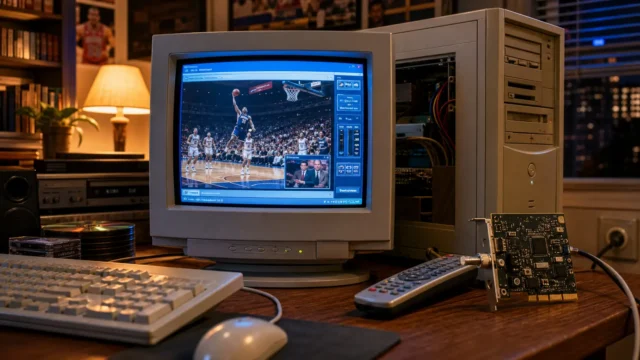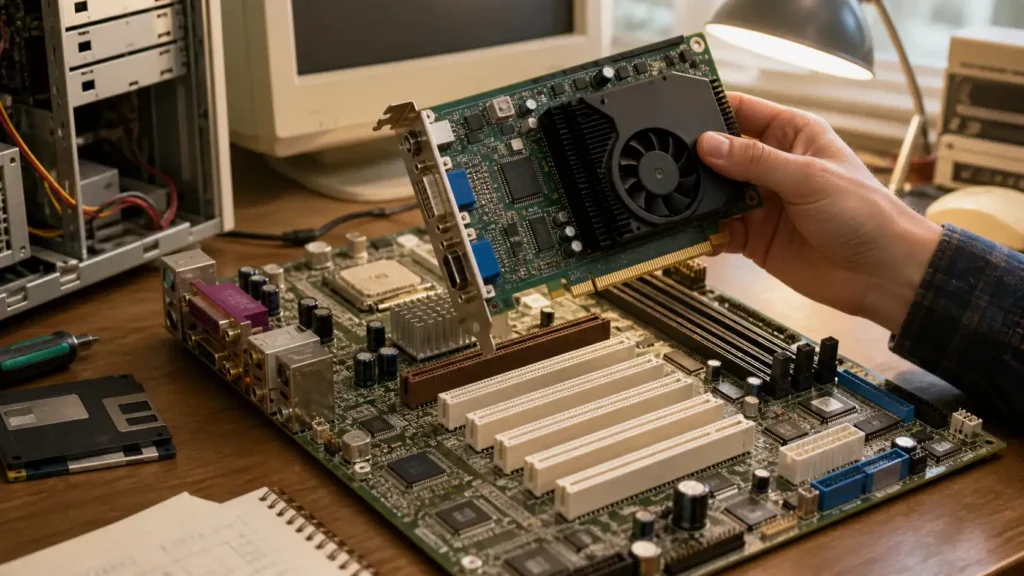
There was a very specific feeling inside a late-1990s PC case that younger hardware no longer has.
You opened the side panel and saw order.
White PCI slots lined up like dependable office workers.
Sound cards went there.
Modems went there.
Network cards went there.
Whatever the machine needed, PCI was the place where normal expansion happened.
Then AGP arrived and broke the mood.
Suddenly the graphics card no longer looked like just another add-in card sharing space with everything else. It looked promoted. It had its own slot, its own color on many boards, its own marketing language, and eventually its own mythology. If PCI had been the sensible public transport of motherboard expansion, AGP felt like a private lane built for one impatient class of passenger.
That is why the AGP versus PCI story has always felt bigger to me than a connector argument. It was not only about bandwidth. It was about the moment graphics stopped being treated like one device among many and started acting like the component that could reorganize the machine around itself.
- Why PCI once felt like the natural home for almost everything
- What changed when 3D graphics became the most exciting thing in the PC
- Why AGP felt different before most people understood the technical details
- How the late-90s motherboard gave graphics a new social status
- Why PCI did not really fail so much as lose a specific job
- What the AGP era still says about hardware design now
The historical details below are checked against Intel's official documentation; the interpretation and first-person perspective remain the author’s own.
PCI was the everything slot before graphics demanded special treatment
It is easy to forget how respectable PCI once felt.
Before AGP turned graphics into a headlining act, PCI had already become the practical answer to a messy older world of expansion. It was the modern, orderly slot. It was the place where the motherboard welcomed devices that needed to matter without requiring the user to understand a maze of legacy compromises first.
That broadness was part of PCI’s strength and eventually part of its problem.
PCI was built to be useful across many device types. That made it flexible, successful, and normal. But normal is a dangerous thing to be in a moment when one category of hardware suddenly becomes glamorous. In the late 1990s, graphics stopped behaving like a background utility and began acting like the reason some people bought or upgraded a PC at all.
Once that happened, sharing a conventional expansion bus started to feel less dignified than it had before.
From today’s perspective, the underlying technical distinction is clear enough. Conventional PCI was a shared expansion path. AGP was introduced by Intel as a dedicated graphics port. But culturally, the difference arrived before many ordinary users could have explained it in those terms. They simply saw that graphics now had its own place, and that meant graphics had become important in a new way.
The late 90s made graphics feel too important to stay ordinary
This was the emotional engine behind the whole slot war.
The late 1990s were not a quiet period for the PC. Visual computing was becoming more ambitious. Games looked more alive. 3D acceleration was no longer a strange luxury discussed only by specialists. The machine on the desk was increasingly expected to render worlds rather than merely display windows.
That expectation changed the political map inside the computer.
A sound card could still be "an add-on."
A modem could still be "an add-on."
A network card could still be "an add-on."
But the graphics card was drifting toward something else. It was becoming the device people bragged about, saved up for, argued over, and treated as the visible proof that a PC was ready for the next generation of games.
That is the part I find most memorable.
AGP did not just arrive as a better specification. It arrived at the exact moment when users were ready to believe the graphics card deserved special architecture. The slot made a promise before the benchmarks did. It told you, visually and psychologically, that the machine now recognized graphics as a first-class citizen with unique demands.
In that sense, the brown AGP slot did something almost theatrical. It turned motherboard layout into a statement.
AGP’s numbers mattered, but the symbolism mattered first
Intel’s own March 24, 1997 press material already captured the ambition clearly. The company described AGP as a high-performance port for visually intensive applications, said the specification was designed to scale beyond AGP 2X, and described AGP 2X at 512 MB/s while pointing toward AGP 4X at 1 GB/s. Years later, Intel’s AGP 8X announcement would frame the next step at 2.1 GB/s.
Those are not small claims.
Even without turning this essay into a table of transfers and ratios, the message was obvious: AGP was not being sold as a cosmetic alternative to PCI. It was being sold as a path built specifically for graphics growth.
Conventional PCI, by comparison, belonged to a different emotional category. Intel’s own chipset documentation from the era and the years after keeps describing ordinary PCI operation in the familiar 32-bit, 33 MHz language that defined conventional add-in life for all sorts of devices. If you do the arithmetic, that lands in the rough neighborhood of 133 MB/s for a standard 32-bit, 33 MHz PCI path. That was fine for many things. It just no longer felt like the future for graphics.
And that is the key distinction.
AGP was not merely faster on paper. It was narratively faster. It gave buyers, reviewers, and builders a simple way to imagine where visual computing was going. Dedicated slot. Dedicated language. Dedicated road for the most exciting component in the box.
Sometimes technology wins partly because it gives the market a cleaner story to tell.
The motherboard itself started teaching people how to rank components
I think this is why the AGP era remains so vivid in memory.
A motherboard is never just a technical object. It is also an editorial layout of priorities. It shows what the system considers central, what it considers optional, and what it expects the user to care about.
When a board exposed one AGP slot beside a row of white PCI slots, it was not subtle. It was telling you that one category of device had outgrown the general population.
That visual hierarchy mattered.
Users did not need to read specifications to understand that AGP was special. The slot looked special. It stood apart. It invited a particular kind of upgrade fantasy: not "which card can I add?" but "which graphics card belongs in the graphics place?"
That mental shift changed the culture of PC upgrading.
It made the graphics card easier to talk about as the star purchase.
It made the inside of the case feel more stratified.
It made performance identity more legible.
And it helped the PC become a machine people increasingly described through graphics-first language. Once visual experience becomes central, people start defending the parts that shape it with unusual intensity.
PCI did not lose because it was bad
This part deserves more kindness than retro conversations sometimes give it.
PCI was not some humiliating loser that AGP had to rescue the world from. PCI remained useful because it was supposed to remain useful. It handled general expansion. It stayed relevant for the long list of components that did not need a dedicated graphics path to justify their existence.
The problem was narrower.
Graphics had become too demanding, too visible, and too culturally important to remain satisfied with "general-purpose enough."
That is why I do not think of AGP as proof that PCI failed. I think of it as proof that graphics became exceptional. The machine stopped asking the graphics card to behave like a polite participant in a shared architecture and instead gave it a more privileged relationship with the board.
That is also why the AGP story feels so specific to its moment. It belongs to a period when a single hardware category was growing fast enough to demand a transitional architecture of its own. AGP was both solution and signal: a real technical answer to late-90s visual workloads, and a public announcement that graphics had become the emotional center of enthusiast computing.
The dedicated slot made graphics feel elevated before most people could recite bandwidth figures. It turned the graphics card into the motherboard’s most visibly privileged guest.
It also captured the particular drama of late-90s upgrades
Part of what makes retro hardware memorable is not raw capability, but the feeling of choosing a side during a transition.
That is what AGP versus PCI became.
If you were reading hardware discussions from that era, looking at motherboard photos, or staring at store shelves full of promises about faster 3D performance, the question was no longer just whether you wanted a better PC. The question became whether your system belonged to the older, more generalized layout or to the newer, graphics-conscious one.
Transitions like that make hardware feel historical while it is still present.
The same magic hangs around other old PC moments: the little performance mythology of the turbo button, or the way tiny storage limits made software feel more physical in the floppy-disk years. A hardware era becomes memorable when the object in question carries a story bigger than its function.
AGP absolutely carried a bigger story.
It said the old arrangement was no longer enough.
It said gaming and visual computing were driving design now.
It said the motherboard had learned to flatter the graphics card.
And for a while, that felt thrilling.
The strange thing about AGP is that it now feels both important and temporary
That may be the most interesting part of its legacy.
AGP once felt decisive. It solved a real problem, created a new upgrade identity, and gave graphics a dedicated lane exactly when the culture wanted one. Yet from a longer historical distance, it also looks like a transitional bridge. It was the architecture of a moment when graphics had clearly escaped the old order but had not yet arrived at the broader future that would follow.
That does not make AGP less significant.
If anything, it makes it more human.
Some technologies matter most not because they become permanent, but because they name the moment of transition so perfectly that later change cannot erase them. AGP belongs to that category. It was the connector that told ordinary PC users, in a way they could physically see, that graphics had stopped being a side topic.
And once a computer teaches you that one part matters more than the others, you never look at the inside of the case quite the same way again.
That broader period is easier to understand alongside Why SLI (Scan-Line Interleave) Made Dual GPUs the Ultimate Flex and The 3dfx Voodoo Era: When 3D Acceleration First Blew Our Minds, which capture two sides of the same shift in personal computing.
The software side of that transition appears in how Unreal Engine 1 and 2 licensed the 3D future, where new rendering expectations became a platform rather than a single benchmark.
Final thoughts
The AGP versus PCI debate was never only a battle of slots.
It was a late-90s argument about hierarchy, ambition, and what the PC was becoming. PCI represented a sturdy, shared, practical model of expansion. AGP represented the moment one piece of hardware wanted out of that arrangement and had the cultural momentum to get its own lane.
That is why the memory survives.
Not because everyone can still quote AGP transfer modes from memory, but because the slot made a complicated hardware shift feel visible and personal. You could open the machine and see that graphics had been promoted.
For a certain era of PC enthusiast culture, that was more than a technical detail.
It was the future, color-coded into the board.