There are some upgrades that improve a PC, and then there are upgrades that make the owner look slightly unreasonable in exactly the right way.
Original SLI belonged to the second category.
Not the later NVIDIA meaning of the acronym.
Not the broad modern idea of multi-GPU scaling.
The older one.
The stranger one.
The one that stood for Scan-Line Interleave.
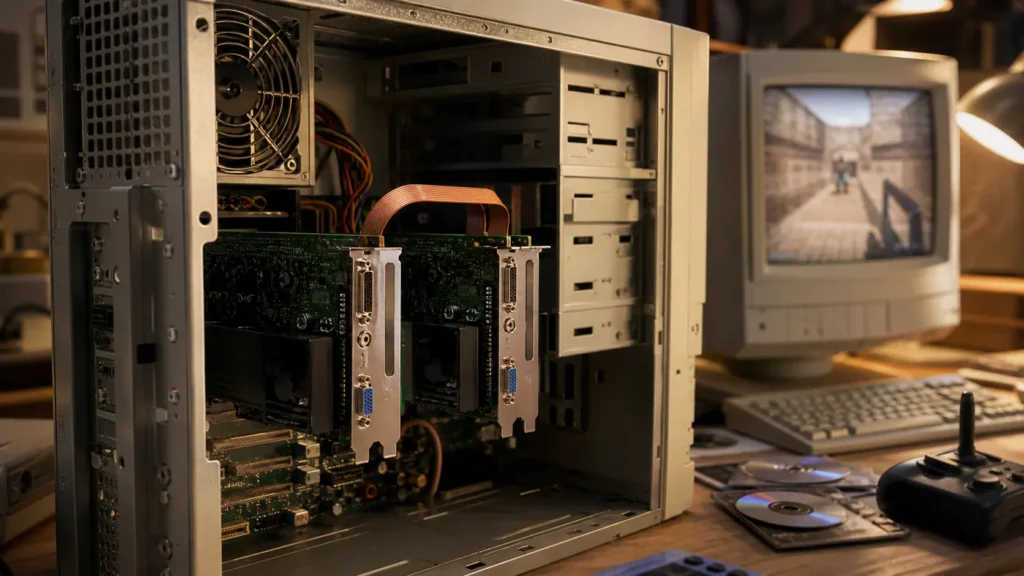
The one where two 3dfx boards were linked together so one card handled the odd scanlines and the other handled the even ones.
That arrangement did more than raise the machine’s capability. It changed the social meaning of the machine. One Voodoo board already said you cared about 3D gaming. Two said you had crossed into a more theatrical kind of seriousness, where performance and bragging rights were no longer separable.
That is why SLI remains so memorable to me. It was technology, yes. But it was also a visible act of ambition.
- Why one 3D accelerator was already impressive in the late 1990s
- What made original SLI technically clever and visually unforgettable
- Why dual GPUs felt like excess in the best possible way
- How the ribbon cable became part of the mystique
- Why SLI was as much about identity as performance
- What this old multi-GPU dream still represents now
The historical details below are checked against the Computer History Museum archive; the interpretation and first-person perspective remain the author’s own.
One serious 3D card was already enough to feel ahead
This part matters because nostalgia can make the old hardware ladder look too flat.
It was not flat.
In the late 1990s, dedicated 3D acceleration already felt like a leap. The Computer History Museum’s 3dfx material describes the company’s role in pushing PC graphics into a far more immersive consumer era. A Voodoo board was not a casual accessory. It was the thing that made the machine suddenly seem aligned with the future of games rather than with the fading logic of software rendering and compromise.
That means SLI arrived in a world where "owning one good accelerator" was not baseline normality yet. It was already a choice. It already implied priorities. It already said that visual smoothness, texture filtering, and the whole emotional promise of 3D mattered enough to spend money on.
So when two boards entered the picture, the meaning changed immediately.
This was not just more performance stacked on top of familiarity.
It was extravagance layered on top of aspiration.
That is why the old SLI setups felt legendary so quickly. They were not solving a humble problem. They were extending an already premium fantasy.
That fantasy started with the hardware culture around the 3dfx Voodoo era, when one dedicated accelerator had already made 3D graphics feel like the most exciting upgrade in the machine.
The original idea was technically elegant in a way that also looked wild
One of the reasons the old implementation has stayed so famous is that it was both practical and dramatic.
The 3dfx Reviewer’s Guide for Voodoo5 looks back on the earlier Voodoo2 method very plainly: two video cards were linked, one rendered odd lines of the output, and the other rendered even lines. The 3dfxzone glossary describes the same logic in similarly direct terms, explaining scan-line interleave as alternating scanlines across two graphics processors, each effectively storing only part of the image data in local framebuffer memory.
That is a beautiful kind of engineering idea.
It does not sound like marketing fluff. It sounds like hardware people staring at the problem and deciding that the screen itself could be split into turns. NVIDIA’s own later developer writing, while talking about modern rendering ideas, still nods to this as the original historical form of SLI: alternating scanlines split across different GPUs.
The concept was smart.
But the appearance was even better.
Two cards.
A cable between them.
A setup that looked like the computer had been convinced to participate in something slightly forbidden.
If you ever wanted proof that internal PC hardware could look exciting before RGB lighting turned excitement into default decoration, original SLI was already there.
The ribbon cable was not only a connector; it was a status symbol
Every memorable hardware era has one object that becomes larger than its physical role.
For SLI, that object was the linking cable.
It was small, technically mundane in one sense, and yet culturally enormous. The cable made the whole idea legible. Without it, two boards might just look like a confusingly expensive build. With it, the machine announced its intention. The setup stopped being accidental and became declarative.
You could open the case and see the flex.
That visibility mattered.
Many performance upgrades are abstract. Faster clocks, better memory timing, smarter drivers, and architectural advantages often disappear into benchmark charts and smoother gameplay. SLI had a visible body. It literally connected two parts of the machine in a way outsiders could notice without needing a frame-time graph explained to them.
This is one reason it felt closer to the spirit of AGP’s visual promotion of graphics than to a mere hidden optimization. Like AGP, original SLI turned internal design into theater. It gave the enthusiast something concrete to point at.
It made gaming hardware feel a little gloriously excessive
That excess was part of the charm.
Enthusiast PC culture has always loved the point where practical improvement and unnecessary display begin to overlap. The best hardware flexes often live there. They are justifiable enough to defend and outrageous enough to enjoy.
Original SLI sat exactly in that zone.
The Computer History Museum’s oral history around 3dfx makes something important clear: scalability was not an accident that appeared late. The architecture had been designed with expansion in mind. By the time Voodoo2-era linked boards became a real enthusiast object, the technical ambition had already been part of the worldview.
That explains why SLI did not feel like a gimmick bolted onto the side of the product line. It felt like the public unveiling of a deeper instinct: if one graphics processor makes games look transformative, then two ought to feel almost decadent.
And decadent is exactly what it looked like.
A dual-card system suggested that the owner did not merely want to run the game.
The owner wanted to run the game in the most self-conscious way available.
That distinction is subtle, but anyone who lived through hardware culture in those years understood it instantly.
SLI changed the story people told about their PCs
Most retro hardware memories are not just about experience. They are about narrative.
What did you have?
What did your friend’s machine have?
What did the magazine benchmarks make you dream about?
What configuration sounded almost mythical when discussed after school, in forums, or across a cluttered desk?
SLI was one of those configurations.
It had the right ingredients for legend:
- it was expensive enough to stay aspirational;
- it was visible enough to be photographable and discussable;
- it was technical enough to sound impressive;
- and it was tied to an era when graphics progress felt startlingly fast.
That combination turned it into more than a feature. It became a story people wanted to repeat.
Owning a dual-Voodoo setup did not simply imply that you had bought more hardware. It implied that you had entered the hobby at a deeper level, where the machine was becoming a deliberate construction rather than a collection of defaults. In that sense, SLI belonged to the same family of seriousness as the oversized CRT that a gamer would not surrender lightly in the CRT era or the workstation input device that announced intent in the trackball world.
The tools started speaking for the person.
The magic was partly that it looked unnecessary
This may be the strangest compliment I can give it, but it is also the most honest one.
The most memorable enthusiast configurations often look unnecessary to people outside the hobby.
That is exactly why they become icons inside it.
SLI did not hide its own extra-ness. It doubled up on the very component that was already the glamorous part of the PC. It said, with complete lack of modesty, that the right answer to advanced graphics might simply be more graphics hardware. Not subtler tuning. Not elegant restraint. Another board.
That attitude made it irresistible.
It turned the PC into something slightly more like an overclocked argument than a household appliance. The case was no longer only a box where components happened to live. It was a declaration of taste, impatience, and maybe just a little financial irresponsibility in the service of beauty.
There are worse things for a gaming machine to have been.
The later history does not erase the original meaning
Of course, the acronym did not remain fixed forever.
NVIDIA would later reuse SLI for Scalable Link Interface, and multi-GPU technology would continue in new forms, new generations, and new marketing cycles. But that later history does not diminish what the original version represented. If anything, it confirms how powerful the idea had been.
The old scan-line interleave approach became the prototype in memory for a broader fantasy: that if one GPU felt powerful, two would feel transcendent.
And even when the industry moved on, the emotional shape of that fantasy lingered. People kept chasing the idea that the highest-end gaming machine should look not merely fast, but doubled. Reinforced. Overcommitted in a way ordinary users would never attempt.
That is a strong legacy for a ribbon cable and a pair of graphics cards.
What I think the original SLI still symbolizes
Looking back now, I think original SLI symbolizes a very specific chapter of PC enthusiasm.
It belongs to a time when internal hardware still felt mysterious enough that adding another major board could transform the whole machine’s mythology. It belongs to an era when performance was increasingly measurable but still deeply romantic. It belongs to a period when the inside of a computer could look like a secret experiment rather than a polished consumer product.
That is why the memory survives even for people who never owned it.
SLI was one of those rare configurations whose meaning escaped ownership. You did not need to have built it yourself to understand what it represented. You only needed to see it once and realize that the person who had done this was not chasing moderation.
They were chasing the version of the future that looked best with the side panel open.
That broader period is easier to understand alongside Parallel & Serial Ports: Chunky Connectors That Powered the 90s, which captures another part of the same transition in personal computing.
Final thoughts
Original 3dfx SLI made dual GPUs the ultimate flex because it combined real technical ingenuity with visible, unapologetic extravagance.
It improved capability.
It looked amazing inside the case.
It gave enthusiasts a configuration dramatic enough to dream about and concrete enough to show off.
Most of all, it arrived at exactly the right moment, when one powerful 3D card already felt special and two felt almost mythic.
That is why the old meaning of SLI still matters to me more than any later acronym expansion.
It was not just multi-GPU performance.
It was ambition with a ribbon cable attached.