Before the smartphone became the default shape of personal technology, there was a quieter, narrower dream.
It did not try to do everything.
It did not begin with the phone call.
It did not arrive promising entertainment without limit.
It arrived with appointments, contacts, to-dos, notes, a stylus, and the strangely thrilling idea that your important personal information no longer had to stay trapped inside a desktop computer, a paper planner, or your own unreliable memory.
That dream had many forms, but the PalmPilot was the version that made it feel practical.
And once it felt practical, the path to the smartphone became much easier to imagine.
- Why the PalmPilot succeeded where many handhelds had failed
- How the PDA taught people to trust pocket computing
- Why synchronization mattered as much as portability
- How Palm normalized a new relationship with personal data
- Why smartphones inherited Palm’s habits more than its form
- What the PalmPilot still represents now
The historical details below are checked against the Computer History Museum archive; the interpretation and first-person perspective remain the author’s own.
The PalmPilot did not invent the handheld dream, but it stabilized it
This is one of the most important distinctions in the whole story.
The Computer History Museum describes the PalmPilot as the first wildly popular handheld computer, and that wording is exactly right. The handheld idea existed before Palm. So did the PDA label, the stylus, the fantasy of mobile computing, and the frustrating record of devices that had arrived with too much ambition and too little elegance.
Palm succeeded not by being first in every category, but by being believable.
CHM’s PalmPilot background material puts the point clearly: other handhelds had already tried and failed, while Palm succeeded as an accessory to the PC, not as its replacement. That phrase explains almost everything. The company did not demand that users abandon the desktop world they already trusted. It offered a smaller device that complemented it beautifully.
That was a wiser beginning than trying to replace everything at once.
The real breakthrough was trust
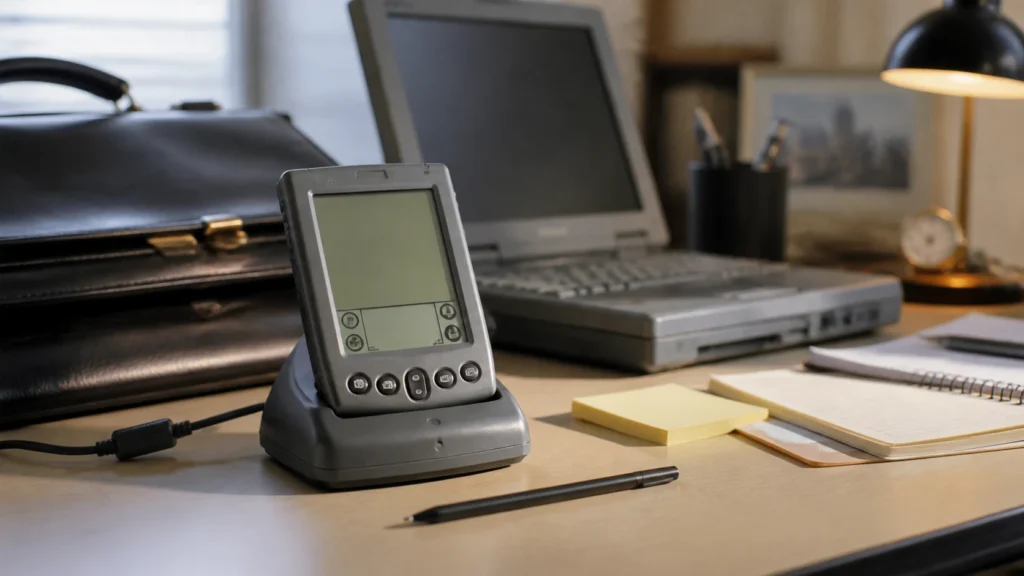
The PalmPilot fit in a shirt pocket, responded quickly, and focused on a short list of things people already cared about: contacts, appointments, notes, and task lists. CHM’s main PalmPilot exhibit highlights exactly those winning features, along with one-button synchronization, useful handwriting recognition, affordability at $299, and a design that felt fast rather than fragile.
But underneath all those details was a more human achievement.
People trusted it.
That trust is easy to underestimate now. A modern person expects a device in the pocket to hold calendars, messages, reminders, maps, notes, and half of life itself. In the mid-1990s, that expectation still needed to be built. The handheld category had to prove it was not just a gadget full of compromise.
The PalmPilot proved it by being narrow enough to succeed.
It did not ask whether a tiny screen could become an office.
It asked whether your schedule, your contacts, and your daily obligations could become portable without becoming a headache.
That was the right question.
Synchronization was the hidden lesson smartphones inherited
I think this is the most important part of the Palm story.
When people talk nostalgically about the PalmPilot, they often remember the stylus, Graffiti, the small gray form, the speed, the pocketability, or the ritual of taking it out in a meeting. All of that matters. But the idea that truly survives into the smartphone era is synchronization.
The Computer History Museum’s Palm timeline entry notes that Palm called the device a connected organizer rather than a PDA to emphasize that it synced with a PC or Mac. CHM’s own exhibit and background sheet keep returning to the cradle and the one-button sync. That is not an incidental feature. It is the conceptual bridge.
Palm was teaching users that:
- personal data could move cleanly between devices;
- handheld information did not have to become isolated information;
- and the pocket device was most powerful when it belonged to a larger digital life.
That is an astonishingly modern idea.
Cloud services would later automate and expand the same instinct, but the emotional logic is already here: your smaller device should not be a dead end. It should remain connected to the wider system you depend on.
The PalmPilot made personal data feel physical and immediate
One reason the machine still feels so vivid to me is that it turned organization into an object.
A calendar was no longer a page in a planner or a window on a desktop. It was something you could carry in a shirt pocket. A contact list was no longer trapped at the office or at home. A to-do list was not just a note pinned somewhere else. The device made those things immediate and handheld.
That changed the emotional scale of personal computing.
It made digital life feel less distant and more bodily. You touched it with a stylus. You placed it in a cradle. You took it with you. You checked it in the middle of the day rather than only when you returned to a desk.
The smartphone would later swallow this whole category and make it seem inevitable. But inevitability is often hindsight wearing confidence. The PalmPilot had to make that pocket relationship feel ordinary first.
It is difficult to overstate how foundational that shift was.
Palm also taught product design the value of subtraction
The wooden PalmPilot prototype may be one of my favorite design artifacts in computing history. CHM describes how Jeff Hawkins used a wooden block with a chopstick as a fake stylus, pretending to take notes in meetings and counting the steps required for common tasks. It is such a simple image, but it explains why Palm succeeded where louder efforts had not.
The team cared about fit, friction, and restraint.
That design discipline matters historically because early mobile computing could easily have gone the other way: bigger, busier, more feature-heavy, more desperate to imitate full computers on screens too small to deserve the burden.
Palm refused that trap.
It built a device around the proposition that a few things done elegantly could matter more than a dozen things done badly. Smartphones later forgot this lesson many times and rediscovered it again and again. But Palm had already shown the value of subtraction in the handheld space.
Graffiti mattered because it made compromise feel usable
Handwriting recognition in that era sounds like exactly the kind of feature that should have failed. And in many other products, it effectively did.
Palm made it work by redefining the problem.
CHM’s background material explains that Graffiti used simplified letter forms, all entered in the same box, to improve accuracy. It was not trying to perfectly understand ordinary handwriting in all its chaos. It was asking the user to meet the machine halfway.
That compromise is deeply instructive.
Instead of pretending technology was already magical enough to disappear, Palm created a system that felt learnable and fast enough to justify the effort. In other words, it treated usability as a relationship rather than as a miracle.
That lesson also flows directly into smartphone history. Mobile interfaces keep winning when they discover the right midpoint between natural human behavior and disciplined system design. Palm found one of those midpoints early.
The PalmPilot’s descendants became phones, but the idea started elsewhere
One of the mistakes retrospective history can make is assuming that smartphones were always basically phones waiting to become better. The Palm story points in another direction.
The PDA path says that smartphones also descend from organizers, calendars, contacts, notes, synchronization, and the desire to carry a compressed personal command center through the day.
The Computer History Museum’s profile of Ed Colligan makes that lineage explicit. After helping establish Palm and Palm OS, he later cofounded Handspring, whose Treo line CHM describes as a forerunner of all future smartphones. That is a wonderfully direct historical thread. The smartphone did not only inherit telecom ambition. It inherited handheld-organizer logic.
And that logic came with habits:
- fast wake-up use;
- glancing rather than sitting down;
- personal data at hand;
- constant portability;
- and an assumption that the device should serve daily life in brief, repeated moments.
Those are Palm habits.
The PalmPilot made mobile computing feel intimate rather than theatrical
This may be the quality I admire most in hindsight.
The PalmPilot was not trying to be a spectacle. It was trying to become dependable. It wanted to disappear into routine without becoming invisible in value. That kind of design ambition is harder than it looks.
A dramatic machine can impress you once.
A modest machine that improves your day teaches you a habit.
Palm taught habits.
That is why it belongs in the same broad family of era-defining devices as the Commodore 64 in home computing culture or the Nintendo 64 analog stick in the learning of 3D movement. These are not just products with specs. They are products that retrain expectation. After them, the old way begins to feel incomplete.
What the PalmPilot still symbolizes
Looking back now, I think the PalmPilot symbolizes the moment mobile computing became humble enough to win.
It did not need to replace the PC.
It did not need to become a phone first.
It did not need to entertain endlessly.
It only needed to become truly useful in the hand.
Once it did that, the future could build on top of it.
The smartphone added telephony, cameras, richer networks, app ecosystems, media, location awareness, and all the rest. But underneath those later expansions is a quieter inheritance: the belief that your pocket device should know your schedule, remember your contacts, carry your notes, and stay connected to your broader digital world.
Palm helped make that belief ordinary.
Final thoughts
The PalmPilot helped PDAs pave the way for smartphones by teaching people the habits mobile computing would need before the phone absorbed everything else.
It made the handheld trustworthy.
It made synchronization feel essential.
It made personal information feel pocketable.
It proved that a device could be narrow in scope and still historically transformative.
That is why the PalmPilot still matters to me.
Not because it already was a smartphone, but because it quietly taught the world why carrying one would someday make perfect sense.