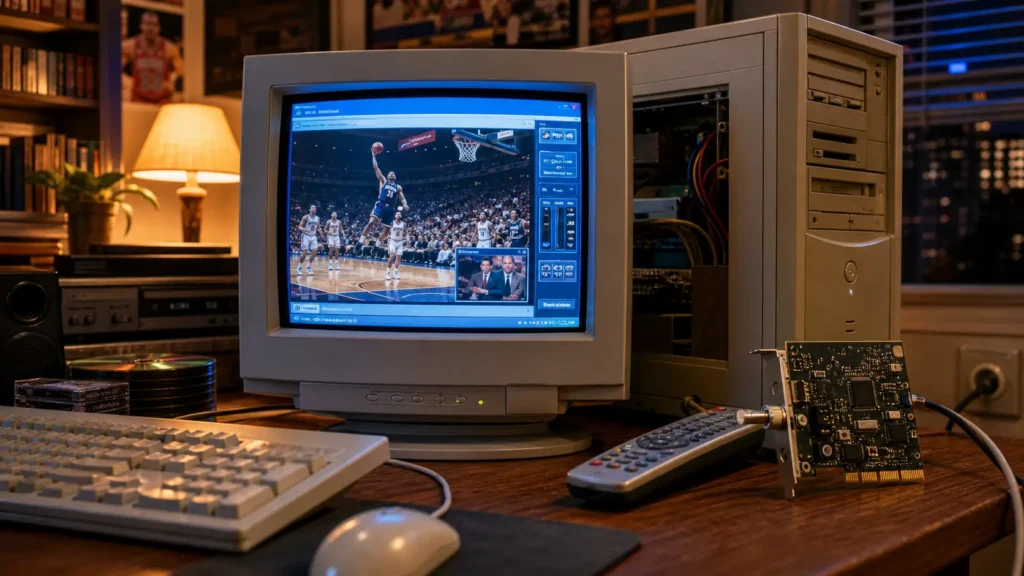
There was something deeply strange and deeply exciting about seeing live television inside a computer window.
It should have felt redundant.
Instead, it felt futuristic.
The television was already in the house. The cable feed already existed. The monitor was already occupied with Windows, games, folders, and software. None of that should have made the idea especially magical. And yet TV tuner cards managed to make the ordinary act of watching television feel newly technological simply by moving it onto the desk.
That is why I still remember them so vividly.
TV tuner cards belonged to a short but memorable era when the PC started behaving as if it wanted to absorb every other screen in the room. It no longer wanted to be only a computer. It wanted to be television, stereo, CD player, recorder, and media center all at once, even if it had to become all of those things somewhat awkwardly.
- Why television on a CRT monitor felt more futuristic than it sounds now
- How tuner cards turned the PC into a multimedia convergence machine
- Why watching TV in a window changed the feeling of desktop space
- What limitations made the experience charming rather than seamless
- Why tuner cards mattered culturally beyond pure convenience
- What this brief era still says about the ambitions of the PC
The novelty was not television itself, but where television appeared
That is the key to the memory.
Nobody needed a tuner card in order to discover TV. What the hardware changed was the location of TV in everyday life. Broadcast and cable content could now appear inside the same machine that already handled documents, games, CDs, chat windows, and internet browsing. Television moved from the living-room appliance into the grammar of desktop computing.
That relocation mattered emotionally.
A CRT monitor had a different authority than a TV set on the desk. It suggested precision, input, control, and multitasking. So the moment live TV showed up inside a software window, the content itself felt transformed. The show may have been ordinary. The experience was not. It felt like the computer was swallowing another category of media whole.
This is what makes TV tuner cards so memorable to me now. They made convergence visible before convergence became a boring industry word.
The PC was becoming greedier about media, and tuner cards fit that mood perfectly
By the late 1990s and early 2000s, the desktop PC was already trying to become more than a work machine.
CD audio mattered. MP3 playback mattered. Games were becoming more cinematic. Multimedia was a selling point, not a side note. Archived PC Computing text from the mid-1990s describes optional TV tuner hardware that could convert broadcast video or cable signals into a window right on the PC screen. That line captures the whole era beautifully. The idea itself was enough to sound like a demo from the future.
It also fit naturally beside products and ecosystems like ATI TV Wonder and Hauppauge WinTV, both of which became closely associated with the notion that a Windows PC could pull live television into software and sometimes record, schedule, or reshape the experience further.
That is why tuner cards felt like part of a larger movement.
The machine was not only getting better at displaying things. It was getting more ambitious about what kinds of things it should be allowed to display at all.
Watching cable TV in a window changed the psychological shape of the desktop
This is the part that still feels oddly modern.
Once television was in a window, it stopped behaving like a dedicated room ritual and started behaving like another stream of information the computer might host. You could make it smaller. Move it. Let it share space with other tasks. Sometimes that meant genuine multitasking. Sometimes it meant pure novelty. Either way, the desktop gained a new layer of life.
That matters more than people sometimes admit.
The old desktop was becoming a media surface rather than a single-purpose interface. A show in one corner, maybe chat or browsing nearby, perhaps a file transfer or a music app still running in the background: this was an early hint of the fragmented screen culture that would later become completely normal.
It also changed the feel of the CRT itself. A monitor was no longer only the portal for software. It was becoming a window onto live outside signals too. That makes this topic connect naturally with how differently CRTs could feel as media objects. They were not just displays. They were versatile endpoints for whatever the desk wanted to become.
Tuner cards made television feel computational. Once TV lived in a movable software window, it stopped being only a channel feed and started feeling like something the desktop could organize.
The experience was impressive, but it was rarely frictionless
This is part of the charm.
TV tuner cards belonged to a time when multimedia on a PC could feel half miraculous and half temperamental. There were drivers, software packages, remote-control accessories, coax connections, audio routing questions, windowed overlays, format quirks, and all the usual possibilities for a machine to become slightly dramatic about new hardware.
That did not ruin the appeal.
If anything, it intensified it.
Because when the setup worked, the result felt earned.
A modern streaming app asks almost nothing of the user compared with that era. Old tuner-card setups often asked for attention, patience, and a little stubbornness. They were part of the period when getting a PC to do one more improbable thing still felt like an event rather than a checkbox.
That is one reason the memory stays warm. It was not seamless enough to be forgettable.
TV tuner cards mattered because they made the home PC feel culturally larger
This is their real legacy for me.
The desktop computer was expanding not only technically, but socially. It was becoming a place where media habits gathered. Music listening, game playing, browsing, file storage, video clips, and eventually television all began negotiating the same physical space on the desk.
That expansion of role is what links TV tuner culture so naturally to the broader emotional arc behind why older Windows systems felt personal and even to software moments like Winamp making the PC feel like a music machine. The computer stopped being a neutral box that merely ran programs. It started absorbing more of domestic media life.
Tuner cards made that ambition visible.
They were the hardware version of a bigger promise: the PC could be the screen you did not expect to need, until you had it.
What this brief era still says about the PC
TV tuner cards now feel like artifacts from a transitional dream.
They belong to the phase before streaming untangled television from dedicated broadcast hardware, before flatscreens changed the ergonomics of media spaces, and before software-first delivery made so much of the old signal-routing magic disappear behind apps and broadband.
But that does not make them trivial.
They reveal something important about the personality of the PC at the time. The desktop computer did not merely want to coexist with other media devices. It wanted to replace them, merge with them, or at least borrow their jobs. Sometimes it did that elegantly. Sometimes it did it awkwardly. But the ambition itself was unmistakable.
TV tuner cards were one of the clearest expressions of that ambition.
Verification note: Historical and technical details in this retrospective were cross-checked against Microsoft’s Broadcast Driver Architecture documentation.
For broader context, continue with The Day I Switched to LCD and Understood Why Gamers Loved CRTs and Parallel & Serial Ports: Chunky Connectors That Powered the 90s.
Conclusion
Watching cable TV on a CRT monitor through a tuner card felt futuristic because it moved television into the logic of the desktop. The content itself was familiar. What felt new was the idea that live TV could become just another thing the PC hosted, resized, organized, and folded into the growing media life of the desk.
That is why TV tuner cards remain so memorable. They captured a moment when the computer was trying to become bigger than a computer without yet becoming the invisible all-purpose device we expect now. For a while, the CRT monitor was not just where software lived. It was where television came to visit too.
FAQ
What did a TV tuner card actually do in a home PC?
It let the computer receive television signals, often from broadcast or cable sources, and display TV inside software on the PC monitor rather than requiring a separate television set.
Why did watching TV on a CRT monitor feel so futuristic at the time?
Because it moved familiar television content into the software space of the desktop. Seeing live TV inside a movable window made the PC feel like it was absorbing another media device.
Were TV tuner cards mainly about convenience?
Partly, but not only. They also represented the broader multimedia ambition of the era, when the PC was increasingly expected to handle music, games, video, CDs, and live television in one place.
Which products were associated with this era?
Families like ATI TV Wonder and Hauppauge WinTV became especially tied to the idea of television on the PC desktop, and they helped make the category visible to everyday users.
Why do TV tuner cards feel like a transitional technology now?
Because they belonged to the period before streaming, modern flatscreens, and app-based video delivery made the old broadcast-to-desktop setup far less central. They capture an in-between stage of media convergence.