Online gaming gave multiplayer reach.
LAN parties gave it a body.
That is the simplest way I know to explain the difference.
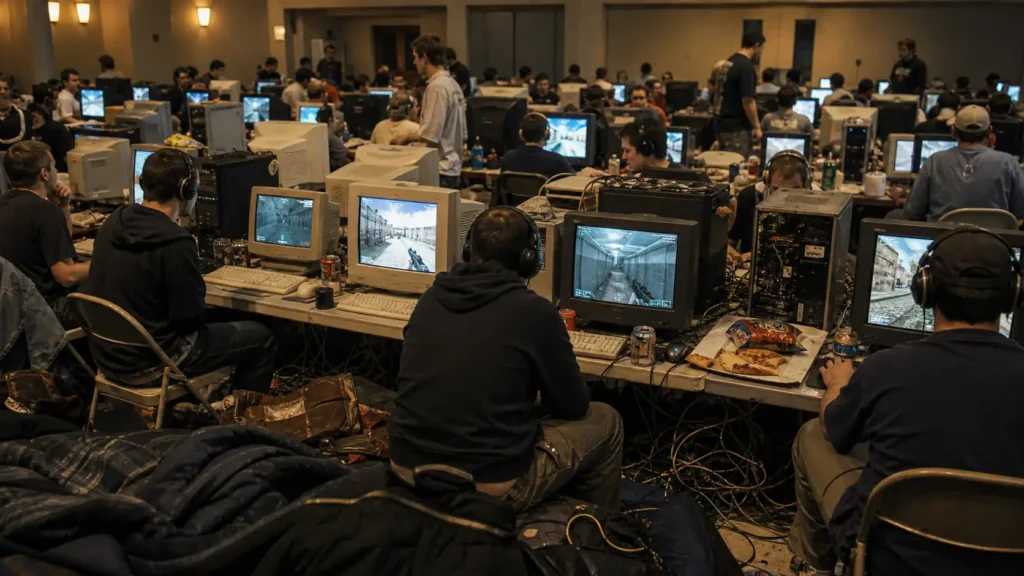
When people remember LAN parties from the 2000s, they often start with the surface details because the surface details were impossible to ignore. Heavy CRTs. Loud fans. Tangled Ethernet cables. Folding tables that never seemed built for the weight they were carrying. Tower cases under chairs. Energy drinks, pizza boxes, chips, and the strange sleep-deprived dignity of a room that had given up on looking respectable sometime around midnight.
But the real memory is deeper than clutter.
LAN parties built a kind of gaming culture that online play still struggles to reproduce, not because the games were inherently better on a local network, but because the entire social architecture was different. You did not merely connect to a server. You arrived. You hauled your machine into place. You claimed physical territory. You became visible to the people you were about to cooperate with, lose to, laugh with, and argue with for the next twelve hours or the next whole weekend.
That visibility changed everything.
- Why LAN parties felt bigger than the games being played
- How physical effort created a different kind of commitment
- Why the room itself became part of the multiplayer experience
- How online gaming solved distance but weakened certain rituals
- Why LAN culture still feels emotionally unmatched
- What the 2000s LAN party still represents now
The historical details below are checked against the Computer History Museum archive; the interpretation and first-person perspective remain the author’s own.
A LAN party began before the first match loaded
That is one of the most important differences.
Online gaming begins when the client launches, the friends list wakes up, or the queue starts moving. A LAN party began much earlier, in the act of preparation. The Computer History Museum’s glossary defines a LAN simply enough as a local area network connecting computers and devices in a shared physical environment. But a party built on that network was never just a network.
It was logistics.
It was planning.
It was carrying.
It was showing up.
That physical preparation created its own mood. Even before the first server appeared, everyone had already paid a small tax in effort. The machine had to be moved, cables had to be packed, power strips had to exist, the monitor had to survive the trip, and the desk space had to be negotiated in a room that often felt like a temporary village assembled out of consumer electronics and stubbornness.
That effort mattered socially.
The cost of attendance was not abstract. It had weight in your hands. Because of that, the room felt full of people who had already committed to being there in a way that "click to join" could never fully imitate.
The room became part of the game
This is what online gaming still cannot quite rebuild.
At a LAN party, the environment itself played along. You heard reactions before voice chat compressed them into convenient audio. You saw frustration before it turned into text. You felt momentum ripple through a section of the room when a match became tense or ridiculous. Victory was louder when the defeated team was three chairs away. Trash talk was warmer because the other person still had to borrow your screwdriver ten minutes later.
That proximity gave multiplayer a texture that was partly competitive and partly domestic.
A LAN party was intense, but it was also communal in a strangely practical way. People shared ports, adapters, snacks, spare mice, extension cords, drivers, patches, and troubleshooting knowledge. The machine beside you was not just another player object in the network list. It belonged to a person who might help you fix a boot issue, recommend a map, hand you a drink, or disappear for an hour and ask you to watch their seat.
This is one reason the culture felt denser than online matchmaking. Everyone in the room was participating in more than one layer of play at once. There was the game itself, and then there was the social operating system of the room.
Physical presence softened rivalry in a very particular way
This may sound counterintuitive, but I think it was one of the healthiest things about LAN culture.
Competition in person often felt sharper in the moment and gentler in the aftermath.
When you lose to a username online, the experience can collapse into a result screen and a feeling. When you lose to someone sitting two meters away, the defeat lands inside a richer context. That person has a face, habits, equipment problems, bad posture, snack preferences, and a laugh you have already heard six times. The opponent becomes harder to flatten into abstraction.
That changes behavior.
It does not remove conflict, of course. LAN parties had arguments, ego, score obsession, local myths, and the occasional unpleasant personality just like any gaming scene. But physical presence often forced a minimum level of social friction that prevented some of the cold detachment modern online spaces make easy. You had to remain in the same room after the match. That fact alone improved a surprising amount.
Even the noise helped. Reactions were shared, not packaged. A room could groan together, cheer together, or laugh together in a way that made the event feel collective even when the teams were divided.
Multiplayer used to look like infrastructure
This is one of the things I miss most when I think about 2000s LANs.
Gaming was not floating invisibly through broadband and platform layers yet. It looked physical. It looked built. Switches mattered. Cables mattered. Network cards mattered. Cases mattered. The inside of the machine still felt related to the experience outside it.
You can feel the same spirit in other hardware memories from the era: the visual promotion of graphics in the AGP years, the extravagant internal confidence of SLI-era hardware flexing, or the lingering dignity of heavy displays in the CRT era. In all of those cases, the PC was not hiding its machinery. LAN parties extended that truth outward into the room itself.
Multiplayer was something you could see happening.
The cables under the tables were part of the atmosphere. The monitor glow was part of the atmosphere. The fact that every player had physically brought their own version of a gaming machine was part of the atmosphere. The event looked like a temporary civilization built out of local networking and bad sleep.
That visibility created ownership.
Online play became more convenient and less ceremonial
To say that LAN parties built something online gaming could not is not to deny what online gaming solved. Online multiplayer was a miracle of scale. It removed distance, made group play more frequent, lowered the barrier to entry, and allowed communities to persist far beyond one room or one weekend. None of that should be minimized.
But convenience changes ritual.
Once multiplayer became easy to access, it also became easier to treat casually. That is not automatically bad. Casual access is one of the reasons online gaming became central to modern play. Yet some of the old intensity faded with the friction that had once produced it.
A LAN party asked for sacrifice.
Online gaming asks for availability.
Those are not the same cultural conditions.
When the price of participation is lower, participation becomes more common. But it can also become thinner. The room no longer needs to be negotiated. The machine no longer needs to be transported. The shared exhaustion no longer needs to be earned. The social memory no longer accumulates around the same physical mess.
Online gaming gave us persistence.
LAN parties gave us occasion.
And occasion has its own power.
LAN culture made people remember the whole weekend, not only the scoreboard
This is why so many old LAN memories blur together into atmosphere rather than match results.
People remember:
- the trip there;
- the awkward unloading;
- the desk setup ritual;
- the glow of a room that never properly went dark;
- the moment everyone stopped pretending sleep was still part of the schedule;
- the friend who always forgot something important;
- the improvised fixes that somehow worked;
- the rounds played at the edge of exhaustion because no one wanted to be the first to stop.
The matches mattered, but the event was larger than the game.
That is what true subculture usually looks like. It develops its own rituals, inconveniences, private jokes, recurring failures, and emotional weather. You attend for the activity, but you return for the atmosphere.
DreamHack’s own official description still frames the event around connection, celebration, and shared experience, and QuakeCon’s current homepage still highlights the BYOC hall as a living 24/7 space of tournaments, freeplay, meetups, and unforgettable moments. Even LANFest chapters, describing modern community events, still explain LANs in terms of gathering in person on the same network and building healthy communities through gaming. The language may be newer, but the emotional center is familiar.
The room still matters.
LAN parties created accountability without formal systems
One thing I appreciate more in hindsight is how much social regulation happened naturally in physical space.
You could not vanish into anonymity as easily.
You could not hide tone as easily.
You could not rage with the same clean distance and then simply alt-tab into another life.
The people around you became part of your behavior loop.
That did not make LAN parties pure or utopian. Nothing that involves tired gamers, fragile egos, technical issues, and tournament stakes is ever that simple. But it did create a shared reality strong enough to absorb conflict differently. The group did some of the moderation simply by existing together in the same room.
That is a major reason LAN culture felt more human to me than much of what replaced it.
Online systems became better at moderation, reporting, and account-level enforcement. But those are institutional answers to problems that physical presence sometimes reduced before policy ever entered the picture.
What the 2000s LAN party still represents
Looking back now, I think LAN parties represent a version of multiplayer that was less optimized and more memorable.
They were inefficient.
They were inconvenient.
They were physically demanding.
They were often noisy, messy, and improvised.
And precisely because of all that, they created dense social memory.
A LAN party did not only ask whether you liked the game. It asked whether you liked the whole ordeal around the game: the carrying, the setting up, the troubleshooting, the shared fatigue, the crowded room, the human unpredictability, the fact that a weekend of competition could also feel like a temporary hometown built from towers, monitors, and Ethernet.
That is not something online gaming failed to understand.
It is something online gaming was never designed to carry in the same way.
That broader period is easier to understand alongside Dial-Up Modems: The Nostalgic Symphony of Connecting to the Web, which captures another part of the same transition in personal computing.
The games in those rooms also depended on the technology shift explored in the Unreal Engine 1 and 2 licensing story, which helped advanced 3D rendering travel far beyond one studio.
Final thoughts
LAN parties in the 2000s built a culture online gaming could not because they made multiplayer physical, visible, and socially dense.
The commitment had weight.
The room had a personality.
The opponents had faces.
The memory attached itself to an entire weekend, not only to a server log or a ranking screen.
Online gaming gave us reach, convenience, and continuity.
LAN parties gave us presence.
And sometimes presence is the difference between participating in a game and belonging to a scene.