There was a time when buying a tech or gaming magazine felt dangerously close to buying software.
Not the full thing, of course.
Not in the retail-box sense.
But close enough to change the feeling of the whole purchase.
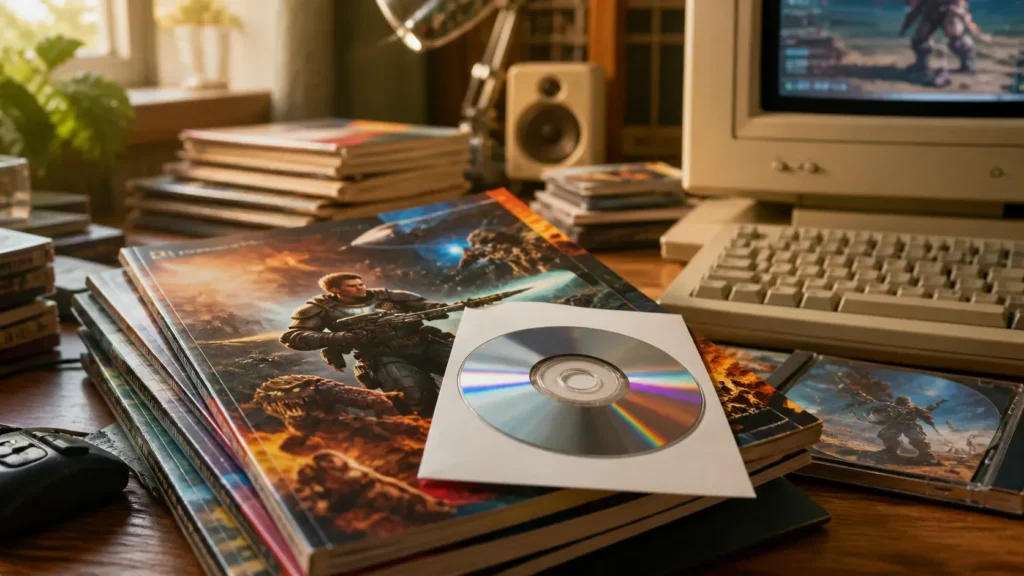
The magazine was no longer just paper. It was paper plus possibility. Paper plus a reflective disc. Paper plus a sleeve or jewel case that whispered that somewhere between the preview pages, hardware reviews, and screenshots was a playable fragment of the future waiting for your CD-ROM drive.
That is what game demo CDs did to magazines.
They turned them from commentary into delivery systems.
And once that happened, the monthly issue stopped feeling like a report on what was coming. It started feeling like a small shipment from the world that was coming.
- Why a magazine changed when it started carrying a disc
- How demo CDs turned reading about games into touching them
- Why limited disc space made discovery feel curated
- How cover discs blended journalism, software, and anticipation
- What was lost when everything became instantly downloadable
- Why the memory of demo discs still feels so vivid now
The historical details below are checked against the Computer History Museum archive; the interpretation and first-person perspective remain the author’s own.
The disc made the magazine feel heavier in every sense
Before demo CDs, a magazine mainly promised information.
That was already exciting. Reviews mattered. Preview screenshots mattered. Release calendars mattered. In a world before the internet became the default nervous system for gaming culture, print had real authority. But once a disc arrived attached to that authority, the relationship changed.
Now the issue could contain software.
That might sound obvious from today’s perspective, but at the time it felt transformative. The Computer History Museum’s recent archival material on cover disks describes magazines bundling downloadable or included programs ranging from utilities and shareware to games and other software packages. That bundling turned the magazine from observer into participant. It was no longer only describing digital culture. It was physically carrying pieces of it.
You felt that in your hands.
A cover disc made an issue seem like an object with hidden depth. It had a second layer. You did not only flip through it. You installed part of it. The purchase became more than reading material; it became a small event waiting to happen later at the desk.
Demo CDs let magazines deliver an appetite, not just an opinion
This is the part I think mattered most.
A review tells you what someone thought.
A preview tells you what someone saw.
A demo lets you begin forming desire through contact.
That difference is enormous.
Game demo discs made magazines emotionally riskier in the best way. A good preview could make you curious, but a playable build could make you obsessed. Suddenly the screenshots were no longer sealed behind editorial interpretation. They became navigable space, half-finished worlds, or carefully selected slices of an experience you were now allowed to test in person.
The Internet Archive’s preserved PC Gamer material captures this atmosphere beautifully. One transcribed issue advertises 12 major demos as part of the CD-ROM Edition. Another issue literally calls itself the world’s first magazine and playable demo disc package for video gamers. That is such a revealing phrase. It shows how the disc was not a side bonus. It had become part of the identity of the publication.
The magazine did not merely accompany the disc.
The disc helped define what the magazine was.
CD-ROM capacity made the whole ritual possible
This was not only a publishing idea. It was also a storage story.
The Computer History Museum’s piece on QuickTime and multimedia reminds us why CD-ROM mattered so much in the first place: around 650 MB on a disc was enormous compared with floppy-era expectations. That scale made software, audio, video, and playable demos far easier to package together in one consumer-friendly format.
Without that leap in physical media, the cover-disc era would have felt much thinner.
A floppy could carry a sample of the future.
A CD could carry a whole mood.
That matters because demo discs were rarely just one file and goodbye. They were often little ecosystems of possibility:
- playable demos;
- patches;
- shareware;
- trailers or videos;
- utilities;
- bonus maps;
- drivers;
- and sometimes odd little extras you only launched because they were there.
This is one reason the discs felt so rich. They were not always perfectly organized, and they were not always full of masterpieces, but they created a curated sense of abundance. The issue had an afterlife beyond the reading.
Limited space made curation feel real
One of the strange gifts of older media is that it forced decisions to remain visible.
A demo disc could not contain everything.
A magazine could not attach the whole internet.
Someone had to choose.
That limitation gave cover discs character.
Today, discovery often feels algorithmic or infinite. Back then, it felt editorial. If a demo, a patch, or a weird shareware experiment made it onto the disc, it felt selected. Someone had decided it deserved a place among the month’s cargo. That decision might not always have been perfect, but it gave the disc a personality the modern download page rarely has.
I think this is why old demo CDs remain so emotionally memorable. They were not only repositories. They were monthly mixed tapes for curiosity.
The same feeling appears in other media memories from the era. In the floppy-disk years, storage limits made every file feel heavier. In the CD-R and DVD-R era, blank discs turned packaging into a personal ritual. Demo CDs sat somewhere between those two feelings: professionally distributed but still intimate, curated but still exploratory.
A demo did not need to be complete to become unforgettable
This is one of the most magical things about the era.
Demos were fragments.
Sometimes short fragments.
Sometimes awkward fragments.
Sometimes deeply misleading fragments.
And yet they could become enormous in memory.
A limited level, an early build, a mission slice, a benchmark-like scene you replayed far too many times because the full game was still somewhere in the future: all of these could grow larger in the imagination than they objectively deserved. The incompleteness was not a flaw every time. Often it was the reason the thing lingered.
A demo could leave just enough unfinished space for longing to move in.
That is a very different relationship from the instant totality we often expect now. Modern digital storefronts move us toward either full ownership, free-to-play continuity, or endless clips of gameplay. The demo-disc era lived more comfortably with partial access. It allowed anticipation to remain an active part of the experience.
Cover discs made waiting feel productive
This may be the quality I miss most.
Waiting used to have more texture.
You read the preview.
You looked at the screenshots.
You installed the demo.
You played the same opening section too many times.
You talked about it.
You imagined the final release.
You waited a little longer.
The disc transformed that waiting period from absence into activity. You were no longer simply waiting for a game to exist in your home. Part of it had already arrived. That partial arrival made the future feel nearer and more personal.
It also made the magazine issue itself feel longer-lived. You did not consume it once. You returned to it. The disc kept the issue relevant after the articles had already been read. In that sense, the publication became an event with two timelines: the fast one of reading, and the slower one of installing, trying, replaying, and revisiting.
That is a rare kind of editorial power.
The magazine rack became a distribution channel for wonder
Looking back, I think the cover-disc era was one of the most elegant meetings of print culture and software culture.
The magazine rack was already a place of promises. Headlines offered exclusives, reviews, rumors, and hardware dreams. Add a disc to that and the promise becomes almost materialized. The future is no longer only announced. It is attached in plastic.
This did something subtle to trust as well.
People often bought those issues believing that the editors had not only written about the scene, but assembled a monthly gateway into it. The disc and the magazine reinforced each other. Editorial taste gave shape to the bundle, and the bundle made the editorial voice feel closer to the actual software world it was describing.
That is why the ritual felt so complete.
The desk sequence mattered:
- bring the issue home;
- read it;
- remove the disc;
- hear the tray open;
- install whatever looked most irresistible;
- then go back and reread the article now that the software felt real.
There was a loop there that modern coverage rarely creates.
Online abundance solved access and flattened some of the romance
To say that demo CDs mattered is not to pretend that the old way was functionally superior.
It was not.
Downloads are faster. Archives are broader. Updates are easier. Discovery is more democratic in some ways and less constrained by the economics of print bundles. That is real progress.
But progress can still dissolve a form of magic.
When every demo is a click away, the demo becomes ordinary. When every trailer, patch, preview build, and free sample lives inside an endless stream, none of them need the ceremonial gravity of a plastic disc attached to a magazine spine.
The old ritual had friction.
And friction gave it shape.
You can feel the same truth in LAN party culture, where physical effort deepened memory rather than merely slowing access. Demo CDs belonged to that broader world of slower but denser anticipation, where the path to the game was part of the game culture around it.
Why the memory still holds
I think demo CDs remain vivid because they combined so many kinds of pleasure at once.
They satisfied the collector instinct.
They satisfied the curiosity instinct.
They satisfied the installation instinct.
They satisfied the hopeful instinct that believes a fragment of something can stand in for the whole thing until release day arrives.
Most importantly, they made media feel layered.
The magazine gave you words.
The disc gave you contact.
Together they created a monthly artifact that felt smarter, richer, and more alive than either medium would have felt alone.
That combination is hard to forget once you have lived with it.
Final thoughts
The era of game demo CDs attached to tech magazines mattered because it made discovery physical, selective, and strangely intimate.
A magazine stopped being only an opinion about games.
It became a carrier for games-in-waiting.
That changed how reading felt, how anticipation felt, and how a monthly issue sat on a desk after the first read-through was over.
We gained convenience when that era faded.
But we lost a certain kind of beautiful delay:
the feeling that the next game was arriving not all at once, but one preview page and one reflective disc at a time.