There was a very specific kind of blue light that belonged to early-2000s media software.
Not literal blue alone, although there was plenty of that.
I mean the emotional blue.
The soft digital glow that made a bedroom PC feel less like a beige machine for homework and more like a private entertainment space you had built for yourself.
For me, Windows Media Player 9 lived inside that light.
I know Winamp usually gets more of the myth, and fairly so. But Windows Media Player 9 mattered in a different way. It was less rebellious and more architectural. It made digital music feel organized, polished, and part of the official shape of the PC. Microsoft’s own 2002 announcement positioned it around fast playback, Smart Jukebox features, and better media quality. That all sounds corporate on paper. But in a real room, with real CDs stacked near the keyboard, what it actually felt like was possibility.
It felt like the PC was learning how to become a music room.
- Why Windows Media Player 9 arrived at the perfect cultural moment
- How visualizations and skins made the player feel personal
- Why ripping CDs felt like building something, not just copying files
- How Microsoft turned bundled software into a customizable media space
- Why the nostalgia still lands even now
It arrived right when the PC was becoming a personal jukebox
Windows Media Player 9 did not appear in a vacuum. It landed at the moment when a lot of people were trying to understand what a digital music collection on a home PC was supposed to feel like.
CDs still mattered.
Shelves still mattered.
Optical drives still mattered.
But hard drives were becoming large enough, broadband was becoming more normal, and the idea of keeping your music inside the machine instead of beside it no longer felt eccentric. Microsoft’s January 7, 2003 release announcement framed Windows Media Player 9 Series as a digital media upgrade for Windows XP, explicitly aimed at both beginners and enthusiasts who wanted stronger control over their music and video collections.
That wording matters in hindsight.
Because Windows Media Player 9 was not merely trying to play files.
It was trying to make the collection itself feel curated.
That is why I remember it less as “the default Microsoft player” and more as one of the first pieces of bundled software that seemed to understand mood.
It belonged to the same general emotional universe as the Windows XP era itself: polished, slightly luminous, a little theatrical, convinced that the PC should feel more alive than it had a few years earlier. That is part of why it still pairs so naturally in memory with the atmosphere behind why Windows XP felt faster, simpler, and more personal.
The visualizations were not practical, which is exactly why they mattered
The older I get, the more I appreciate useless beauty in software.
Visualizations in Windows Media Player 9 were absolutely part of that. Microsoft’s 2003 plug-ins announcement made a point of highlighting themed 3-D visualizations and new enhancements built around the player. In plain language, Microsoft knew this was not just about utility. They knew people wanted a media player to perform a little.
And perform it did.
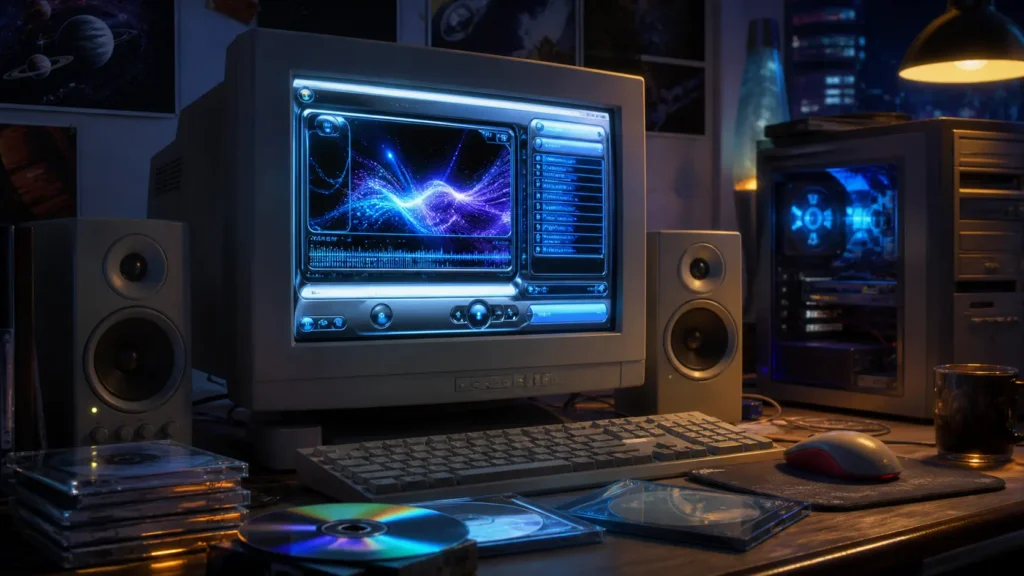
Those moving shapes and glowing patterns were not helping you organize metadata or rip discs any faster. They were helping the music feel visible. They turned listening into a mild event, especially when the room was dark, the CRT was bright, and the machine seemed to pulse in time with whatever track had taken over the evening.
That is easy to dismiss now as ornamental fluff.
But I think it mattered because the early digital music experience risked feeling sterile otherwise.
Files are colder than jewel cases.
Folder trees are colder than shelves.
Visualizations helped bridge that emotional gap. They gave a little motion, spectacle, and softness back to a music library that was becoming more abstract by the month.
Skins made the player feel like part of your room
This was the other half of the magic.
Microsoft’s SDK documentation describes skins as a way to customize the player interface and even extend functionality. That is a clinical description for something that, in practice, felt much more like interior decorating for your computer life.
A skin was not just a different arrangement of buttons.
It was a vibe choice.
You could make the player feel cooler, sleeker, stranger, more metallic, more futuristic, more “mine.” Microsoft’s own January 2003 plug-ins announcement even pointed to official themed skins and a growing ecosystem of enhancements, which says a lot about the ambition behind the platform. They were not treating appearance as incidental. They were treating the player as a space users might want to inhabit.
That is one reason WMP9 felt distinct from plain functionality software.
It invited you to customize not just how the player worked, but how it emotionally sat inside your room and routine. In that sense, it had something in common with the pleasure behind why MS Paint was my ultimate digital canvas: both pieces of software became more memorable when they gave you enough room to impose yourself on them.
Ripping a CD felt like a ritual of conversion
This is the part that hits me hardest now.
The Microsoft documentation for ripping a CD is, naturally, technical and straightforward. But the experience itself never felt technical to me. It felt ceremonial.
You put the disc in.
The drive spun up.
The album information appeared if the internet cooperated.
Track names arrived.
Folders filled.
And little by little, something that had belonged to a physical shelf crossed over into the machine and stayed there.
That was a bigger emotional shift than it sounds like today.
Ripping a CD was not just copying audio. It was declaring that the library now had another life. The album still existed in your hand, but it also now existed in playlists, folders, searches, and late-night listening sessions that no longer required opening a case or changing a disc.
That process gave music ownership a second form.
And Windows Media Player 9 was especially good at making that second form feel polished rather than purely technical. Even Microsoft’s support material about file types reminds us that WMP 9 introduced things like the .wpl playlist format and Auto Playlist behavior, which again points to the bigger truth: this was software designed not just to store songs, but to stage a library.
It was bundled software that did not feel resigned to being ignored
That may be the most interesting part in retrospect.
Bundled software often carries the reputation of obligation. It is there because it came with the system, not because anyone loved it. But Windows Media Player 9 had enough style and enough care that it broke out of that role for a lot of people.
Microsoft’s 2002 and 2003 messaging clearly wanted the product to feel like a real digital media destination, not just a checkbox in Windows XP. The plug-ins site, the visual enhancements, the skins, the smart library language, the CD workflow, the sense of a “series” rather than a tiny revision — all of that was part of a larger attempt to make the player feel current and culturally involved.
And I think it worked.
Not always in the cool-kid way Winamp worked.
Not always in the hacker-tinkerer way more niche tools worked.
But in a domestic, mainstream, very consequential way.
Windows Media Player 9 made the idea of a personal digital music environment feel normal enough to move into the center of the room.
The nostalgia survives because the software gave the transition a soundtrack
What I miss now is not only the interface or the glow or the skins.
It is the feeling that music software was helping narrate a transition.
A CD collection was becoming a hard-drive collection.
A static shelf was becoming a searchable library.
A standard operating system was becoming a personal media machine.
Windows Media Player 9 happened to stand exactly at that doorway.
It did not create the shift by itself, of course. But it gave the shift a visual language and a ritual structure: rip the disc, watch the library grow, choose a skin, turn on a visualization, let the machine become part stereo, part archive, part bedroom theater.
That is why the nostalgia still holds.
It is not only nostalgia for a product.
It is nostalgia for the moment when digital ownership still felt tactile enough to be exciting, and polished enough to feel like the future.
Verification note: Historical and technical details in this retrospective were cross-checked against Microsoft’s Windows Media Player SDK archive.
For broader context, continue with Why Total Commander Still Has a Cult Following Among Techies and CD-R vs. DVD-R: The Optical Storage Revolution.
Conclusion
Windows Media Player 9 mattered because it made digital music feel staged, personal, and atmospheric at the exact moment when CDs were starting to migrate into hard drives and playlists. Microsoft’s own release materials from 2002 and 2003 show how deliberately the product was framed around Smart Jukebox ideas, plug-ins, visualizations, skins, and media collection management. The technical pieces were real, but what made the player memorable was how elegantly it translated them into mood.
That is the part I still remember most clearly: the glowing interface, the visualizations that made listening feel visible, the downloadable skins that made the player feel like part of your room, and the ritual of ripping a CD into a library that slowly began to look like a private archive. Windows Media Player 9 did not just play music. For a while, it helped the PC feel like it knew what music meant.
FAQ
Was Windows Media Player 9 mainly important because it came bundled with Windows?
That helped, but I do not think that alone explains the nostalgia. What made it stick was that Microsoft clearly treated it as a real media experience, with skins, plug-ins, visualizations, and Smart Jukebox-style features that made it feel more like a destination than a default obligation.
Why does CD ripping feel so central to the memory of Windows Media Player 9?
Because it turned physical ownership into digital presence in a very visible way. Every rip felt like a small act of conversion: one more album crossing from the shelf into a searchable, playable, customizable library that lived inside the PC.