Some machines become famous because they were powerful.
Others become famous because they were cheap.
The Commodore 64 became legendary because it managed to feel like much more than either of those words.
It was affordable enough to enter ordinary homes, capable enough to feel like a serious computer, playful enough to become a gaming machine, and open enough to suggest that the person sitting in front of it might do more than consume what others had made. It was a machine that invited use, experimentation, collection, obsession, and identity all at once.
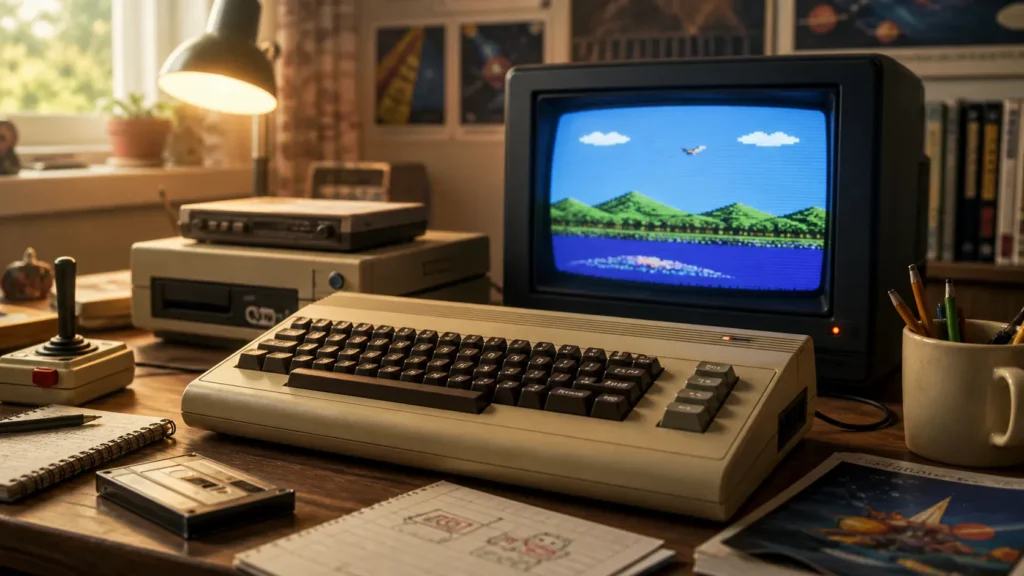
That is why I think the Commodore 64 defined an era. It was not just a successful home computer. It was a whole domestic culture compressed into one beige keyboard.
- Why the Commodore 64 felt bigger than a normal product success
- How affordability and capability arrived together at the right moment
- Why the C64 blurred the line between game machine and real computer
- How it turned homes into small laboratories of curiosity
- Why its cultural afterlife remains so strong
- What the Commodore 64 still symbolizes now
The historical details below are checked against the Computer History Museum archive; the interpretation and first-person perspective remain the author’s own.
The Commodore 64 was not only a computer; it was a whole entry point
The Computer History Museum’s 1982 timeline summarizes the machine in a way that still feels startlingly compact: the Commodore 64 launched for $595, included 64 KB of RAM, offered strong graphics for the time, and went on to sell more than 22 million units across its lifespan according to one of the Museum’s widely cited summaries. Its own 25th-anniversary event page frames the sales more conservatively at close to 17 million. Guinness, meanwhile, keeps the more careful modern framing that exact totals remain debated while still recognizing the C64 as the best-selling single desktop-computer model of all time.
Even the uncertainty is revealing.
You only argue at that scale when the machine has already exceeded ordinary success and entered the territory of historical monument.
But what matters most to me is not the precise number. It is what the number means: the C64 became common enough to stop feeling exotic, yet special enough to feel aspirational. That balance is rare. It is the difference between a machine people admire and a machine that actually enters homes in enough volume to define habits.
It arrived at the moment when "home computer" could finally feel plausible
The C64 did not invent the home computer idea, but it helped make the phrase feel believable in a mass-market sense.
The Computer History Museum’s object note on the Commodore 64 advertisement from 1983 is wonderfully blunt: Commodore emphasized the low price, "UNDER $600," and the machine’s gaming capabilities. Another CHM note about the machine itself adds the broader recipe: simplicity, low cost, superior graphics, quality sound, good game software, and aggressive marketing made it a blockbuster success.
That recipe matters because it reveals how carefully the C64 sat between worlds.
It was not trying to be only a toy.
It was not trying to be only a business machine.
It was not trying to be only a hobbyist device.
It was trying to be the machine a household could justify.
That is a much more powerful position than "best specs." A household computer has to win arguments in the room. It has to feel useful, exciting, reachable, and future-facing all at once. The C64 managed that trick better than most of its era.
It blurred the line between game machine and "real" computer
This is one of the reasons it remains so emotionally vivid.
Many systems of the period were easier to categorize. Some felt mainly like game devices. Others felt mainly like serious computers that happened to allow games. The Commodore 64 lived in the fertile middle. It could load games that became cultural landmarks, but it could also greet you with BASIC and quietly suggest that the machine’s true boundary might be your own patience and curiosity.
That combination changed what ownership felt like.
You were not only buying entertainment.
You were buying permission.
Permission to type.
Permission to learn commands.
Permission to wonder what was behind the screen.
Permission to move from playing software to thinking about how software came into being.
This is why the C64 feels so era-defining to me. It normalized a kind of computing life in which games and making were not opposites. They lived near each other.
The machine made experimentation feel local and domestic
One of the beautiful things about the Commodore 64 is how thoroughly it belongs to the house.
Not the corporate office.
Not the lab.
Not the arcade.
The house.
The C64 on a desk or under a television changed the emotional geometry of the home. It created a place where typing, loading, listening, failing, retrying, copying, reading magazines, and swapping disks or tapes could all become ordinary rituals. The machine did not need the atmosphere of a formal computing environment to feel legitimate. It made legitimacy at home.
That is a huge cultural achievement.
When a technology becomes domestic enough, people stop treating it like a visiting marvel and start building routines around it. The C64 encouraged those routines. It invited collections of software, stacks of magazines, handwritten notes, peripheral decisions, and all the little practical habits that make a machine part of daily life rather than a museum piece-in-progress.
It sold not only hardware, but a whole surrounding ecosystem
The more I think about the C64, the more I think its true product was abundance.
The Computer History Museum’s 25th-anniversary event page says around 10,000 commercial software titles were developed for the Commodore 64, including games, office applications, and development tools. That kind of software depth changes everything. A computer stops feeling like a single purchase and starts feeling like a territory.
Territory invites exploration.
And once a machine becomes a territory, culture grows around it almost automatically:
- magazines;
- guides;
- type-in programs;
- game recommendations;
- peripherals;
- disk drives and cassette decks;
- user groups;
- local swapping rituals;
- and the slowly accumulating confidence that you are living inside an ecosystem rather than merely operating a device.
This is one place where the C64 connects beautifully to later memories like the demo-disc magazine era. In both cases, the machine is not just a box with features. It is a center of gravity around which media, software, curiosity, and collecting begin to orbit.
Commodore also changed where computers were sold
This detail has always stayed with me because it says so much in so few words.
The Computer History Museum’s C64 object note says many units were sold in retail stores that had never sold computers before. That is not just a distribution fact. It is a cultural fact.
A computer sold only in specialist environments still feels selective.
A computer sold in ordinary retail space starts to feel socially available.
The C64 helped widen the door.
It made home computing less ceremonial and more reachable. You no longer needed to imagine that computers belonged only to engineers, offices, schools, or unusually technical households. The machine could appear in places and conversations ordinary families already trusted.
That expansion of context may be one of the biggest reasons the C64 became so era-defining. It met people where they already were.
It taught a generation that computers could be playful without becoming trivial
This might be my favorite thing about its legacy.
The Commodore 64 embraced fun without apologizing for it. Its games mattered. Its sound mattered. Its personality mattered. Yet that playfulness did not reduce it to a toy. If anything, it made the machine more complete.
I think this is why so many people still speak about it with a kind of total memory. They do not remember only one use case. They remember an environment. The C64 was a place where someone might play, type, learn, fail, restart, tweak, read, and imagine a future in computing all on the same afternoon.
That range is historically important.
It helped define a vision of the home computer as something broader than productivity and broader than entertainment. It was a domestic multi-tool for digital curiosity.
The Commodore 64 belongs to the same family of technologies that changed expectations
Some machines are memorable because they improve the old routine.
Others are memorable because they teach people a new routine entirely.
The C64 belongs to the second group.
It did for home computing what the Atari 2600 did for the living-room platform model in the cartridge-console era: it made a category feel permanent. And in a different emotional register, it also foreshadows the way later generations would attach identity to the tools on their desk, whether through storage media in the floppy years or through the magazines, demos, and local rituals that built software anticipation.
The C64 was not merely used.
It was lived with.
That distinction is everything.
Why it still feels like a whole era by itself
Looking back now, I think the Commodore 64 remains powerful in memory because it gathered too many roles into one object for nostalgia to separate them cleanly.
It was:
- a computer;
- a game machine;
- a first programming prompt;
- a sound chip legend;
- a magazine ecosystem;
- a software library;
- a family purchase;
- a personal obsession.
That density is rare.
Most technologies become easier to summarize with distance. The C64 becomes harder, because each person seems to meet it at a slightly different point of entry while still feeling that they encountered the same era-defining machine.
That is usually the sign of something bigger than product success.
It is the sign of a cultural platform.
Final thoughts
The Commodore 64 defined an era because it made home computing feel possible, exciting, affordable, and expansive all at once.
It did not ask households to choose between play and seriousness.
It let both live in the same machine.
It sold in extraordinary numbers, yes.
But more importantly, it helped teach people what a home computer life could feel like:
software libraries, magazines, peripherals, experiments, games, and hours of curiosity gathered around a single beige keyboard.
That is why the Commodore 64 still feels larger than a computer to me.
It was an era with a power switch.