For a long time, PC cooling did not feel elegant.
It felt necessary.
If the processor ran hot, you put something louder on it. If the case trapped heat, you cut more vents into the problem or added another fan and hoped the room would forgive you. The machine could become faster, but it rarely became calmer. Performance and irritation seemed to rise together.
That is why the evolution of PC cooling is so memorable to me. It is not only a story about lowering temperatures. It is a story about changing what we expected from a powerful computer. At one point we accepted tiny screaming fans as the tax you paid for serious hardware. Later we started asking for something much more ambitious: performance, stability, and acoustics that did not make the whole room sound annoyed.
By the time water loops became mainstream enough to stop looking absurd, the culture had changed completely. Cooling was no longer a grudging technical fix. It had become part engineering, part design, and part identity.
- Why early PC cooling often felt crude rather than refined
- How hotter CPUs pushed fans from optional to unavoidable
- Why tiny high-RPM coolers became the sound of performance anxiety
- How tower coolers and quiet-fan engineering changed expectations
- Why water cooling moved from extremism to mainstream aspiration
- What the history of cooling says about the personality of the PC
The earliest lesson was simple: more power eventually becomes a thermal problem
That sounds obvious now, but older home PCs did not always make that truth feel dramatic.
There was a time when the thermal side of the machine could remain relatively invisible to ordinary users. Not every desktop needed a noisy cooling identity to announce itself. But as processors became denser, clocks climbed, and expectations grew, heat stopped being something the hardware could hide politely in the background.
Intel’s current thermal-solution support documentation reflects the endpoint of that transition in a very ordinary way: boxed processors are generally shipped with thermal solutions because active cooling is simply part of the expected package. That normality had to be earned.
Earlier enthusiast memory is full of the stage before refinement, when the answer to rising heat was often just more direct airflow and more obvious spinning hardware. Cooling was becoming inseparable from performance, but it had not yet become graceful.
Tiny fans became the sound of a whole era
This is the part people remember instantly.
The little whine of small high-RPM CPU fans was not subtle. It could sound thin, urgent, and permanently offended by the laws of thermodynamics. Some machines seemed to spend their entire lives acoustically confessing that the chip underneath them was asking too much from too little metal.
That sound mattered culturally because it taught users to hear performance.
A powerful PC was not only seen. It was heard. The hotter and faster things became, the more cooling started to shape the emotional texture of the room. The machine no longer felt like a silent appliance. It felt active, strained, and sometimes proudly overcommitted.
That is one reason old desktops remain so vivid in memory. Just as I still think about the physical presence of older displays in the CRT era, I also think about how cooling changed the soundscape of computing itself. A serious machine often had a serious noise floor.
For a while, cooling felt like a compromise between survival and dignity
This is where the emotional story becomes interesting.
The problem was not simply that fans existed. It was that many cooling solutions felt reactive. They kept the system alive, but not beautifully. The hotter the platform became, the more the user seemed forced into awkward negotiations:
- more fan speed versus more sanity;
- smaller cases versus worse airflow;
- overclocking ambition versus daily tolerability;
- safe temperatures versus a machine that sounded permanently busy.
That is why cooling eventually became a hobby instead of staying a hidden subsystem.
Once users care enough about the compromise, they start wanting a better answer than “add another loud thing.” The PC world had reached the point where thermal behavior was no longer secondary to the experience. It was part of the experience.
Better heatsinks and better fan design changed the culture of air cooling
This was one of the most important shifts.
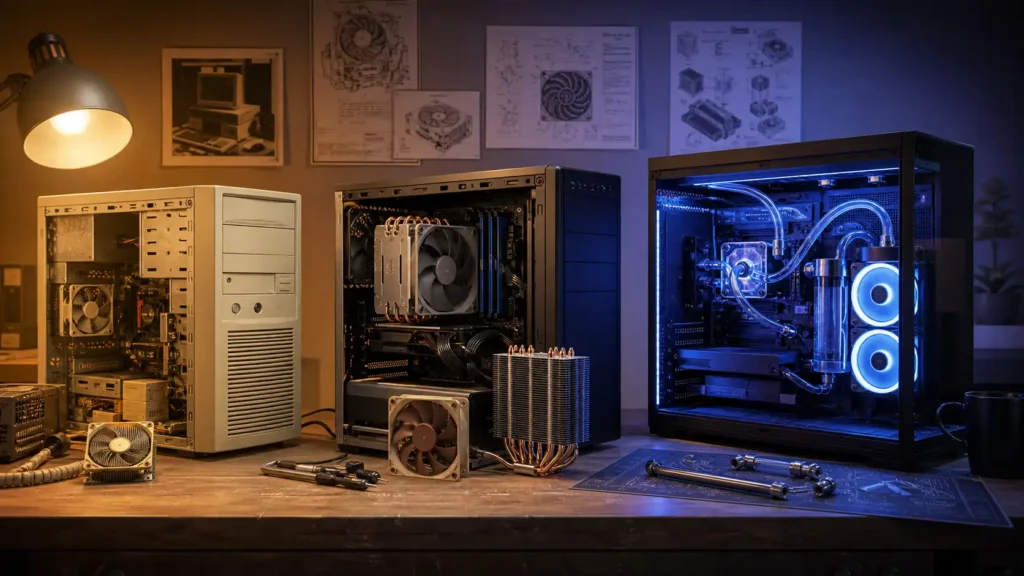
The rise of larger, more capable air coolers did not only improve temperatures. It changed the philosophy. Instead of making tiny fans scream harder, designers started making heatsinks more effective and fans more intelligent. Heatpipes, larger fin stacks, slower-spinning fans, and better acoustic priorities made cooling feel less like emergency management and more like system design.
Noctua’s official timeline and company history are useful markers here. Founded in 2005, Noctua positioned itself around premium quiet cooling and then helped shape the market through products that treated acoustics as part of performance rather than as an afterthought. That matters historically because it reflects a broader cultural demand: people no longer wanted cooling that merely worked. They wanted cooling that worked without sounding like punishment.
That was a major change in expectations.
Once a good air cooler could be both effective and restrained, the old assumption that high performance had to sound irritated started to weaken.
The maturing of air cooling changed the conversation from “How do I stop this CPU from cooking itself?” to “How do I cool this system properly without turning the desk into a wind tunnel?”
Water cooling stopped being a stunt and started becoming a product category
This is where the story becomes especially interesting.
For a long time, liquid cooling felt like something enthusiasts did partly for necessity, partly for bragging rights, and partly because the whole idea looked a little unreasonable in a machine full of expensive electronics. It carried a sense of spectacle.
Asetek’s official history is useful here because it shows how the company moved from extreme cooling approaches such as VapoChill toward liquid solutions that became viable for OEM partners and, later, mainstream DIY use. Asetek says it invented its closed water-cooling circuits in 2003, received its first OEM order from HP in 2007, and then saw the modern era of its desktop liquid coolers begin going into OEM partner systems in 2009.
That timeline matters because it captures the transition from exotic experiment to recognizable category.
Water cooling was no longer only the sort of thing you admired in forums or custom builds. It was becoming productized, normalized, and eventually expected in some premium systems. Tubes, radiators, and pump blocks stopped looking like improvised ambition and started looking like a legitimate thermal language of the enthusiast PC.
The real evolution was not air versus water, but panic versus control
That is the clearest way I know to summarize the whole journey.
Early aggressive cooling often felt anxious. It was trying to keep up with rising heat using blunt tools and small margins. Later cooling solutions, whether large air towers or liquid loops, felt more composed. They offered headroom. They made the machine seem less on edge.
That change in feeling matters as much as the degree difference.
A better-cooled system behaves differently in the imagination. It seems more intentional, less desperate, more like a machine designed around sustained use rather than one permanently negotiating with its own heat output. That is why cooling became part of the visual and emotional identity of powerful desktops, the same broader pattern of the PC becoming a richer and more expressive object that also shaped software and media culture around it, from how audio felt on the desktop to how whole systems felt more personal.
Cooling was no longer invisible infrastructure.
It was part of what the machine was.
What this history still says about the PC
The evolution of PC cooling reflects the larger maturation of enthusiast computing. The desktop did not simply get faster. It learned to care about how that speed was sustained, how loudly it was delivered, and how much aesthetic intention surrounded the hardware making it possible.
That is why tiny screaming fans remain such a strong memory. They mark the era before thermal design felt civilized. Water loops, by contrast, belong to the stage when performance culture started wanting elegance too.
The whole arc is almost poetic in its own nerdy way: from survival to optimization, from noise to control, from crude airflow to systems that treat heat as something to manage with style.
Verification note: Historical and technical details in this retrospective were cross-checked against AMD’s processor-cooling guidance.
For broader context, continue with The Turbo Button Myth: What That PC Case Button Actually Did and Why Desktop PC Cases in the 90s Were Always Beige.
Conclusion
PC cooling evolved from tiny screaming fans to water loops because the machine itself kept asking for more. More clocks, more density, more sustained workloads, more overclocking, more silence, more control. The early answer was often brute force: small, loud fans doing their best to keep fast hardware alive. The later answer became far more sophisticated, with larger air coolers, quieter fan design, and liquid systems that made thermal management feel intentional rather than desperate.
What stays with me most is not only the hardware progression. It is the change in attitude. Cooling stopped being a crude necessity and became part of the personality of the enthusiast PC. And once that happened, the sound of a machine mattered almost as much as its speed.
FAQ
Why were old CPU coolers often so loud?
Because many older systems relied on small high-RPM fans to move enough air through relatively limited heatsink designs. Small fans often had to spin fast to keep temperatures under control, which made them acoustically harsh.
What changed when better air coolers appeared?
Larger heatsinks, heatpipes, and bigger slower-spinning fans made it possible to cool processors more effectively without relying so much on high-pitched fan noise. Cooling began to feel designed rather than improvised.
Was water cooling originally only for extreme enthusiasts?
For many people, yes. Early liquid and other extreme cooling approaches felt niche, ambitious, and somewhat intimidating. Over time, companies like Asetek helped turn closed-loop liquid cooling into a more mainstream product category.
Did water cooling replace air cooling completely?
No. Good air cooling remained highly effective and often simpler. Water cooling became another strong option, especially for users who wanted different thermal, acoustic, or aesthetic tradeoffs.
Why is PC cooling history so memorable to enthusiasts?
Because cooling is one of the clearest places where performance, noise, reliability, and identity all meet. You can hear it, see it, and feel its effect on the machine every day.