There was a time when doing nothing on a computer still looked like something.
That may be the simplest way to explain what screensavers once were. They existed for a practical reason, of course. Older displays needed protection from static images lingering too long. But the cultural memory of screensavers is not really about phosphor burn-in. It is about the strange, delightful period when the machine became theatrical the moment nobody touched it.
An idle screen was not blank.
It performed.
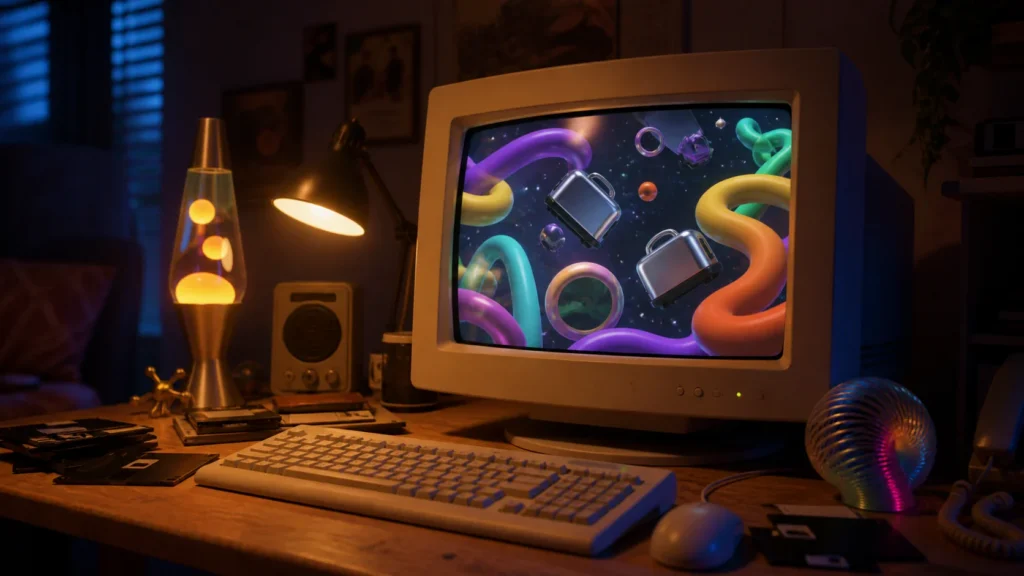
Flying shapes drifted across the darkness.
Colorful pipes grew through impossible space.
Stars, mazes, aquariums, logos, abstract geometry, and small digital jokes unfolded slowly in a quiet room.
The computer was resting, but it was also showing off.
- Why screensavers felt larger than their original purpose
- How Flying Toasters turned idle time into absurd personality
- Why 3D Pipes felt like engineering poetry
- How screensavers became part of a user’s identity
- Why they mattered more in the CRT era
- What we lost when idle screens stopped needing imagination
The historical details below are checked against the official documentation at archive.org; the interpretation and first-person perspective remain the author’s own.
A screensaver was one of the first ways a computer could seem to have a mood
Modern systems still have wallpapers, lock screens, and ambient effects, but screensavers belonged to a more specific emotional category.
They appeared only after absence.
That timing mattered. A screensaver did not greet you when you arrived. It emerged when you stepped away. It was the machine filling the silence by itself, or at least pretending to. That gave screensavers a surprisingly intimate quality. They made a room feel occupied even when no one was actively using the PC.
In hindsight, they were a kind of domestic digital theatre. Small loops of style and motion that said something about the household, the office, or the person who had chosen them.
Flying Toasters made computers feel like they were allowed to be weird
This may be the most important cultural contribution of all.
The Internet Archive description of After Dark 2.0 calls it the software that kicked off the screensaver craze of the 1990s, and Flying Toasters became the image many people still associate with that era. It is easy to see why. The concept was ridiculous in the best possible way. Toast, with wings, gliding across the screen as if this required no explanation.
That absurdity mattered.
Computers in the public imagination were often framed as serious machines: useful, technical, a little intimidating, designed for work or calculation. Flying Toasters interrupted that tone completely. They suggested that software could be whimsical without apology. Not educational whimsy. Not productivity with a smile. Just pure surreal atmosphere.
And once that possibility existed, the whole machine felt warmer.
The old After Dark packages now preserved on the Internet Archive still capture that specific kind of creativity. They belong to a time when screen idle time was not just protected space, but expressive space.
3D Pipes was a totally different fantasy, and that contrast is part of the magic
If Flying Toasters represented absurd softness, 3D Pipes represented technical confidence.
Raymond Chen’s official Microsoft account of the Windows 3D Pipes screensaver gives the historical detail that makes it even more charming: the saver came out of work around Windows NT 3.5, where Microsoft was showing off what the graphics stack could do. That makes perfect sense in retrospect. 3D Pipes did not feel cute. It felt like the computer was demonstrating a strange internal dream of geometry.
It was mesmerizing because it looked procedural, confident, and slightly pointless in a way that only old software could get away with. Colored pipes would grow, twist, intersect, and fill the screen with a kind of industrial patience. Nothing about it was narratively meaningful, but it felt important anyway.
That is one of the reasons so many people remember it so vividly. 3D Pipes made pure rendering feel eventful. It took the idea of "look what this machine can do" and turned it into slow hypnotic spectacle.
It was not protecting the screen in your memory.
It was performing capability.
Screensavers became tiny declarations of personality
Choosing a screensaver used to say something.
Maybe not something profound, but something real.
The person who picked Flying Toasters seemed different from the person who picked 3D Pipes. The person who liked stars or fish or floating text felt different from the person who preferred abstract geometry or custom image slideshows. A screensaver was one of the earliest mainstream ways ordinary users could make a computer feel cosmetically theirs without needing any real technical skill.
That matters because personal computing in the 1990s and early 2000s still had many such rituals. Winamp skins, desktop icons, startup sounds, mouse cursors, wallpaper choices, browser themes, and screensavers all contributed to the feeling that a PC was not just a device. It was a habitat with taste.
That is part of why screensavers still belong emotionally beside pieces like MS Paint as a private creative room or floppy disks as small containers of possibility. They are all memories from the period when digital life still felt more tactile, local, and idiosyncratic.
A blank screen used to feel like wasted opportunity
This is easy to forget now because modern systems often go dark, sleep quickly, or shift to simple lock-screen behavior. Efficiency won, and for understandable reasons.
But the older assumption was different.
If the machine was going to sit there, why should it not become beautiful, funny, eerie, or mesmerizing for a while?
That assumption tells you a lot about the era.
Personal computing had not yet fully submitted itself to the design religion of calm minimalism. A little drama was still welcome. A little flourish was still respectable. Software did not always feel obligated to disappear politely when inactive. Sometimes it did the opposite.
That is why the old screensaver era feels so vivid in memory. It was an age when idle time still had aesthetic rights.
Screensavers also made the room itself feel technological
A CRT with a moving screensaver changed the atmosphere of a room in a way modern black rectangles rarely do.
The shifting light mattered.
The reflections mattered.
The hum of the machine mattered.
The screensaver was not just a graphic on the display. It was environmental lighting. It made walls flicker faintly. It turned a dark corner of a room into a small stage. If the computer sat in a bedroom, study, or office, the screensaver became part of that room’s nighttime character.
This is one reason old screensavers remain more emotional than many newer visual features. They were not just UI. They were ambience.
You could walk past a machine and know, at a glance, what kind of idle dream it had been assigned.
3D Pipes was beautiful partly because it was so unnecessary
I think this is worth saying directly.
The best screensavers were lovable because they spent real creative energy solving a problem in a completely excessive way. Protecting a display did not require 3D pipes, floating toasters, mazes, starfields, or bouncing logos. A blanking screen would have done the job.
But once software designers and users realized idle time could be entertaining, the functional problem became an artistic excuse.
That is a very 1990s form of optimism.
It assumes that even small technical necessities can become playgrounds. It assumes the machine should surprise you a little. And it assumes there is no shame in a purely decorative delight if it makes the device feel more alive.
That spirit is hard not to miss.
Flying Toasters and 3D Pipes represented two sides of the same era
This is why I like pairing them together.
Flying Toasters said:
"The computer can be absurd and playful."
3D Pipes said:
"The computer can be hypnotic and impressive."
Both say something larger:
"The computer does not have to be boring when you are not using it."
That shared belief is what made screensavers culturally bigger than their technical role. They turned inactivity into personality.
One did it with surreal humor.
The other did it with geometric spectacle.
Both became part of the emotional furniture of a generation of PCs.
Nostalgia should not pretend the practical reason stayed relevant forever
Of course it did not.
As display technology changed, the original burn-in problem mattered less in ordinary home use, and power-saving logic became the smarter default. Once flat panels, sleep modes, and new expectations around efficiency took over, many of the reasons for classic screensaver culture weakened.
That was the rational shift.
But rational shifts still leave emotional leftovers.
And the emotional leftover here is strong because screensavers had become more than utilities. They had become mood pieces. Little self-contained works of software personality. Their decline feels, in a small way, like the disappearance of one of the last socially acceptable places where mainstream computing used to indulge in pointless charm.
They protected old displays, yes, but they also made computers feel like they had a sense of humor, a visual imagination, and a small private life when nobody was watching.
What we really miss is not just the animation
When people miss old screensavers, I do not think they are only missing Flying Toasters or 3D Pipes as specific artifacts.
I think they are missing the permission those things represented.
Permission for software to be decorative.
Permission for the machine to be a little dramatic.
Permission for idle time to feel imaginative instead of optimized away.
That permission belonged to the same era as beige PCs, CRT glow, local customization, and the sense that computers were not yet fully flattened into pure workflow appliances.
It is not that the old world was better in every way.
It is that it had more tolerated weirdness.
And screensavers were some of its gentlest, most memorable weirdness.
Conclusion
The lost art of screensavers was never just about protecting monitors. It was about what happened when a practical requirement turned into a tiny stage for digital personality. Flying Toasters made computers feel surreal and funny. 3D Pipes made them feel hypnotic and technically magnificent. Together, they represent a period when the idle PC still seemed willing to entertain the room.
That is why they linger.
Not because anyone urgently needs animated pipes now.
Not because toasters with wings were efficient.
But because both belonged to a time when software still made space for useless beauty, and when the machine, left alone for a minute, could become strangely alive.
FAQ
Why did screensavers exist in the first place?
Originally, screensavers helped prevent static images from lingering too long on older displays, especially CRTs, where burn-in was a more meaningful concern.
Why are Flying Toasters so famous?
Because they became one of the defining images of the 1990s screensaver boom through Berkeley Systems’ After Dark software, which helped turn screensavers into a cultural phenomenon.