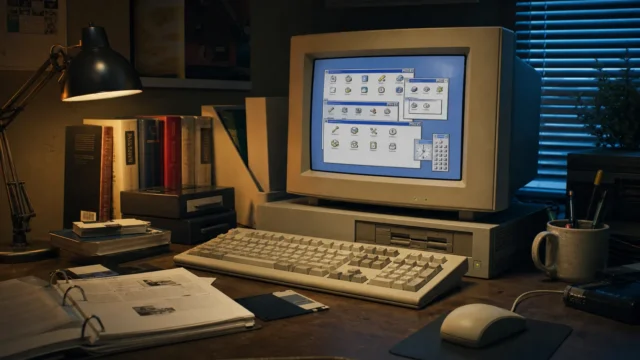
Some games become classics.
Some become scenes.
Very few become atmosphere.
Brood War in South Korea felt like atmosphere.
It was not only a successful game. It became something larger and stranger: a shared public ritual, a television spectacle, a language of rivalry, and for many people outside Korea, the first proof that competitive gaming could look like a real sport instead of a niche hobby played in the dark.
That scale is exactly why the story stayed in my head.
It is tempting to explain the phenomenon by saying the game was brilliant, and it was. But brilliance alone does not turn a strategy game into something that can fill beaches, build television stars, and make professional players feel like public figures. To understand that leap, you have to look at timing as much as design.
- Why the historical moment mattered as much as the game
- How PC bangs turned StarCraft into a daily social habit
- Why Brood War was unusually good television
- How institutions and star players turned popularity into culture
- Why the whole thing still feels bigger than ordinary nostalgia
The timing was almost unnervingly perfect
One of the best broad explanations is not about Blizzard at all. Korea.net’s 2024 retrospective on Korean gaming points to 1998 as a turning point shaped by the Asian Financial Crisis and a national push toward the IT industry, while the Korean Cultural Center’s PC bang feature ties the spread of high-speed internet and PC rooms directly to the growth of Korean gaming culture.
That matters enormously.
StarCraft did not fall into a cultural vacuum. It arrived in a country building broadband identity at exactly the moment networked play could become cheap, communal, and routine. A game that rewarded repetition, rivalry, and constant improvement suddenly had the infrastructure to live everywhere.
That is one reason Brood War feels different from many Western success stories from the same era. It was not just a hit sitting on home PCs. It was a hit plugged into a fast-growing public play environment.
PC bangs made StarCraft feel social before esports made it feel prestigious
This part is impossible to overstate.
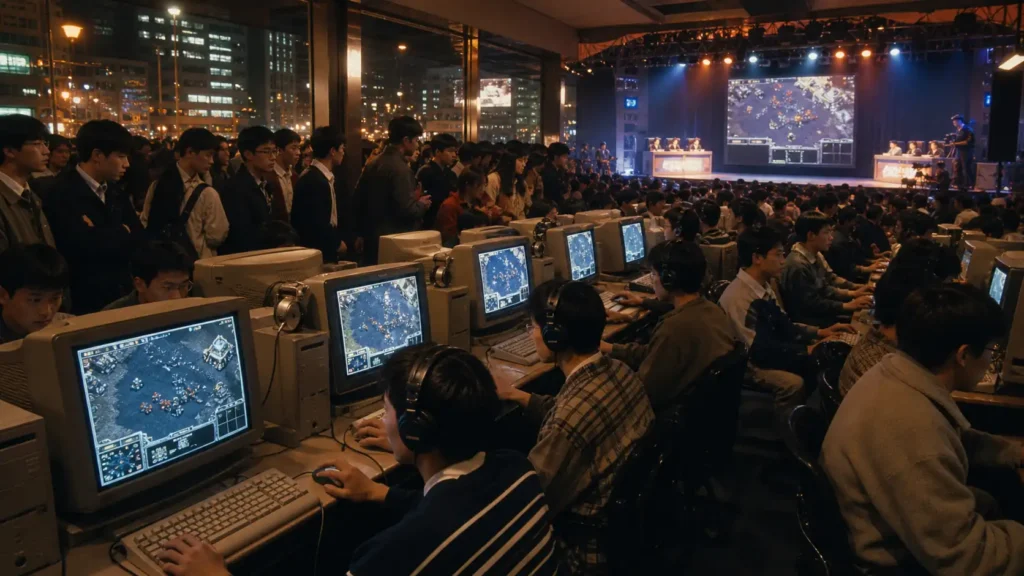
The Korean Cultural Center describes PC bangs as a distinctive gaming space deeply tied to the history of Korean gaming culture. That phrase sounds mild, but the effect was huge. PC bangs did not merely give people access to computers. They turned play into a visible social habit.
Brood War was perfect for that world.
It was easy to replay.
It was competitive immediately.
It was exciting to watch over someone’s shoulder.
It turned one more game into one more rematch.
That matters because communities often form before institutions do. Long before the image of esports became polished and broadcast-ready, StarCraft had already become something people gathered around physically. It lived in rows of machines, in shouted reactions, in little circles of advice and mockery and pride.
The game did not have to teach people how to be social around it.
The environment did that naturally.
Brood War was also unusually easy to turn into spectacle
Some competitive games are deep but visually opaque. Others are exciting but strategically thin. Brood War landed in a rare place where high-level play could look dramatic even to people who were still learning how much they did not understand.
Bases expanded.
Armies clashed.
Drops happened.
Comebacks looked miraculous.
Mechanical speed itself became part of the performance.
That visual clarity matters more than people sometimes admit. A spectator does not need full mastery to feel momentum, risk, panic, or genius in a Brood War match. That made the game naturally compatible with television in a way many other PC games of the era were not.
Blizzard’s own reflections on StarCraft: Remastered show how lasting that fit became. In one behind-the-scenes interview, Blizzard described StarCraft in Korea as something timeless, closer in spirit to a game whose rules should not be casually rewritten. That is not just developer pride. It reflects how thoroughly Brood War had already stabilized into cultural memory.
Television and institutions turned a craze into a structure
Popularity alone can be loud and temporary.
Institutions make it durable.
The academic history of Korean esports in the International Journal of Communication tracks this transformation clearly, pointing to the long life of Brood War Proleague and the broader rise of organized spectatorship. Meanwhile, Blizzard’s 2018 announcement of the Korea StarCraft League could still casually describe StarCraft as a competition watched by millions over nearly two decades. That kind of sentence only sounds normal after a scene has already become historic.
This is where the story stops being just “people loved a game.”
Once leagues, broadcasters, governing bodies, sponsorships, and team systems exist, the culture gains memory. Players are no longer just good ladder grinders. They become recurring characters. Rivalries become seasonal. Matches become appointments instead of accidents.
That is how a game starts to resemble sport.
And then came the stars
A national sport is not built from systems alone. It also needs faces.
Blizzard’s Korea launch event for StarCraft: Remastered is revealing in this way. Even in 2017, the celebration leaned on legendary names like BoxeR, YellOw, Bisu, Jaedong, and Flash because the mythology was still alive enough to summon a crowd on memory alone.
That says everything.
People did not only love the mechanics of Brood War. They loved the people through whom the game became legible. The champions gave the strategy drama. They made styles recognizable. They gave audiences someone to fear, worship, resent, imitate, and remember.
Without that star system, Brood War might still have been a landmark game.
With it, the game became public theater.
Why this story still feels larger than nostalgia
What fascinates me most is that Brood War in Korea still does not read like ordinary retro affection. It feels more structural than that.
It changed how the world imagined esports.
It showed that a strategy game could support celebrity, broadcast ritual, and long-term cultural prestige.
It proved that competitive gaming could be organized, narrated, and remembered at a scale many outsiders had not yet learned to take seriously.
That is why calling it Korea’s national sport never felt entirely like exaggeration. It was metaphor, yes, but it was a metaphor built on visible infrastructure: PC bangs, broadband, leagues, broadcast studios, fan culture, and star players whose names carried social weight beyond the match itself.
Brood War did not merely entertain South Korea.
For a long stretch, it helped describe a version of modern South Korean digital life back to itself.
Verification note: Historical and technical details in this retrospective were cross-checked against Blizzard’s retrospective on Brood War Starleague.
For broader context, continue with How LAN Parties in the 2000s Built a Culture Online Gaming Couldn’t and AGP vs. PCI: The Graphics Slot War of the Late 90s.
Conclusion
StarCraft: Brood War became something like a national sport in South Korea because too many powerful conditions aligned at once for it to remain just a successful game. It arrived during a period of broadband expansion and IT-driven cultural change, found a natural home in PC bang culture, translated beautifully into televised competition, and then gained the institutions and personalities needed to turn popularity into tradition.
That is why the story still feels so singular. Plenty of games are beloved. Very few become public ritual, career ladder, broadcast product, and cultural shorthand all at the same time. Brood War did, and that is why its Korean legacy still feels less like a chapter in gaming history and more like one of the founding myths of esports itself.
FAQ
Was Brood War only popular in South Korea because of PC bangs?
No. PC bangs were a huge part of the story, but not the whole story. Broadband expansion, TV broadcasting, organized leagues, strong institutions, and iconic players all helped turn popularity into lasting national-scale culture.
Why did Brood War work so well as an esport compared with many games of its era?
Because it combined strategic depth with strong visual drama and spectator clarity. Even when viewers did not understand every high-level decision, they could still feel momentum, tension, and personality in the match.