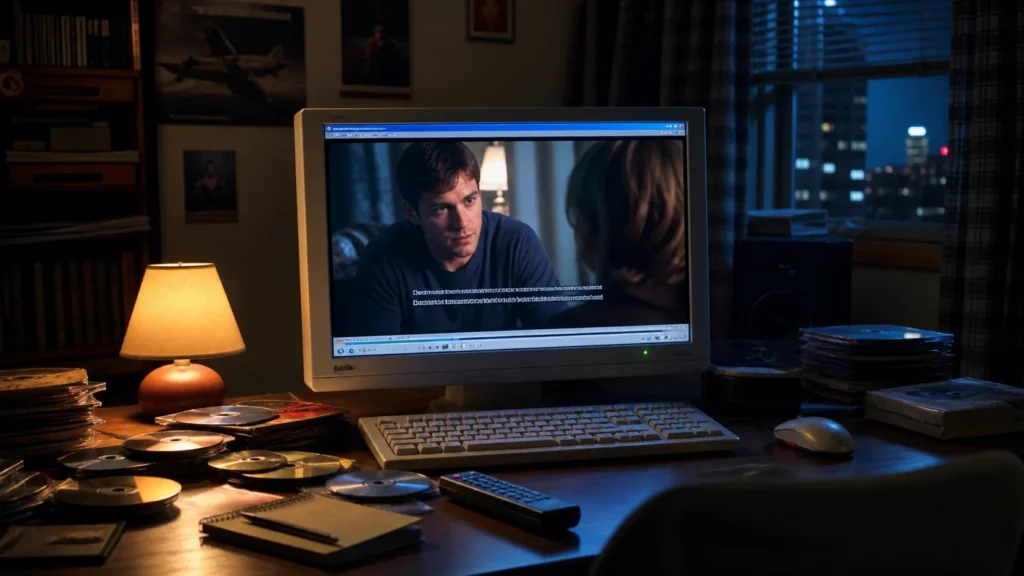
Watching a movie on a PC in the 2000s was rarely as simple as people now remember.
The memory tends to keep the atmosphere and discard the negotiation.
You remember the dim room, the cool glow of the monitor, the stack of burned CDs or downloaded files, the ritual of choosing what to watch late at night. What you forget, or at least soften, is how often the whole experience depended on a fragile little sequence of technical luck:
- would the file open;
- would the video render correctly;
- would the sound behave;
- would the subtitles load;
- would they be the right subtitles;
- and if they were the right ones, would they actually be in sync.
BS.Player mattered because it made all of that feel survivable.
- Why subtitle support mattered so much in real PC movie watching
- How BS.Player matched the actual habits of Windows users
- Why timing fixes and subtitle control felt like superpowers
- How automatic subtitle downloading changed the ritual
- Why the player felt more personal than polished
- What its legacy says about 2000s PC culture
The historical details below are checked against the official BS.Player site; the interpretation and first-person perspective remain the author’s own.
BS.Player understood the real problem better than many prettier players did
This is the key to its reputation.
The official BS.Player home page still describes the software in plain terms: a movie and media player that supports many formats, uses relatively little CPU, and, most importantly for this story, offers advanced subtitle options and can automatically search and download missing subtitles.
That is the reason people loved it.
Not because it was the most elegant piece of software ever made.
Not because it belonged to some perfect golden age.
But because it seemed to understand what a huge number of actual Windows users were trying to do at home.
They were trying to watch things they had acquired in messy, real-world ways.
And that meant subtitles were not a side feature.
They were often the whole battle.
In the 2000s, subtitles were part of the movie, not an afterthought
This is one of those cultural details younger users can easily miss.
For a lot of people, especially outside the English-speaking mainstream or among anyone dealing with mixed-release ecosystems, subtitles were central to the experience of home movie watching on PC. They were not a professional accessibility layer added neatly by a streaming service. They were local files, separate downloads, mismatched encodings, uncertain formats, sometimes excellent, sometimes awful, and often emotionally essential.
That is why BS.Player’s feature list reads the way it does even now.
The official features page emphasizes:
- font and size control;
- shadows and outlines;
- subtitle position;
- simple keyboard shortcuts for bad timings;
- support for two external subtitles at the same time;
- support for subtitle tracks in
.mkvfiles; - multilingual subtitle friendliness.
That is not accidental product design. That is software built by people who clearly understood that subtitle handling was not some rare expert demand. It was normal use.
The king of subtitles is the player that treats timing as a real human problem
This is probably the most emotionally important part of the whole story.
If you used PCs for films in that era, you know the dread. The subtitle file exists. The player loads it. You feel hopeful. Then the first line appears two seconds too early, or four seconds too late, or slowly drifts out of sync across the whole movie.
That was enough to ruin the mood instantly.
BS.Player earned loyalty because it did not behave as though this problem were beneath it. The official features page states plainly that bad subtitle timings can be fixed inside the program itself with simple keyboard shortcuts. That sounds small on paper. In real life, it was enormous.
Because once a player gives you direct power over timing, the movie stops being broken and becomes salvageable.
That is a huge difference.
The best software in messy ecosystems is rarely the one that assumes perfect conditions. It is the one that helps ordinary people recover from imperfect ones.
BS.Player also matched the hardware reality of the time
This mattered more than many people admit now.
The official site still boasts that BS.Player does not use much CPU processing power and is suitable even for slightly less capable computers. That line feels very true to the period. Watching movies on a PC in the 2000s was not always happening on luxurious, overpowered hardware. Plenty of people were using perfectly ordinary machines, sometimes old ones, sometimes shared ones, sometimes systems that could absolutely remind you they had limits.
In that world, a lightweight player was not just convenient. It was social technology. It widened who could participate comfortably in PC movie culture.
That is part of why BS.Player became beloved. It was not only good at handling subtitles. It was good at feeling plausible on the kind of machine people actually had.
It treated subtitles as part of the interface, not just metadata
This is another subtle strength.
A lot of media software historically acted as if video was the real product and subtitles were a polite accessory. BS.Player did not feel that way. It felt more honest than that. The way its features are presented, shadows, outlines, subtitle placement, dual subtitles, embedded subtitles, and timing adjustment all suggest that subtitles were part of the visible experience, something the user might actively work with and care about.
That philosophy matters.
The player was not saying:
"If your subtitles happen to work, lovely."
It was saying:
"We know this is one of the reasons you opened the player in the first place."
That is how software becomes culturally sticky. It recognizes the actual center of user pain and treats it like the center of user importance.
Automatic subtitle download made the future feel closer than it really was
This is where the product starts to feel almost prophetic.
The official home page and the BSPlayer Community page both emphasize the online subtitle system. BS.Player could automatically search and download missing subtitles for the currently playing video, and the community page explains how user votes, uploads, hashes, filenames, FPS data, and even IMDB IDs helped improve subtitle matching over time.
That is fascinating in hindsight.
Because it means BS.Player was not just a passive player. It was participating in a networked subtitle ecosystem that tried to make movie watching smarter and less manual. In other words, it was doing a small version of what later streaming platforms would make seem normal: connecting the video you have with the language layer you need.
But in the 2000s and early 2010s, that still felt like a little miracle.
The player opening a file and then finding the subtitle for you did not feel routine. It felt like a favor from the future.
It belonged to the same culture as codecs, skins, and practical Windows cleverness
BS.Player also belongs to a broader emotional family of software that solved annoying real-world problems while still looking like it came from a desktop culture of tinkering.
It did not feel sleek in the modern streaming-app sense.
It felt adjustable.
Useful.
Slightly technical.
Comfortably Windows.
That is the same reason it sits so naturally beside other beloved utility-era programs in memory. Like Total Commander, it rewarded people who liked control. Like some of the stranger, more expressive software I wrote about in Total Commander and classic Windows workflows, it belonged to a time when software did not need to be minimalist to feel personal.
BS.Player looked like something you lived with, configured, nudged, and trusted.
That matters more in memory than elegance ever does.
Dual subtitles says everything about the world it served
I honestly think this one feature tells the whole story.
The official features page explicitly says BS.Player can display two external subtitles at once and let you position both. That is such a specific, generous, real-world feature. It tells you immediately what kind of audience the player imagined:
- bilingual households;
- learners trying to compare languages;
- people sharing a movie across different comfort levels;
- viewers who were not living inside a one-language media bubble.
Software reveals its users by the features it bothers to prioritize.
BS.Player’s subtitle decisions reveal a very international, very practical, very unpretentious user culture. It is one of the reasons the player still inspires such loyal nostalgia in so many different countries.
The king of subtitles did not need to be the king of everything
This is worth saying because nostalgia can become too totalizing.
BS.Player did not have to be the universal best media player in every category to earn this reputation. It only needed to dominate a pain point that mattered enough to shape the whole experience. And in the 2000s, subtitle handling mattered that much.
If your player was beautiful but your subtitles were broken, your player was useless.
If your player looked a little utilitarian but your movie opened, the subtitle loaded, the timing could be fixed, and the machine did not struggle, then you had what mattered.
That is a very old PC truth:
practical software wins memory through relief.
What people really remember is the feeling of being rescued
I do not think people miss BS.Player only because of format lists or feature checkboxes.
I think they miss the sensation of opening a questionable file on a not-always-powerful Windows machine and having one piece of software make the whole evening feel possible again.
That is a stronger memory than polish.
It is the same kind of memory that makes older tools linger in culture long after the market has moved on. We do not only remember what they did. We remember what they saved us from.
That sounds simple, but in the 2000s it was a profound act of empathy toward how people actually watched movies on PCs: with mismatched files, uncertain encodings, and just enough patience left to hope the player would help.
Conclusion
BS.Player was the king of movie subtitles in the 2000s because it understood that subtitle handling was not a peripheral feature. It was often the central condition of whether a movie night on Windows would work at all. By supporting many subtitle formats, allowing easy timing fixes, offering dual subtitles, staying light on system resources, and eventually automating online subtitle discovery, it turned a fragile, messy ritual into something that felt manageable.
That is why it still survives so vividly in memory.
Not as the most glamorous player of its era.
As one of the most useful.
And in the age of codec packs, uncertain files, and late-night movie watching on home PCs, usefulness like that could feel almost royal.
FAQ
Why was BS.Player so popular for subtitles?
Because it treated subtitles as a core feature rather than an afterthought, with broad format support, timing adjustment, positioning controls, dual subtitles, and later automatic subtitle searching.
Did BS.Player automatically download subtitles?
Yes. The official site says it can automatically search for and download missing subtitles for the currently playing video, if available.
For additional context, see The Turbo Button Myth: What That PC Case Button Actually Did and AGP vs. PCI: The Graphics Slot War of the Late 90s.