Winamp was not just a media player. For a certain era of PC users, it felt like a glimpse of what personal computing could become when software stopped behaving like paperwork and started behaving like culture. It was fast, expressive, customizable, internet-aware before that was ordinary, and somehow both technical and playful at the same time. Looking back now, the fascinating part is not just the nostalgia. It is how clearly Winamp captured an idea of software that modern platforms often smooth over.
- Why Winamp felt so different from older media software
- How speed and personality shaped the experience
- Why skins, plugins, and visualization mattered
- How the early internet amplified its cultural impact
- What modern software lost when everything became cleaner and safer
The historical product baseline below is checked against Winamp’s official site; the interpretation and first-person perspective remain the author’s own.
It felt immediate in a way a lot of software did not
One of the reasons Winamp felt futuristic was simple: it was quick. It launched fast, responded instantly, and did not make everyday playback feel heavier than it needed to be. In an era when plenty of software still carried the emotional weight of installation CDs, modal dialogs, and bloated interfaces, Winamp felt like it belonged to a lighter, more personal future.
That speed mattered culturally as much as technically. When software gets out of the way, it begins to feel like part of your environment instead of an obstacle inside it. Winamp gave people that sensation early, and it did so in a category that many of us touched every day.
It treated the PC like a personal space
Modern software often wants to be neutral, consistent, and protected from too much user alteration. Winamp came from a time when software still believed your desktop could be yours in a more expressive sense. You could change how it looked, reshape its identity with skins, add plugins, choose visualizations, and make it feel like a tiny cultural object sitting on top of the operating system.
That was not superficial. It changed how people related to the computer. A personalized media player sitting next to chat windows, downloaded MP3 folders, browser toolbars, and desktop icons helped create the feeling that the PC was a place, not just a utility.
People often remember Winamp for aesthetics, but what they are really remembering is a form of ownership. The software felt like it belonged to them.
Skins were not just decoration
The skinning culture around Winamp is easy to dismiss if you reduce it to visual novelty. In reality, skins were part of a larger moment in consumer computing when users expected to shape their tools. The media player became a canvas for taste, mood, fandom, and experimentation. Software was not merely used. It was curated.
That is one reason Winamp still occupies such a vivid place in memory. It was not trying to look universal. It was happy to let people make it weird, sleek, metallic, translucent, minimal, or absurd. Today that kind of variation is much rarer in mainstream software because consistency and cross-device predictability have won the argument.
Visualizations made digital media feel alive
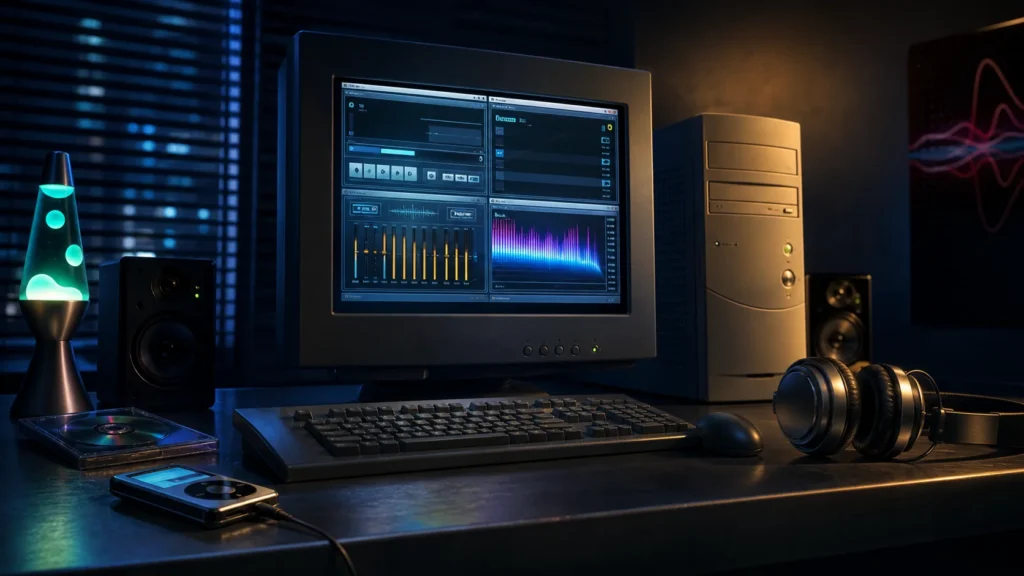
There was also the matter of visualizations, which now read as wonderfully of their time. They were often over the top, sometimes tacky, sometimes mesmerizing, and exactly the kind of feature that made software feel like an experience rather than a service endpoint. Visualizations turned listening into something more ambient and more performative. The PC was not just playing your files. It was reacting to them.
That mattered because early digital music was not yet completely normalized. Playing MP3s on a computer still carried some of the thrill of new possibility. Winamp gave that moment a theatrical interface.
The plugin ecosystem widened the horizon
Winamp also benefited from the kind of plugin culture that once defined a lot of desktop software. If the base application did not quite do what you wanted, there was a good chance somebody had built an extension, output plugin, library enhancement, or visual add-on that nudged it closer to your ideal setup. That created a sense that software was expandable by the community, not merely delivered by a vendor.
The result was a media player that often felt more like a platform than a product. That feeling was common in late-1990s and early-2000s enthusiast software, and it is one reason those tools continue to inspire nostalgia among users who miss software that invited tinkering.
It lived at the exact intersection of music, files, and the early web
Winamp arrived at a fascinating cultural point. Personal music libraries were becoming digital. File sharing was changing the shape of discovery. Broadband was growing, but local files still mattered immensely. The web was becoming social, but not yet fully platform-locked. In that environment, a media player could feel central to how you inhabited the PC.
Winamp was right there in the middle of it: local enough to feel personal, connected enough to feel modern, configurable enough to feel alive. It was not just software you installed. It became part of how the era sounded and looked.
Why it still feels more “future” than some modern software
This is the paradox. Modern media platforms are vastly more capable in technical terms, but they often feel less personal. Streaming apps optimize for convenience, scale, licensing, and uniformity. They do many things better, but they rarely create the same feeling that the software is yours. Winamp did not have the smoothness of today’s cloud ecosystems, yet it often felt more intimate and more imaginative.
That is why it still lands so strongly in memory. It represented a version of the future where software could be fast, customizable, and culturally textured without asking permission from a centralized platform.
Not everything was better. Formats were messy, libraries were fragile, and plenty of desktop software was awful. But nostalgia sometimes points to qualities worth recovering, and in Winamp’s case those qualities include speed, ownership, and personality.
What it says about the PCs we miss
Winamp nostalgia is really about more than music. It connects to a broader memory of the PC as a machine that rewarded curiosity and tolerated weirdness. That is the same emotional terrain behind pieces like why Windows XP felt faster, simpler, and more personal. People are not only remembering an operating system or a player. They are remembering a more tactile relationship with software.
That perspective fits naturally on a site that also covers modern homelabs and self-hosting. The through-line is not nostalgia for its own sake. It is interest in systems that feel more understandable, more personal, and more under the user’s control.
That discovery culture also overlapped with the era of magazine demo CDs, when music players, game demos, utilities, and codecs all arrived through the same hands-on PC ecosystem.
That broader period is easier to understand alongside Dial-Up Modems: The Nostalgic Symphony of Connecting to the Web, Why Desktop PC Cases in the 90s Were Always Beige, and Why Total Commander Still Has a Cult Following Among Techies, which captures another part of the same transition in personal computing.
Conclusion
Winamp felt like the future because it combined speed, personality, customization, and musical context at exactly the right moment in PC history. It turned the computer into a more expressive place and made digital media feel exciting rather than administrative. Even now, long after streaming won the mass-market argument, Winamp still represents a version of software that many people quietly miss: fast, playful, extensible, and unmistakably theirs.
FAQ
Was Winamp really technically ahead, or just stylish?
It was both. The styling mattered, but so did the speed, plugin ecosystem, and the feeling that the player fit naturally into how people were already using their PCs.
Why do skins matter so much in the memory of Winamp?
Because they represented user ownership. Skins made the application feel personal, and that changes how software lives in memory.
Did modern streaming apps replace Winamp completely?
Functionally, yes, in many ways. Emotionally and culturally, not really. They solve different problems and create very different user relationships.
Why include retro pieces on a modern infrastructure site?
Because they broaden the editorial voice, create shareable contrast, and connect modern technical readers to the longer emotional history of personal computing.
Is this mostly nostalgia?
Partly, but useful nostalgia can also highlight qualities that modern software often underdelivers on, especially speed, ownership, and personality.