Every so often, a piece of hardware arrives that does more than win a product cycle.
It changes the emotional weather.
That is how the Radeon 9700 Pro feels in memory.
Not merely fast.
Not merely successful.
Disruptive in a way that made people suddenly speak about the future in a different tone.
Before it, ATI still felt to many people like the company trying to prove it could lead. After it, that argument got much harder to dismiss.
- Why the market felt predictable before the 9700 Pro arrived
- How ATI launched a card that felt immediately different
- Why DirectX 9 mattered as much as raw frame rates
- How the card changed image quality expectations too
- Why Nvidia felt genuinely caught off balance
- What the 9700 Pro still represents in PC history
The launch timeline and ATI’s contemporary claims below are checked against ATI’s 2002 annual report filed with the SEC; the interpretation and first-person perspective remain the author’s own.
The shock came partly from how settled the hierarchy had seemed
That is what people sometimes forget.
The power of a disruptive launch depends on what the market believed before it happened. And before the Radeon 9700 Pro, Nvidia felt like the company many people expected to keep setting the pace. ATI had strong products and real presence, but there was still a cultural difference between being respected and being presumed to lead.
Then the 9700 Pro arrived and changed the feeling almost immediately.
It did not look like a small tactical win. It looked like ATI had shown up with the card that belonged to the next moment rather than the current one.
That is why so many people still remember it with a kind of delighted surprise. It was not only that ATI won. It was that ATI won in a way that made the result feel obvious once you saw it, which is the most unsettling kind of loss for the other side.
The Radeon 9700 Pro felt like a real generational step, not a tidy refresh
This is where the hardware story matters.
The Radeon R300 family, whose first flagship consumer card was the 9700 Pro in August 2002, was the first fully Direct3D 9-capable consumer graphics chip. The architecture also brought things that sounded serious even before you understood every detail: a 256-bit memory bus, 8 pixel pipelines, and a card that did not merely keep up with contemporary expectations but started to exceed them.
That kind of specification sheet lands differently when it is backed by performance that people can actually feel.
And they could feel it.
The card did not just benchmark well in a narrow, nervous way. It felt roomy. It had headroom. It looked like a piece of hardware built for the next wave of games rather than merely surviving the present one.
That is why the launch has stayed so vivid in memory. The 9700 Pro felt like future hardware that had somehow shown up early.
DirectX 9 was part of the aura, not just a bullet point
One of the biggest reasons the card felt culturally larger than a normal product launch is that it arrived with real next-generation credibility.
DirectX 9 support mattered because it suggested not only that this card was fast now, but that it was aligned with where PC graphics were heading. A high-end card that looks great in current games is one thing. A high-end card that feels architecturally prepared for the near future is another.
That second feeling is what makes a launch feel visionary.
The R300 architecture’s association with full Direct3D 9 capability gave ATI something more powerful than bragging rights. It gave the company narrative authority. ATI was not just shipping a competitive board. It was shipping the kind of board that seemed to define what "modern" graphics should now mean.
That is what made the card feel like a statement instead of a reply.
Image quality became part of the victory too
This is a part of the story I think deserves more affection.
The Radeon 9700 Pro was not only remembered for being fast. It was remembered for making quality settings feel less like a tax and more like a reasonable part of the experience. The R300 era is famous for helping anti-aliasing and anisotropic filtering feel truly usable at a level that mattered to real players, not just reviewers chasing laboratory settings.
That matters because the best hardware victories do not just increase raw speed. They change what people dare to turn on.
A graphics card becomes culturally important when it lets users stop asking:
- can I afford the pretty option?
and start asking:
- why would I play without it?
That is a bigger psychological shift than frame-rate bragging alone can create.
Nvidia did not just lose a round; it lost the tone
This is why the phrase "the card that shocked Nvidia" feels right to me.
The card changed the tone of comparison. Nvidia was no longer simply the company everyone else had to explain themselves against. ATI had, for a moment, become the cardmaker with the more convincing future.
And because the win was architectural as well as immediate, it was harder to dismiss as a fluke.
The R300 did not feel like a lucky SKU.
It felt like a stronger idea.
That distinction matters in tech history because companies can recover from losing one benchmark race much more easily than they recover from looking strategically late. The wider story around the GeForce FX period only deepened that contrast later. Once that happened, the 9700 Pro started to look less like a surprise victory and more like the first sign that Nvidia had genuinely been caught leaning the wrong way.
It was one of those rare cards that made the enthusiast crowd sound almost unified
This is another thing I remember about launches like this. Usually the hardware crowd finds ways to complicate every victory. Someone points to drivers. Someone points to a specific game. Someone argues the whole thing will look different in six months. Someone decides the price changes the moral meaning of everything.
All of that still existed, of course.
But the Radeon 9700 Pro had enough force that the overall reaction felt clearer than usual. The card made a strong impression quickly. It was the sort of product that caused people to talk less like cautious auditors and more like witnesses to a real shift.
That kind of clarity is rare.
And when it happens, the part becomes legendary.
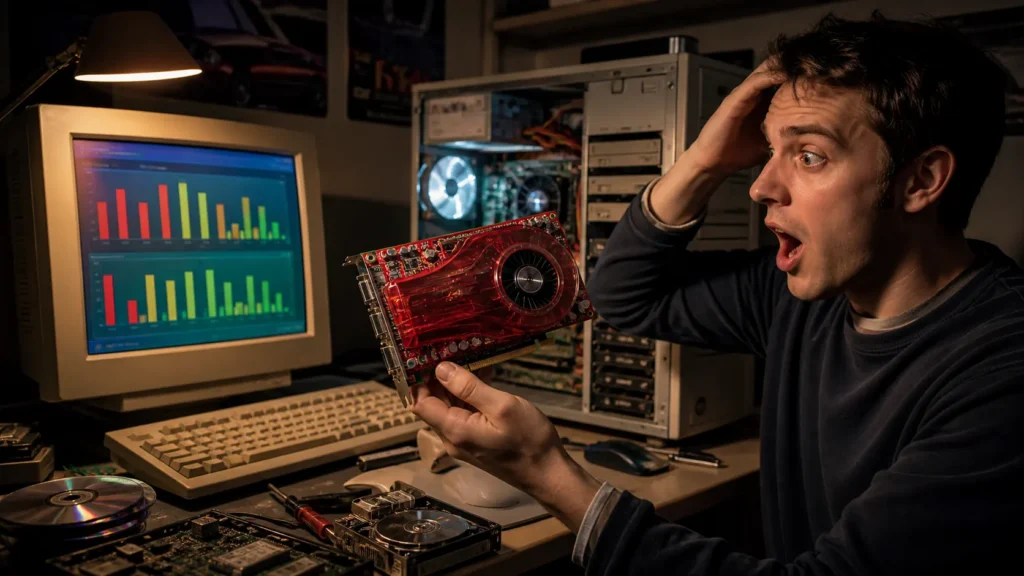
The 9700 Pro also belongs to the emotional history of the red PCB era
Some hardware becomes memorable partly because it arrives with a look.
The early-2000s high-end graphics card world had that quality in abundance: exposed coolers, aggressive packaging, dramatic color choices, and a general sense that your GPU was not an invisible component but a public declaration of taste. The Radeon 9700 Pro fits perfectly into that memory.
It belongs to the same emotional shelf as LAN-party hardware bragging, benchmarking culture, late-night driver installs, and the era I touched on in 2000s LAN-party culture, where the home PC still felt like a machine you tuned, admired, and occasionally built small myths around.
That matters because great hardware is never only technical. It is social too.
People remember how it ran, but also how it felt to own, covet, discuss, and defend.
It changed expectations for what a top-tier GPU should deliver
This may be the deepest legacy of all.
Once a card like the 9700 Pro appears, the standard changes. Suddenly, a flagship is not exciting simply because it is ahead. It is exciting because it looks meaningfully ahead. People begin expecting:
- strong current performance;
- convincing future-facing feature support;
- image quality settings that feel usable rather than ornamental;
- architecture that seems smarter, not just more aggressive.
That expectation did not end with the card.
It became part of what people would ask from high-end GPUs after it.
That is how you know a part changed history. It does not merely dominate the present. It teaches the market new definitions of adequacy.
Nostalgia should not pretend the 9700 Pro existed in some perfect vacuum
It did not.
Driver maturity still mattered. Games still varied. Hardware budgets still constrained what people could actually buy. The GeForce4 Ti line did not become irrelevant just because ATI changed the mood. Real life was, as always, messier than the cleanest version of hardware legend.
But even inside that messiness, some launches still stand apart.
The 9700 Pro stands apart because it made the future feel visible. It showed up with enough architecture, enough bandwidth, enough feature confidence, and enough real-world speed that the usual hedging language around big GPU launches started to sound weaker than the card itself.
It was not just faster than what many people already had. It felt like a card from the next chapter arriving early enough to embarrass the current one.
What people really mean when they remember it so fondly
I do not think people remember the Radeon 9700 Pro only because they can list specifications from memory.
I think they remember it because it captured one of the best feelings in PC history:
the moment when a component makes the whole market seem newly alive.
Suddenly reviews matter again.
Suddenly upgrade dreams feel sharper.
Suddenly competition seems real.
Suddenly the company that was supposed to be chasing looks like the one defining the road.
That is bigger than a benchmark sweep.
That is a cultural event inside enthusiast technology.
The Radeon 9700 Pro also belonged to the social PC era captured by 2000s LAN-party culture, where benchmark results and GPU upgrades became part of the gathering itself.
Conclusion
The ATI Radeon 9700 Pro shocked Nvidia because it was more than a slightly better graphics card. It arrived with stronger architecture, real DirectX 9 authority, a 256-bit memory bus, impressive image quality options, and enough unmistakable speed to make ATI look like the company carrying the next generation on its back.
That is why it still matters.
It did not simply win a launch.
It changed the hierarchy of belief.
And in hardware culture, that kind of victory lasts much longer than any one frame-rate chart.
FAQ
Why was the Radeon 9700 Pro considered such a big deal?
Because it combined strong real-world performance, full DirectX 9 credibility, a 256-bit memory bus, and an architecture that felt clearly more future-ready than many of its contemporaries.
When did the Radeon 9700 Pro launch?
The Radeon 9700 Pro launched in August 2002 as the first flagship consumer card based on ATI’s R300 architecture.
For additional context, see The Turbo Button Myth: What That PC Case Button Actually Did and AGP vs. PCI: The Graphics Slot War of the Late 90s.