Some connectors were so large they seemed to have opinions.
Parallel and serial ports were like that.
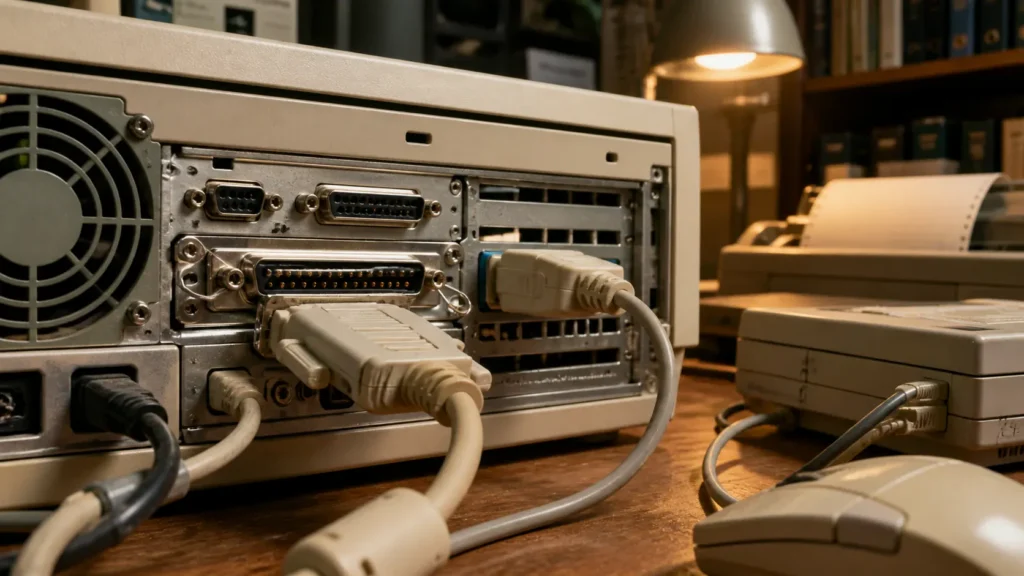
They did not disappear discreetly into the machine. They arrived with screws, metal shells, thick cables, and enough physical presence to suggest that if you plugged something into your PC, you were not performing a small convenience. You were establishing a relationship between machines.
That is one of the reasons I still find them so memorable.
They made computers feel infrastructural.
The 1990s PC was not just a box for software and a monitor for light. Through its serial and parallel ports, it became a place where printers, modems, mice, scanners, organizers, and all sorts of awkwardly practical hardware could meet, negotiate, and occasionally refuse to cooperate until you reseated the connector and tightened the screws one more time.
It was clunky.
It was imperfect.
And it made the machine feel gloriously real.
- Why serial and parallel ports felt bigger than their technical role
- How one bit at a time and many signals at once shaped different jobs
- Why these connectors made PCs feel connected to the physical world
- How printers, modems, mice, and scanners gave the ports their identity
- Why USB replaced them and what it flattened in the process
- What the chunky connector era still represents now
The historical details below are checked against the Computer History Museum archive; the interpretation and first-person perspective remain the author’s own.
The ports looked serious before you knew what they did
Part of their power was visual.
A serial port or a parallel port made the back of a computer look less like an appliance and more like equipment. A beige PC with COM ports, an LPT port, and the right cables attached suggested that the machine was not closed in on itself. It had routes outward. It could print, dial, transfer, synchronize, and speak to specialized devices that gave the desk a practical life beyond games and word processing.
That visual seriousness mattered in the 1990s.
It made personal computing feel more adult, more mechanical, and somehow more contractual. You did not simply "pair" a device. You physically joined it. You aligned pins. You feared bent pins. You tightened screws. The relationship between computer and peripheral had weight in the hand.
That weight created memory.
Serial and parallel told two different stories about communication
The simplest historical distinction is also still the most useful.
The Computer History Museum’s 1969 timeline entry says the RS-232-C standard allowed computers and peripheral devices to transmit information serially, meaning one bit at a time. That same entry notes how widely serial-compatible ports were used for devices like printers and modems before later interfaces displaced them.
Serial communication sounds modest in that phrasing, and in a way it was. It was sequential, deliberate, a stream rather than a burst. But that was exactly why it fit so many things that mattered. Modems, mice, terminals, and other devices did not need theatrical width. They needed a dependable conversational line.
Parallel communication felt different in both idea and reputation.
The name itself suggests breadth. Data moved across multiple lines together, and in practical PC culture that often meant one thing first: printers. The parallel port became so closely tied to printing that many users treated "parallel port" and "printer port" as nearly synonymous. The Computer History Museum’s collection records support that intuition directly, with objects like the Commodore model 2023 dot-matrix printer and Epson FX-85 both explicitly noting female parallel ports on the back, and the IBM PCjr printer attachment existing just to add a printer port to the machine.
If serial was a conversation, parallel felt like delivery.
The connectors made the PC feel like part of a larger desk ecology
This is what I miss most about that era.
A 1990s PC was rarely alone in any meaningful sense. Even when it physically occupied the center of the setup, it lived among other devices that expanded its role:
- a serial mouse;
- an external modem;
- a dot-matrix or inkjet printer;
- a scanner hanging off a parallel adapter;
- an organizer waiting for synchronization;
- maybe a null-modem cable for data transfer or troubleshooting between machines.
The back panel was where those relationships became visible.
You could look at a PC and tell whether it was isolated or socially active in the hardware sense. A machine with cables attached to its chunky ports looked involved. It looked like it belonged to tasks, obligations, and routines outside the screen.
That visible connectedness gave home computing a kind of industrial dignity.
Parallel ports often carried the domestic burden of "real output"
Printers changed the mood of a PC.
A computer that could only display something still felt partially private. A computer connected to a printer felt public-facing. It could turn digital work into paper. It could produce homework, invoices, letters, forms, labels, banners, or that glorious dot-matrix racket that made even mediocre documents sound important on their way into the world.
That is why the parallel port feels so tied to domestic and office seriousness.
The Computer History Museum’s collection examples are wonderfully concrete here. You can almost reconstruct the era from them: a printer with a parallel socket, a printer attachment for a home machine, a scanner adapter with 25-pin connectors for the parallel path. These were not abstract standards floating above human activity. They were the actual hinges between the PC and the tasks people needed done.
The port was part of the ritual of turning the computer outward.
Serial ports gave the PC a slower but stranger outer life
If the parallel port often felt like responsibility, the serial port often felt like possibility.
This was the connector of the mouse that moved the cursor across the screen before PS/2 and USB made that relationship tidier. It was the connector of the external modem with its lights and phone line, the one that made the machine sound busy while it tried to establish contact with somewhere else. It was the connector of terminal-minded seriousness, of configuration headaches, and of the sense that computers could converse beyond the local room if you knew how to help them do it.
The CHM timeline entry does not romanticize it. It simply says serial links were slower, bulky, and later replaced by newer interfaces. All true.
But slowness does not erase significance.
Serial ports belonged to the period when "connection" still felt procedural. If you used one, you often knew you were doing something with consequences: dialing out, configuring equipment, talking to another machine, synchronizing a device, or persuading one stubborn system to acknowledge another.
That gave serial computing an unusually intimate drama.
These ports made the machine feel mechanical, not magical
I think that is a large part of why people who grew up with them still remember them so clearly.
Modern interfaces are better in almost every practical sense. USB deserved its victory. It is easier, smaller, faster, broader, and far more graceful in everyday life. But elegance also hides process.
Parallel and serial ports did the opposite.
They exposed process.
They reminded you that devices had protocols, roles, expectations, and limits. A parallel cable was not just "a cable." It implied a class of job. A serial connector was not just "connectivity." It implied sequence, configuration, device types, and often enough troubleshooting to make success feel earned.
That tactile friction taught people a lot about what computers actually were. The desk was not a seamless cloud-shaped illusion yet. It was a network of physical negotiations.
USB won because it was kinder, but it also made the edges blur
I would never argue that the old ports should have stayed dominant.
They were bulky.
They were awkward.
They were easy to misalign.
They demanded space.
They often required more knowledge than casual users wanted to have.
USB solved real problems and deserved its triumph.
But when USB arrived, part of what disappeared was identity. The old ports had personalities. Serial suggested one class of relationship. Parallel suggested another. Each connector hinted at purpose before you even plugged anything in. The back of the PC looked like a map of distinct intentions.
Once the universal connector took over, life became easier and more abstract.
That abstraction is good technology.
It is also less narratively vivid technology.
The chunky connector era still symbolizes practical computing to me
Looking back now, I think serial and parallel ports symbolize a stage of personal computing when the machine still felt honest about its dependencies.
The computer needed things.
The things needed cables.
The cables needed matching ports.
The ports announced what sort of relationship was being formed.
That is an unusually concrete vision of digital life.
It belongs to the same broad historical family as the handheld sync ritual in the PalmPilot era, the local infrastructure of LAN parties, or the broader domestic ecosystem around a machine like the Commodore 64. In all these cases, the technology was not hiding its relationship to the rest of life. It was wearing that relationship openly.
The ports were part of that openness.
That broader period is easier to understand alongside Why Trackball Mice Were the Choice of CAD Professionals, which captures another part of the same transition in personal computing.
Final thoughts
Parallel and serial ports powered the 1990s because they turned the PC into more than a screen-and-keyboard device.
They connected printers, modems, mice, scanners, organizers, and all the practical hardware that made a computer useful outside its own case.
They were ungainly.
They were mechanical.
They were satisfyingly specific.
And because they were so physical, they made the act of connecting machines feel memorable in a way today’s cleaner standards rarely do.
That is why I still remember them fondly.
They were not elegant.
They were the chunky connectors that made the computer feel like it could actually do things in the world.